For the last five years, Slash has commissioned some of the area’s most thoughtful independent curators, like Ninth Planet, Diego Villalobos, Dorothy Santos, Tanya Zimbardo, the late Margaret Tedesco, and many more. In Sky Hopinka’s solo exhibition “Sonic Transmissions” (runs through April 18), guest curator Gina Basso adds another exciting exhibition to the gallery’s strong history.
While Hopinka, who is based in New York and Massachusetts, has been included in many local group exhibitions and screenings, Basso dives deep into the artist’s work with six films created over a nine-year period. As a member of the Ho-Chunk Nation/Pechanga Band of Luiseño Indian, Hopinka’s use of poetry and atmospheric aesthetics is not only visually compelling, but mines the edges of linguistic, visual, and cultural legibility.
At the exhibition’s entrance, Hopinka presents the words for the “Ho-Chuck Holy Song.” The text immediately introduces viewers to an oneiric world of ghosts that desire to be heard by the world and command one to dream. The text, which is repeated by “In Dreams and Autumn” (2021), suggests the power of an incantation and sets the stage for Hopinka’s exploration of in-between worlds and visual poetry.
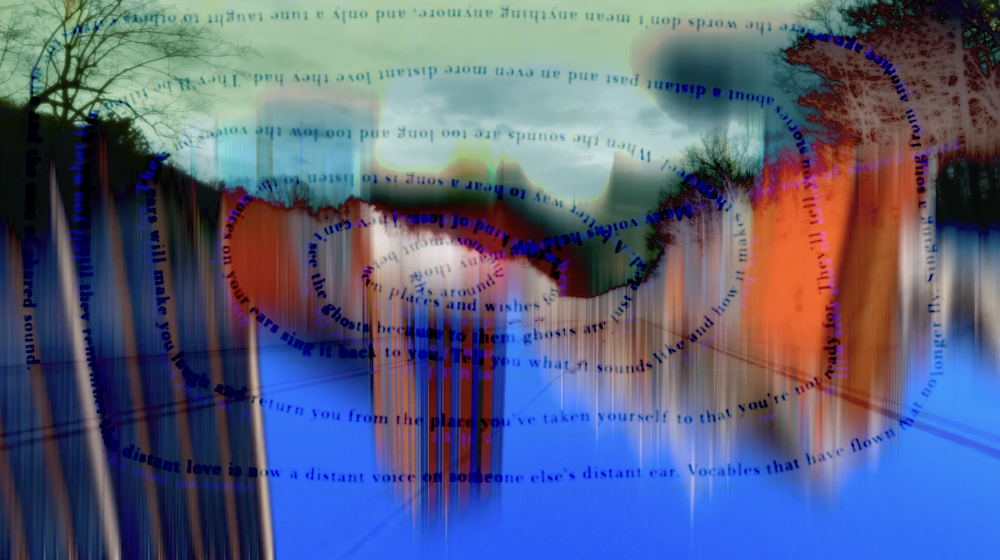
Throughout the exhibition, text reappears in Hopinka’s films as calligrams and animated poetry. In “He Who Wears Faces on His Ears” (2025), words crawl along the outer perimeter of the screen and spiral in center. With the text’s movement and orientations, sometimes sideways and upside-down, Hopinka forces viewers to engage in the animated linear pattern, rather than focusing on reading. When viewers are momentarily able to catch phrases or words, the poetry suggests a cacophony of voices and movement between places.
Layered beneath Hopinka’s visual poetry, sections of the film feature stretches of a long, rather mundane rural highway where leafless trees frame the road ahead and sky above. As the film progresses, Hopinka applies extensive post-production filters that reverse and exaggerate the colors. In transforming the road into streaks of color, Hopinka imbues place with the magic of the Northern Lights or thunderstorms.
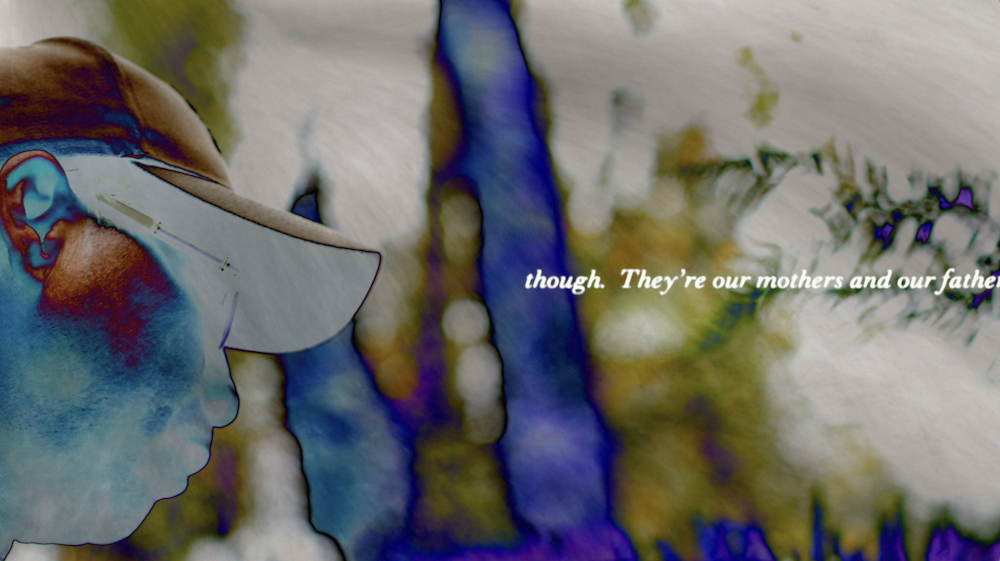
Out of all of Hopinka’s films, the location for “In Dreams and Autumn” (2021) is most clearly established. In it, the artist presents footage of fans walking through the Green Bay Packers Stadium. As the rather uneventful footage oscillates between raw, unprocessed and color reversal filters, the individuals and stadium become abstracted and made strange. On the adjacent two-channels in this three-channel work, Hopinka juxtaposes the stadium with shots of winding roads through mountainous landscape, streaming water, and wide shots of lakes with flat horizon lines that blend into the sky. With the film centering landscape and place, Hopkina suggests a personal and cultural connection to Wisconsin, as the home of the Green Bay Packers, where Hopkina completed his graduate studies and lived, and traditionally part of the Ho-Chuck Nation.
Additionally, Hopinka also inserts footage of “Tribute to Survival,” a diorama of native Americans dressed in regalia installed at the Milwaukee Public Museum. Created with input from local Indigenous community members and based on life-casts of living Ho-Chuck members, the figures stand frozen and on display. The juxtaposition of Green Bay fans and the “Tribute to Survival,” invites questions of who occupies this land and how we memorialize the past.
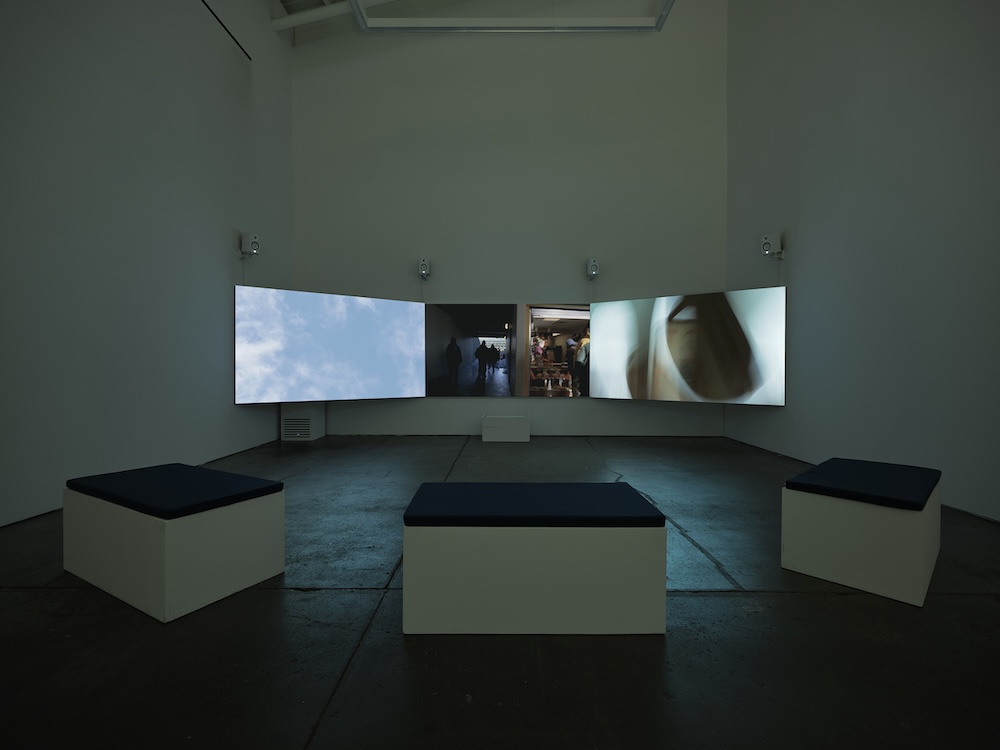
Throughout Hopinka’s exhibition, the artist’s use of poetry and poetic intervention loosely anchors the works’ narratives. As the artist pushes the parameters of reading versus viewing, he holds space for the unknown, unfixed, or undefined. While, Hopinka’s visual poetry and surreal montages provoke questions about how to decipher his imagery, the work’s strength lies in allowing it to unfold through time.

SONIC TRANSMISSIONS runs through April 18. Slash, SF. More info here.