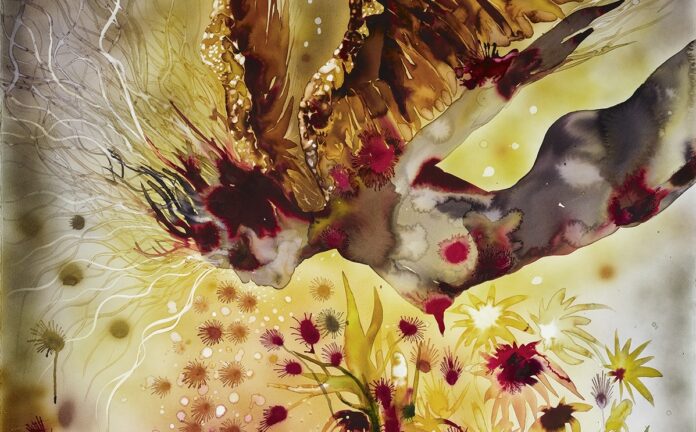
As an interdisciplinary artist working in paint, sculpture, and animation, Shiva Ahmadi is reflecting her personal journey as an immigrant into art. At first glance, her works draw the viewer in with a seductive interplay of vibrant colors, mythical characters, and ethereal narratives. But Ahmadi asks us to see beyond the beauty of each piece to bear witness to the sometimes-brutal global issues facing marginalized and threatened communities, in stories illuminated beneath layers of surface treatment.
Ahmadi grew up in Tehran, Iran where she received her BFA. In 1998, she moved to the United States to complete an MFA at Cranbrook Academy of Art in Michigan (2005) where she lived and worked for 16 years before coming to the Bay Area. She currently resides in the East Bay community of El Cerrito where she enjoys the diversity, culture, and natural beauty that is on offer.
Ahmadi’s work engages the feelings of displacement, instability, and disquiet that stem from her own lived experiences, specifically growing up in Iran during the Islamic Revolution and the eight-year Iran–Iraq war, and later living as an Iranian immigrant in the United States after 9/11. Ahmadi keeps abreast of the news throughout the day as political events are directly connected to her life as an immigrant.
“Politics has had a direct and lasting impact on my life, shaping both my personal experiences and my worldview. A sense of anxiety is something I carry every day, and regardless of medium, it remains at the core of my practice,” Ahmadi told 48hills.
At the time that we began discussing her work, Ahmadi had become keenly aware of the uprising that was being brutally suppressed by the Islamic regime and expressed deep concern for friends and family. Then, the United States began military action against numerous cities in Iran, spurring broader regional conflict.
“Thousands of people have been killed in what has become one of the bloodiest massacres in recent history. The Internet was shut down, with no access to the outside world. I checked the news constantly, hoping for any information. It is devastating, and it has left me on edge and extremely anxious,” Ahmadi shared.
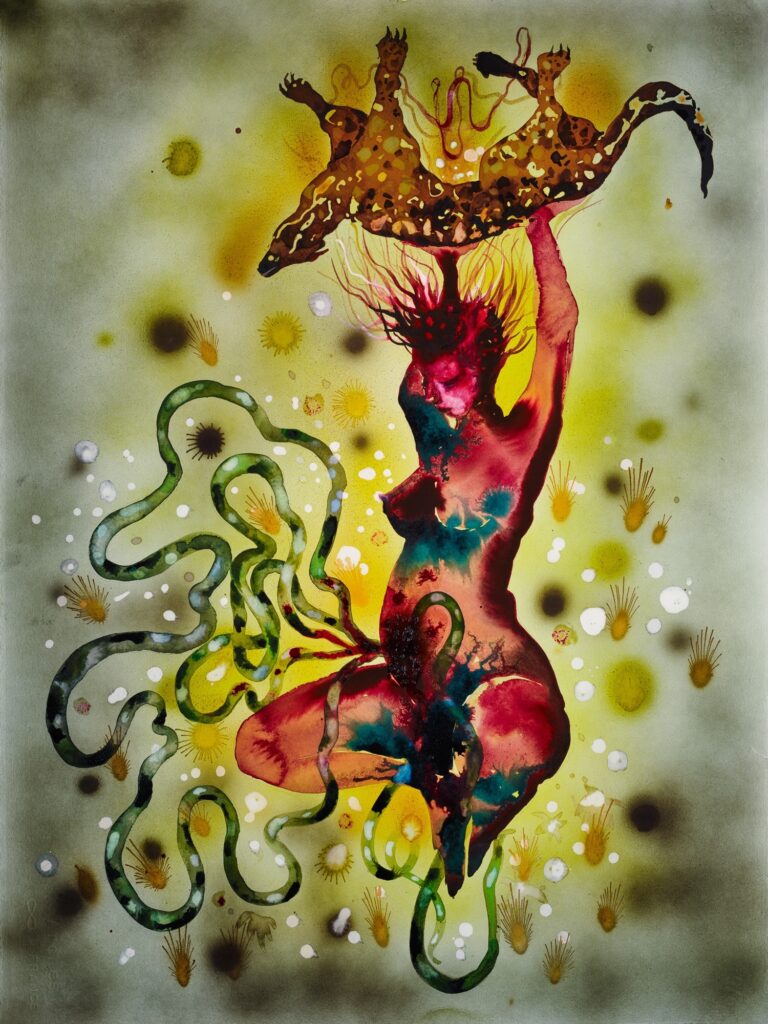
In contrast, Ahmadi says she has always been preoccupied with beauty and is constantly trying to bring it forward through color, form, and pattern as a means of veiling the harsh truths embedded in her work. She wants her audience to look more than once, to discover new things each time they view her work.
“Finding the right balance has always been challenging. I don’t want to make purely decorative work, I want beauty to cover just enough to draw people in and make them pay attention. This sense of discovery creates engagement and I want people to ask themselves the questions that are being addressed within the piece,” she said.

Ahmadi says there have been two major influences on her work: Persian miniature painting and reading the book, Animal Farm, by George Orwell during her childhood.
“These paintings filled our home and I often sat in front of them for hours inventing stories and discovering multiple narratives within their small, intricate compositions. Rooted in Persian poetry and folk traditions, these works were richly detailed, colorful, and populated with imagined heroes, foes, and animals,” Ahmadi said.
Animal Farm was equally formative for the artist as she was drawn to the way complex political ideas were conveyed through animals and allegory. “Looking back, I see that the narrative impulse in my work grows directly out of these early encounters with dense, symbolic storytelling,” she said.
Ahmadi also mentions how viewing the solo exhibition of Dutch painter Marlene Dumas at Palazzo Grassi in Venice in 2023 impacted her, bringing her to tears. She says she possesses a deep admiration for the raw honesty and emotional intensity in Dumas’s work. In her own work, creating across multiple disciplines allows Ahmadi to approach various sociopolitical themes from different perspectives.
“I primarily paint with watercolor because of its inherent nature—the way it flows, stains, and resists control closely mirrors my internal emotional landscape. Water-based media allows me to build and dissolve layers, revealing and concealing narratives over time,” she said.
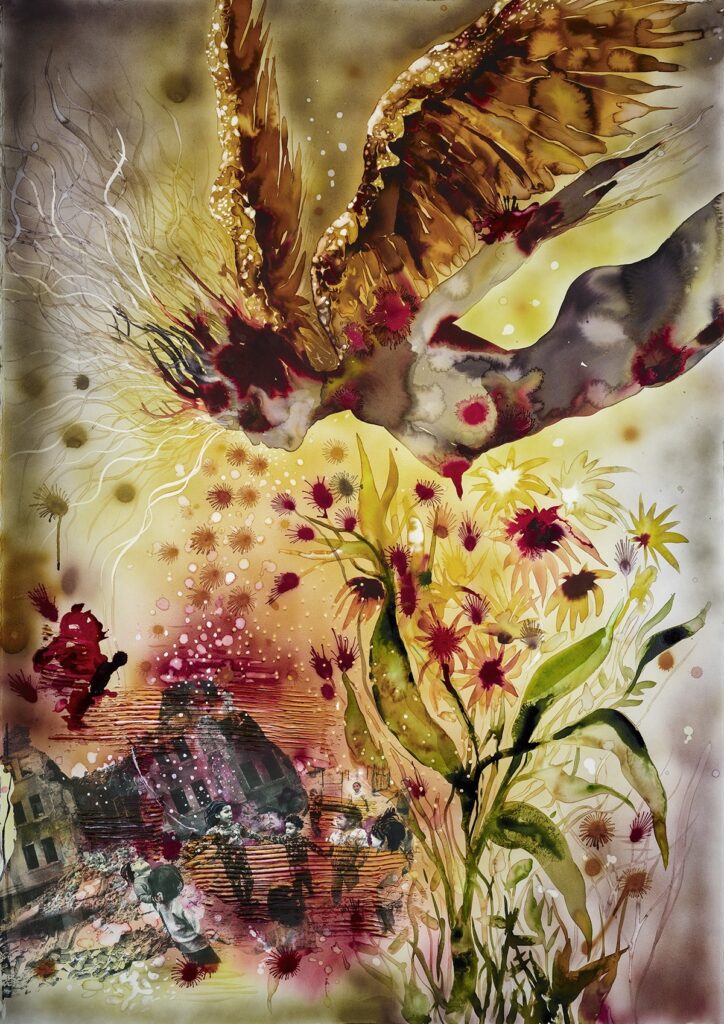
In her painting, Fiery Descent, a winged female figure descends into a landscape of ruins intertwined with flowers and images of children playing amid destruction.
“Her exposed nipple functions as a symbol of nourishment and care, while her wings suggest protection, freedom, and the possibility of intervention. Watercolor enables me to layer these symbolic elements, allowing stories to surface and recede simultaneously,” Ahmadi said.
Extending her painted narratives into animation by incorporating time and movement, Ahmadi relies on hundreds of watercolor paintings to animate scenes to further unpack the dense, layered storytelling embedded in her work. “The digital element allows the narrative to unfold gradually, offering another way for viewers to engage with the complexity of the imagery,” Ahmadi said.
Ahmadi first dipped her toe in the artform in 2014 when she was commissioned to create a work for the In Focus exhibition series at Asia Society Museum in New York. “Without hesitation, I proposed making an animation—something I had never done before. Because my work has always been deeply narrative, I was eager to bring the figures in my paintings into motion, expand the storyline, and introduce additional layers of meaning,” she said.
Her work, Lotus, became a successful animation acquired by several other museums and screened at numerous film festivals. Since then, she has created three additional works. She says the combination of hand-painted imagery and digital elements has been pivotal in expanding and reshaping her art practice.
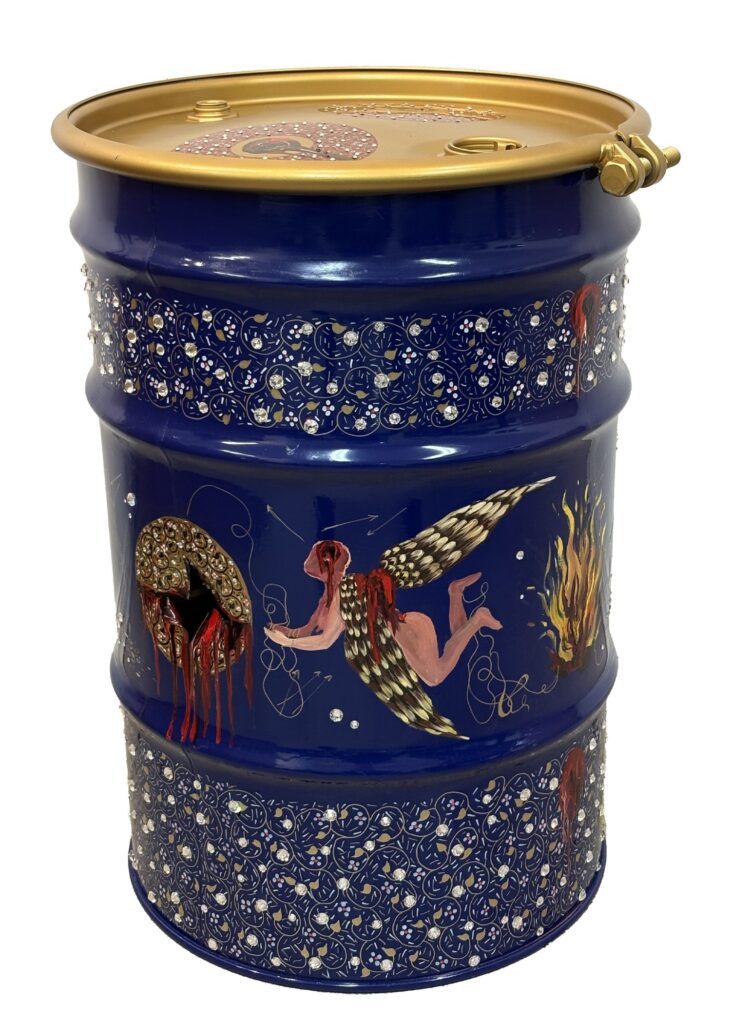
In her sculptural work, Ahmadi says that “ornamentation becomes a form of resistance.” She explains how her piece, Oil Barrel #33, takes a politically charged object then reclaims and transforms it by covering it with elaborate decorative elements.
“Here, ornament is not embellishment but an act of defiance by asserting beauty, care, and agency in the face of violence and extraction,” she said.
In her current studio for almost 10 years, Ahmadi loves the light and openness of the space as well as its inviting garden, where she takes breaks to reset and reflect. Each day begins by putting on a podcast and sketching. She then prepares surfaces and lays down washes on paper.
“This stage takes a great deal of time. Watercolor is a temperamental medium, and the large-scale paper I work on requires considerable skill to ensure the washes are controlled yet appear effortless. I spend a long time making sure the background has the right color, texture, and atmosphere for the image to emerge,” she said.
Ahmadi concludes each day with a restorative evening walk with her Chihuahua, Meelo, as a source of discovery and connection with nature, an aspect of living in the Bay Area she finds very grounding. So thoroughly engaged in her process, Ahmadi believes an artist is always working even while sleeping, as the subconscious continually sorts through creative problems confronted in the studio.
Speaking about the ways in which societal events influence her work, Ahmadi reflected on the period of the pandemic and its isolating effect. She began creating fast, gestural drawings as a way to release stress and, over time, she noticed that the forms were all female bodies. Until then, the figures in her work had been largely ungendered, with the focus primarily being on story rather than identity.
“Discovering that I was drawing women felt new and unexpected. Shortly afterward, in 2021, the Woman, Life, Freedom movement erupted in Iran and profoundly affected me. It resurfaced many of my own nightmares and memories as a young Iranian woman—being jailed for showing a small strand of hair and living under constant surveillance and control.
“The movement was one of the most powerful feminist uprisings in the Middle East. I felt immense pride in it, despite the devastating reality that it resulted in many deaths and countless imprisonments. The female body, particularly hair, has since become a central site of resistance, vulnerability, and power in my work,” she said.
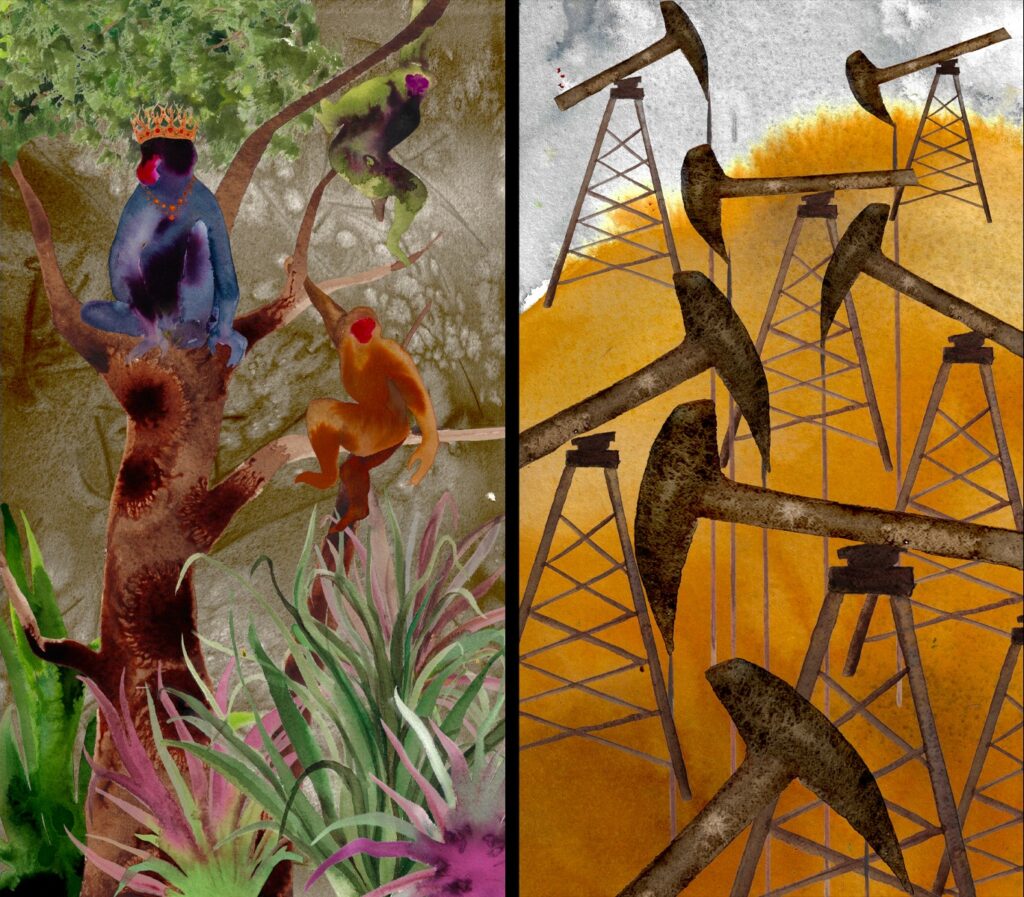
Several of the works from this exploration are included in her solo exhibition, Crown of Flames, on view at Haines Gallery in San Francisco, her primary representative. The show, which runs through April 25, also includes a new multi-channel animation which centers on monkeys riding oil pumps after setting their own environment on fire.
“It is rich in allegory and has involved thousands of individual paintings. In parallel, I am also developing a full-scale oil pump installation. While it is not part of the exhibition, it’s a project I am actively working on,” Ahmadi said.
In 2024, Ahmadi had two solo exhibitions: the first at Manetti Shrem Museum, UC Davis, and a second at Shoshana Wayne Gallery in Los Angeles. Along with Haines Gallery, Ahmadi is also represented by Gallery Rosenfeld in London, where she had a solo exhibition in 2023.
Diligent in her craft, Ahmadi understands the nature of staying dedicated to one’s creative path despite obstacles. She advises other artists to keep working hard without worrying too much about what others think of their work. And she recognizes that luck plays a part in one’s success.
“Some people will connect with your work and some won’t—that’s simply the nature of making art. You can’t please everyone all the time. Artists often think that working hard is enough, but you also have to have the right people see your work and resonate with it,” she said.
And in a climate which seems to be increasingly threatening the viability of the arts, Shiva Ahmadi encourages support from the community to keep this vital experience alive and well.
“Art is life. Engage with it. Go to galleries and museums, look closely, and spend time it. If you are able, buy art and support artists,” Ahmadi said. “Life is nothing without art.”
For more information, visit her website at shivaahmadistudio.com and on Instagram.