Stalin, Nazis, politically-targeted arrests, government-approved propaganda, military-assisted land theft… A number of this week’s new movies portray 20th-century historical chapters that are proving discomfitingly relevant to our current climate. None are exactly cheering, but they do provide harsh lessons we’d be wise to recall, asap.
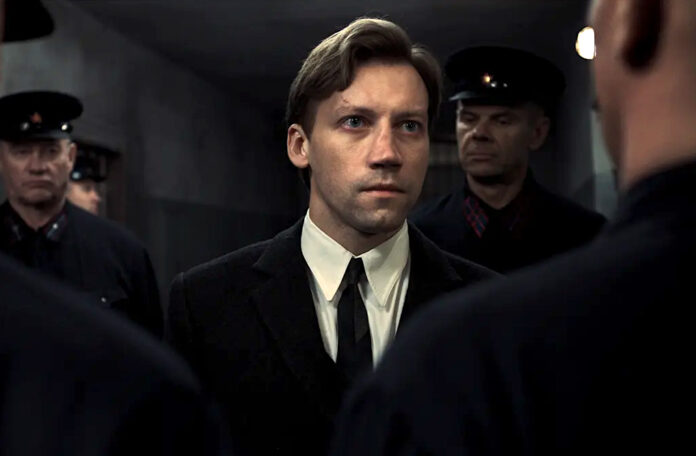
In Sergei Loznitsa’s multinational European co-production Two Prosecutors, Kornyev (Alesandr Kuznetsov) is a newly minted lawyer just starting his job as a Soviet inspector-prosecutor. He receives a letter from a prisoner in Bryansk that contains allegations of serious institutional abuse. Turning up to investigate, Kornyev faces disbelief from the prison staff—not because they dispute the charges, but because they’re stunned a convict successfully smuggled out any such missive, the likes of which get routinely destroyed.
Nonetheless, rules are rules. So our idealistic young protagonist is reluctantly allowed to interview Stepniak (Alexsandr Filippenko), a frail old man who it turns out had penned that letter in his own blood for lack of other means. What he reveals (both in words and the evidence of his own battered body) is a shocking chronicle of systemic torture forcing false “confessions” of alleged counter-revolutionary acts from innumerable innocent citizens.
In the film’s second half, Kornyev journeys to Moscow to report these findings to the Prosecutor General (Anatolly Beliy), believing the administration will want to shut down such wrongful acts in a hurry. But this is 1937, when Stalin’s “purges” of enemies both real and imagined were at their bloodthirsty, paranoid height. Our hero is too naive to realize what Stepniak tipped him to isn’t an aberration by renegade prison staff—it’s government policy, issuing from the top. You can guess where this is headed.
Composed largely of long dialogue scenes between two or three characters, Prosecutors might well have been derived from a stage play (actually the source material is a novel, by Georgy Demidov). As a result, it’s a bit arid and claustrophobic. But to a large extent that works for this story, which functions like a noose tightening around the protagonist’s neck before he knows it’s even there. It’s a crafty, low-key thriller about the perils of whistleblowing when the agencies reported to also happen to be the parties committing the newly-uncovered crimes.
Anyone comforted by the thought “That can’t happen here” should be reminded of National Counterterrorism Center director Joe Kent–his resignation over the war against Iran (a nation he said intelligence showed “posed no imminent threat”) just last week has already triggered retaliatory FBI “investigation” of his supposedly “working…to undermine the President.” Will he end up in prison for telling an uncomfortable truth? Two Prosecutors opens this Thurs/27 at Marin’s Smith Rafael Center, and Fri/27 at SF’s Roxie Theater.
Of course it would take years (even after Stalin’s death) for the USSR to acknowledge such persecutions. One suspects Putin today would also like to sweep them under the rug—it’s notable that this film sports Russian talent, but no Russian funding. Russians today get served a daily dose of propaganda from their now entirely state-controlled “news” media, a source of envy for our own current Dear Leader.
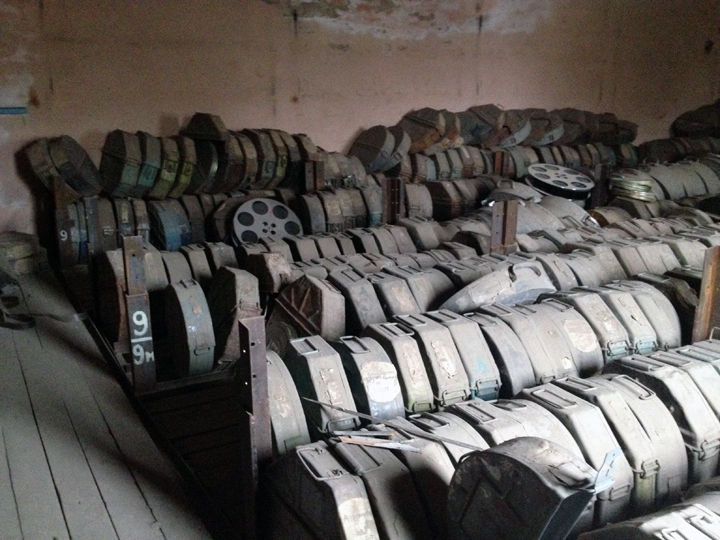
A sample of what they got in that vein during the Cold War era can be had in Other Cinema’s “Soviet Silver” program this Sat/28. It’s largely comprised of morsels culled from a cache of old 16mm prints found in 2014 Tajikistan, which Mark Boswell and John Davis have reconfigured into some new forms. You’ll see industrial films, war-front reportage, an actor playing Lenin “consoling a motherless child,” a tribute to Moldavian wine, and a cautionary film about bathing-suited beachniks making fools of themselves on too much vacation vodka.

Particularly jaw-dropping is 1949’s With Heartfelt Sincerity, a cinematic letter of “radiant love” to Comrade Stalin, a man it calls the very “banner of peace and freedom.” Made on the occasion of his 70th birthday, this short inventories tribute gifts sent him from throughout the Soviet territories and, supposedly, around the world. Perhaps one day we’ll have museum exhibits comparing homemade Stalinist kitsch art versus the Trumpian kind, of which there is already a ghastly plethora. More info on the program is here.
Propaganda doesn’t just happen—it requires engineering. Luuk Bouwman’s The Propagandist, which begins streaming this Fri/27 on the arthouse platform Ovid, provides posthumous evaluation of one life that turned out to be all too well-suited to that job. Jan Teunissen was the only child of an “extremely wealthy” father, so inheritance enabled him to turn a hobbyist obsession with filmmaking into a career… even though the Dutch film industry was not particularly robust at the time. He made purportedly its first sound feature, 1934 costume drama William of Orange, though its poor reception prevented him from taking the director’s chair again for some time. Nonetheless, he remained involved enough (particularly as an editor) that once a “film czar” was required for the whole country, he got chosen.
Chosen by the Nazis, that is. By then the Netherlands was under German occupation. “Being keen to get back to producing my own films,” Teunissen figured he could work with these new masters as well as anyone. At least that’s how he puts it in audio interviews recorded later for an oral history, a decade before his death in 1975. Home movies shot in the 1930s show him playing with his children, a privileged yet apparently fine fellow. Of course later he’d downplay his enthusiasm for collaboration, for which he received relatively mild punishment compared to other highly-placed Dutch Nazi sympathizers.
As The Propagandist almost imperceptibly darkens, however, we realize that Teunissen not only hid a lot about his past in postwar years, he had a hell of a lot to hide. We hear passages from his stepkids’ letters, in which they note him “strutting like a peacock” in Nazi uniform. Through pre-war he’d made a positive documentary about Jewish life, he proved a ready convert to anti-Semitism, purveying grotesque ethnic stereotypes in everything from kiddie cartoons to comedy shorts. It’s suggested he may even have been directly responsible for sending some fellow citizens to the concentration camps. This fascinating movie, with many clips from much vintage Dutch cinema you likely never knew existed, ends up a powerful indictment of ambition and adaptability curled into evil-enabling corruption—then blandly trying to whitewash itself clean.
This week Ovid also begins streaming a notable German narrative feature set during the Nazi era, one also inspired by real-life events. Robert Schwentke’s B&W The Captain is a bizarre, intense story of an AWOL soldier (Max Hubacher) in the Third Reich’s final days. He escapes being shot by assuming the uniform and identity of a high-ranking official found dead by the roadside. This ruse saves his skin…but the power it comes with corrupts, and then some. When it was briefly released in the Bay Area eight years ago, we covered The Captain at greater length here.
Another volatile historical flashback is afforded by Palestine 36, from writer-director Annemarie Jacir (Wajib, Salt of This Sea). This is an impressive large-scale period drama that, like Michael Winterbottom’s British Shoshana (a 2023 feature only released here last year), attempts to examine from multiple perspectives sides the escalating conflict between resident Arab communities and a Jewish emigre population in Palestine under British colonial rule.
The Brits are in an awkward position, resented as an outside occupying force while trying to maintain peace between Arabs who consider the country their incontestable homeland, and Jews fleeing persecution (mostly from a Europe increasingly threatened by Hitler) in ever-increasing numbers. The colonial authorities, led by Jeremy Irons in pompous-and-ineffectual aristocratic mode, keep trying to placate both sides, but their promises are now looking empty, particularly to the longtime residents. Zionist forces simply seize Palestinian land and/or destroy property with little consequence. That in return spurs Palestinians to fight back, realizing the British will no longer honor prior agreements protecting them from settler incursion.
This is one of those narratives that begins amidst widespread tensions everyone hopes won’t get worse, but which inevitably progress towards widespread violence. Among the fictive characters caught up in that are figures played by Karim Daoud Anaya, Dhafer L’Abidine, Billy Howle, Yasmine Al Massri, Hiam Abbass, Liam Cunningham, Saleh Bakri and more. They represent a cross-section of ethnic, economic, political, educational and other identifying loyalties.
Jacir’s screenplay can be criticized for simplifying some aspects of what remain dauntingly complex issues for dramatic purposes. She falls back on the time-tested device of making the Brits seem like the “real” villains, with Robert Aramayo as a particularly odious uniformed officer. But it all works quite well as a jigsaw of many pieces that add up to an involving, tragic, relatively even-handed big picture. And Palestine 36 serves an important purpose in giving viewers a strong sense of the roots of conflicts still very much alive 90 years later. The film opens at SF’s Roxie this Fri/27, then Oakland’s New Parkway April 3, as well as Rialto Cinemas 9 in Sebastopol, Rialto Cinemas Elmwood 6 in Berkeley, Marina Theatre in SF, and Sequoia Twin in Mill Valley.
Elsewhere, there’s much more looking-backward this week—albeit in the rather less painful direction of cinematic history. After a brief partial closure for some renovations, the Roxie is re-opening with a fresh restored print of what’s probably my all-time favorite San Francisco movie: Phil Kaufman’s 1978 Invasion of the Body Snatchers (more info here) remake, in which the terror of enforced, soul-obliterating sci-fi conformity is especially vivid because it attacks our city in an era so proud of its eccentric individualism. (As embodied by a cast including Donald Sutherland, Brooke Adams, Jeff Goldblum, Veronica Cartwright, Leonard Nimoy, and the late Robert Duvall in a cameo.) It plays Fri/27-Sat/28 only.
Starting that same night in theaters across the country is a 40th-anniversary re-release of Stand By Me, which also serves as a tribute to recently slain director Rob Reiner. This adaptation of an atypically warm-and-fuzzy Stephen King story, about four 12-year-old boys (Will Wheaton, River Phoenix, Corey Feldman, Jerry O’Connell) making a pilgrimage in 1959 rural Oregon, is many people’s idea of the best King-based movie. (Not mine, though.)
Also of note are several films from or about still-active veteran filmmakers. This Sun/29 at noon, the Smith Rafael Film Center will world-premiere Zhan Petrov’s The Way Things Seem To Be (more info here), a nearly four-hour portrait of longtime Bay Area director, painter and poet Rob Nilsson. The latter won prizes at both Cannes and Sundance before he stepped up his productivity, using a combination of digital technology, improv, and location shooting to create no less than 45 features (so far), including the 9@Night series. Both directors will be present at this event.
Fri/27 brings two new efforts from 21st-century European masters, Triplets of Belleville animator Sylvain Chomet’s A Magnificent Life, a biopic about the hugely popular French filmmaker, playwright, and novelist Marcel Pagnol (opening throughout the Bay Area, including AMC Metreon); and German director Christian Petzold’s Miroirs No. 3 (opening at SF’s Vogue Theatre), with Paula Beer and Barbara Auer as two women of different generations mysteriously thrown together after a car accident. Neither are among these directors’ best, but if you’re a fan, you’ll still want to check them out.

And on Sat/28, Nathaniel Dorsky will appear as part of BAMPFA’s “Psychedelia & Cinema” series for the “Grains of Perception” program (more info here). It encompasses his own 1983 Pneuma, an immersion in pure color and movement via outdated, unexposed raw film stock, as well as the late Bruce Baillie’s 1970 Quick Billy. That hour-long experimental epic, created over four years’ course, moves from impressionistic, diaristic intimacy to a climactic mock silent-era Western drama of lust in the prairie dust.