Alvin Ailey American Dance Theater’s Saturday matinee April 11 at Zellerbach Hall on the UC Berkeley campus induced euphoria. The company made its annual trek to the Bay Area April 7–12, courtesy of presenter Cal Performances, bringing four exhilarating programs that included five Bay Area premieres of new dances created in 2025. As always, Ailey’s revered 1960 work, Revelations, ended most of the performances.
Saturday’s Program B began with Maija García’s Jazz Island, a work adapted from Trinidadian dancer, writer, actor, and artist Geoffrey Holder’s collection of Caribbean folk tales, “Black Gods, Green Islands.” The book written in 1959 includes one tale, “The Goddess,” from which García developed the dance’s narrative threads. Simply put, the Afro-Haitian goddess of love, Erzulie, commands ancestral forces and uses them to overcome Baron Samedi, the guardian of the dead, whose evil machinations threaten the true love interest and life of a young village girl.
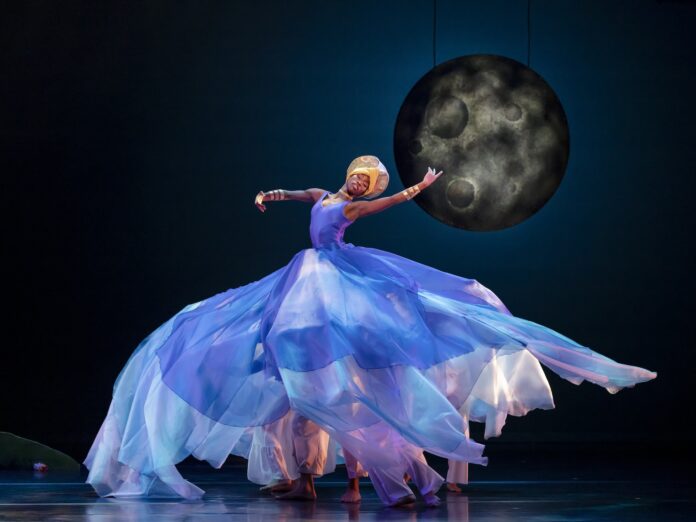
García’s dance began with great promise, with Erzulie (a lush, regal Caroline T. Dartey) appearing in a stunning costume designed by Carlton Jones. Her enormous, umbrella-shaped white with purple trim “tutu” looked like a supersize jellyfish a person might see at the Monterey Aquarium. A half-dozen male dancers semi-hidden underneath the skirt lifted their goddess aloft as the gauzy material poofed and swelled, performing miracles of gorgeous movement that amplified that of the dancer above.
Unfortunately, from there it was mostly a slow, downhill slope for the piece, although individual dancers did the usual marvelous favor of bringing richness and nuance to choreography that only occasional achieved the same level.
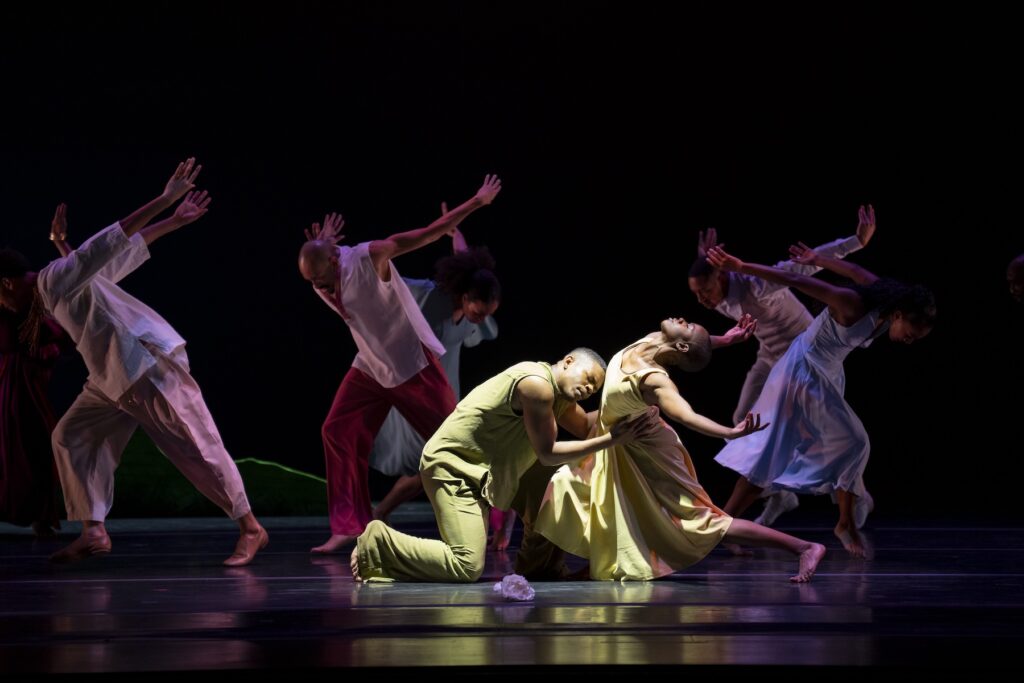
The Ailey dancers can tell entire stories with the bend of a finger, the angle of a chin, the stomp of a foot; Jazz Island could have relied less on transparent hand gestures and trusted more in the dancers’ embedded physicality. Such as what? Yannick Lebrun’s swift and wicked swagger as Baron Samedi conveyed more than a hat toss; Jessica Amber Pinkett as the young girl Bashiba, breathtakingly flinging herself to the ground or flying through the air during a poison-induced solo, said more than any pouting-when-scolded by her elders. And there was grace in the port de bras and épaulement of Solomon Dumas, who with his artistry made the character Claude Jean-Louis infinitely lovable, desirable, the owner of everyone’s heart.
Of course, Jazz Island is based on a simple story and while admiring that the choreographer avoided superfluous embellishment, the hopes that a battle between good and evil and other interactions might play out with the grand vision of the dance’s earliest moments slowly faded. In retrospect, it was the dancers’ acuity, along with the exceptional original score by Carlton Jones that left lingering positive thoughts about the work.
After an intermission, Frederick Earl Mosley’s Embrace followed. The work’s solo, duet, and ensemble dances were set to an eclectic mix of songs such as Stevie Wonder’s “Never Dreamed You’d Leave in Summer,” Kate Bush’s “This Woman’s Work,” “What About Us” by Johnny McDaid and Steve Mac, and others. The choreography centered on love lost, found, or newly discovered; all of it expressing the timeless nature of the human heart and its vulnerability, fragility, and resilience.
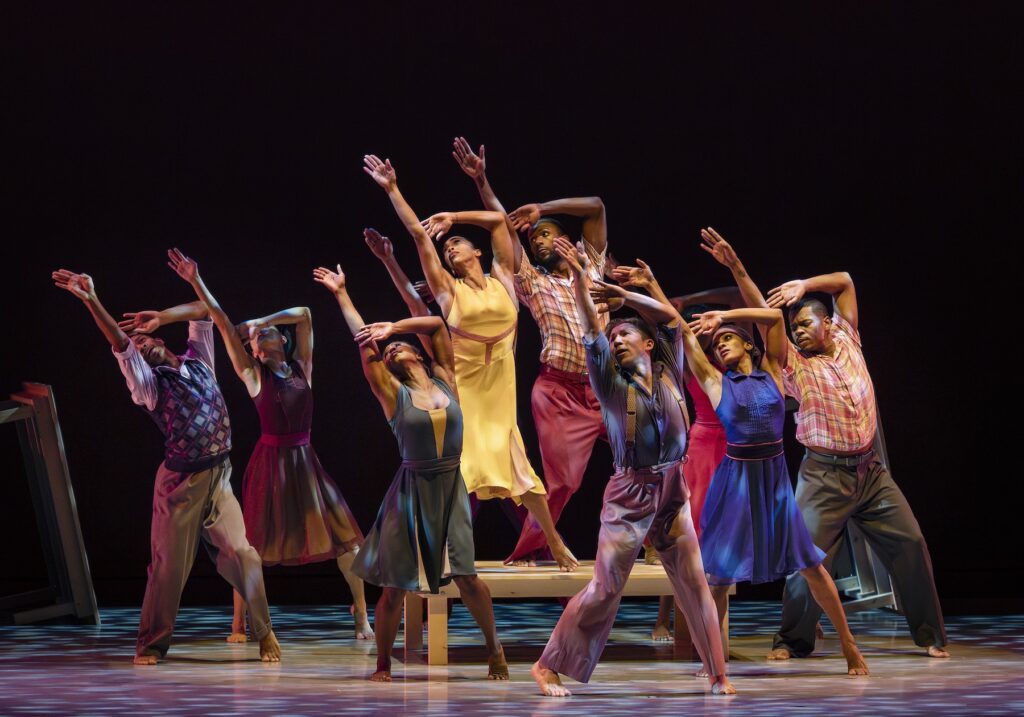
Embrace was a remarkable piece throughout. The opening male solo was the first stroke of casual genius in delivering elegance and excruciating pathos. (Christopher R. Wilson was spectacular every moment he was onstage). Soon after, “What About Us” brought out love’s discordant decimations; and Ed Sheeran’s “Photograph” with lyrics about love’s power to hurt and heal, had Mosley proving that a rippling torso atop an arabesque is the essence of romance; the knock-knees and clown-like-head-tilt of a dancer can express how love is foolish and yet, profound; and more.

Notably, scenic design by Joseph Anthony Gaito turned something as elemental as a table into an endlessly interesting prop. The tables were dramatic framing devices: Under lighting designer Josh Monroe’s keen eye, they were illuminated effectively as set pieces, especially at one point when warm light hit each of five or six tables turned on their sides. The pooled, golden glow, with one couple seated in front of each table, created intimate spaces for the paired lovers.
At other times, with equally effective lighting, Mosley had dancers lift a table with a dancer on it above their heads, creating an elevated platform reminiscent of royalty carried by human-propelled chariots during parades. Several times, a dancer plastered themselves against a table that was set askew. With their arms spreading like wings, they appeared to be like a bird caught in a cage or taxidermy-gone-rogue and leaving the remains of a human preserved, mounted, and on display.
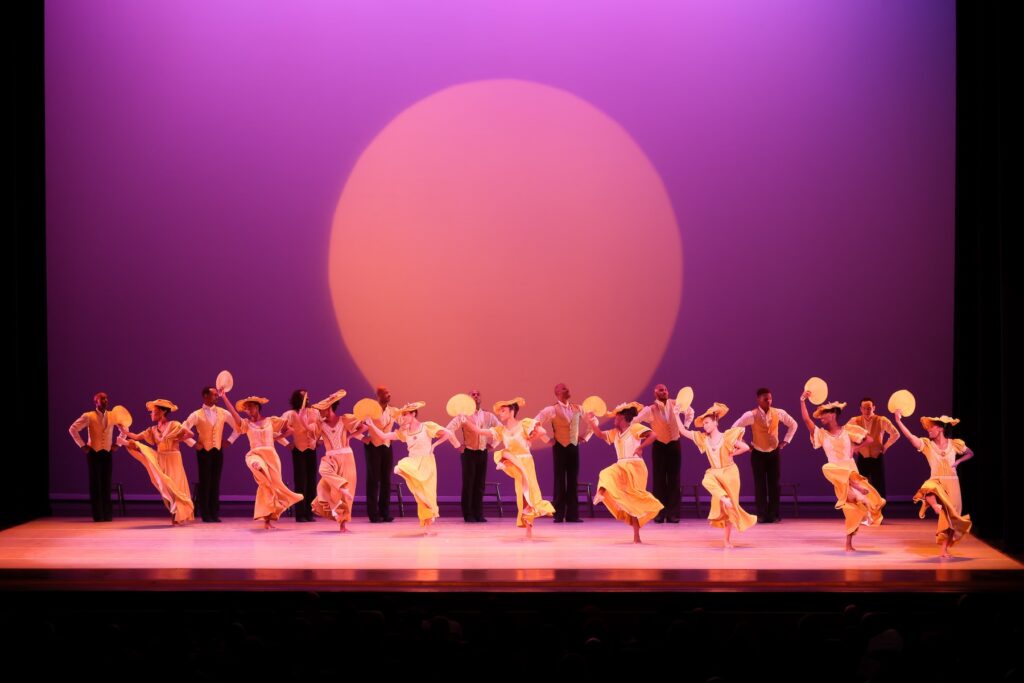
Revelations demonstrated once again that a 66-year-old ballet has legs. Cheers erupted as the first notes of “I Been ‘Buked” sounded in the darkness before the curtain rose.
Among many highlights on Saturday was the male solo dance to “I Wanna Be Ready.” Having seen Revelations more than three dozen times (the first was in the early 1960s, with the late Judith Jamison carrying the dance’s signature umbrella), it was a surprise—and a rewarding one—to watch Yannick Lebrun keep true to the choreography but also make it entirely his own. A softened gesture here, a sharp accent there, a dose of hinged, side-lateral derring-do, and the timing of a sudden collapse and rebound were his alone. Seconds later, the three men in “Sinner Man” set a high bar with riveting first solos, then continued to meet the challenge. Their momentum carried on in the ensemble sections that close the ballet.
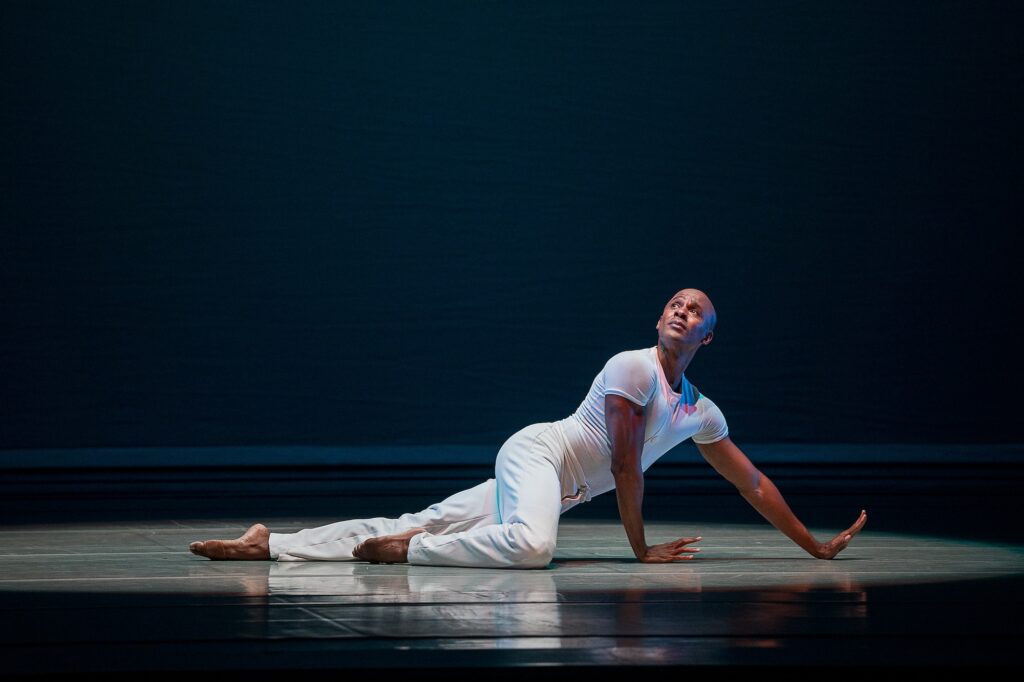
The Ailey experience is something akin to being in the world of Jimmy Hendrix’s classic rock tune “Purple Haze.” Absent the LSD and dreams behind Hendrix’s song, the performance still left a person feeling inclined to kiss the sky. The company reliably creates an incomparable atmosphere here in Berkeley and wherever it performs around the world. It’s a carnival, worship service, dreamland, celebration of African American history, and, it must be said, a revelatory occasion as each new generation of dancers rises and follows the legendary dancers preceding them. Oh, that it may never cease to be.