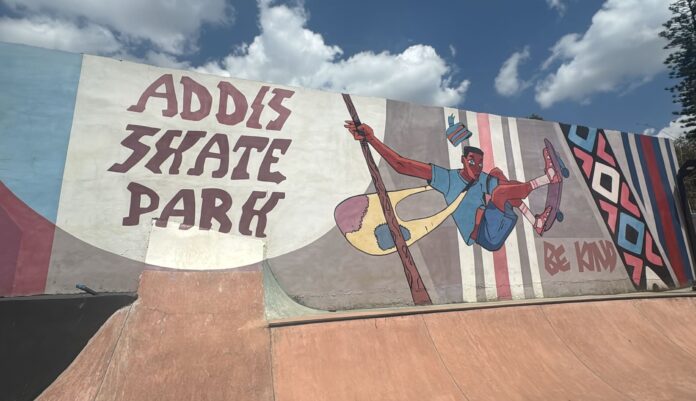
In Addis Ababa—the sprawling metro capital of Ethiopia, located in the altitudinous highlands of East Africa, nearly 9000 miles away from Oakland—a skate revolution is afoot.
Earlier this year, French Canadian skater Mike Boisvert (known online as The Skate Nomad) traversed the African city and documented its youthful scene, ultimately declaring it “the next skate heaven” of the continent. The 20-minute long video includes scenes of intergenerational Ethiopian skaters thrashing their way around Addis Ababa, as Boisvert gains insight by interviewing skatepark builders, rippers, and local heroes.
At one point, a young skater named Yonas runs onto the middle of a bustling multi-lane avenue while cars honk; he calmly tells the camera “this is how we skate here, no rules,” before grabbing onto the back of a moving car and rolling off with traffic.
Ethiopia’s skating paradise is vibrant, communal, and burgeoning, a relatively niche subculture pulsating with energy as it grows into something larger, something the public eye can no longer avoid. Aside from a bit of disorganized chaos and the relatively unfamiliar backdrop—part contemporary, part vintage, part African fauna and landscaping—you’d think it was all happening in California. That is, Ethiopian skaters present a poetic reflection of West Coast skate culture on an internationalized scale in both style and energy.
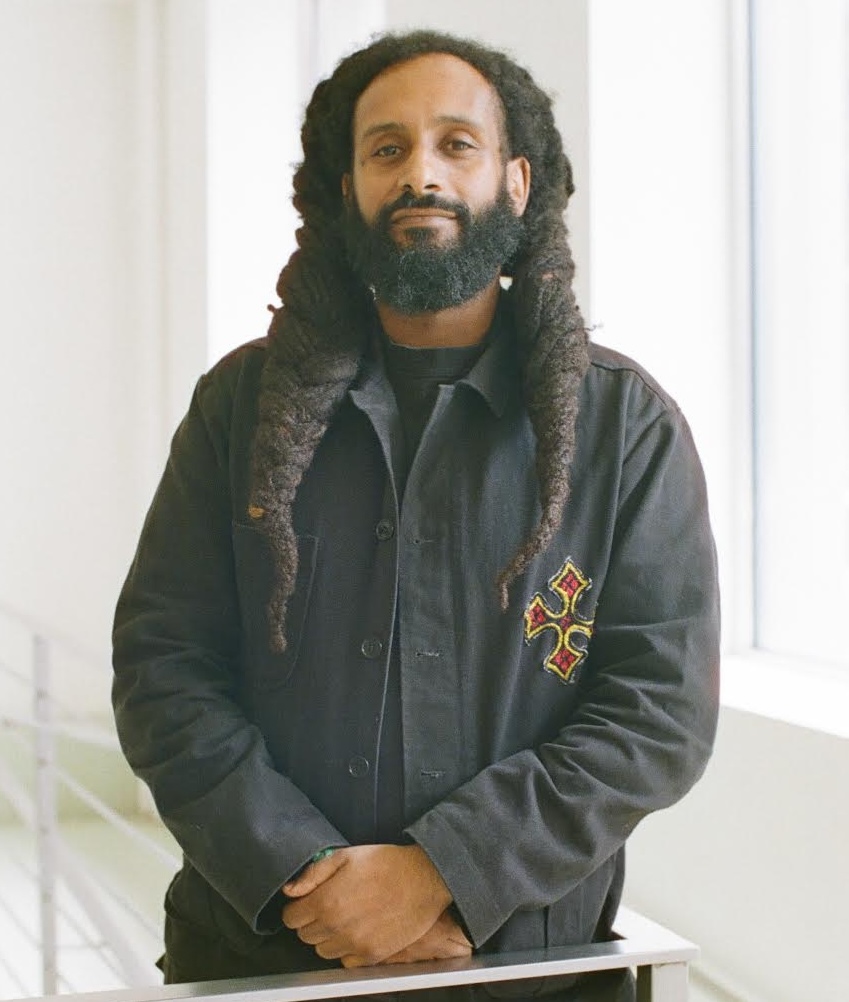
For Daniel Aderaw Yeshiwas, a Bay Area-raised Ethiopian American, it’s a portal into showcasing Ethiopia’s rich, multitudinous textures in a different format.
Yeshiwas’ parents immigrated to Dublin in the East Bay from Ethiopia in the 1970s. In Oakland, his mother grew involved with the earliest iterations of Café Colucci—considered to be among the first and most definitive Ethiopian eateries in the state after formally opening its doors in 1991. Nowadays, Yeshiwas continues his involvement with the restaurant as a general manager, while also operating his own business, Brundo Spice Co., from inside the cafe, where he offers Ethiopian heirloom spices that are grown and directly sourced from Modjo, Ethiopia.
Recently, Café Colucci teamed up with Ethiopia Skate—a non-profit grassroots collective of Ethiopian skaters that launched in 2013 to promote skateboarding in the country.
Together, they released a collaborative t-shirt that celebrates the evolving lineages of Ethiopian culture, streetwear fashion, foodways, and, of course, skating. The shirt, which is available online and at Café Colucci’s Oakland storefront, was designed by Los Angeles-based Ethiopian American artist and designer Addis Daniel of Mandala Studios, with all proceeds going directly overseas to support the Ethiopian skate crew’s mission.

The slick tee features a woman dressed in traditional Ethiopian clothing who is carrying a plate of vegan Ethiopian food while kick-pushing her way forward on a board. In the background, there’s Ethiopian text in a cartoonish font. It’s part of Yeshiwas’ commitment to Ethiopia Skate, who he flew out to Ethiopia to meet, coinciding with a cameo from internet streamer and rapper, DDG.
Yeshiwas noted the overlap between today’s Ethiopian skaters and the Bay Area community that shaped him decades ago. It’s part of his larger ethos to capture and bring some of that energy to Oakland in small, flavorful doses.
“For myself, food has always been a vehicle of how to export portions of Ethiopian culture to California. It’s rich, and it resonates here in the Bay Area. People dig it,” Yeshiwas says. “But I’ve always wanted to take that base of people who have an interest in our food and deepen the connection with what else goes on in Ethiopian society.
“Food is an early entry point. It’s storytelling, it’s placemaking, it’s setting, it’s events being thrown, and it represents the larger diaspora. So it made sense to bring in skating as a larger part of that narrative with ties to California as well. It interests people in the same way our food does, and from there then they can learn more about it on their own.”
As a millennial growing up in the Bay, Yeshiwas couldn’t escape Northern California’s regional skate scene and gravitational pull. San Francisco is, after all, the home of iconic skate brand and magazine Thrasher, founded in 1981, whose eternal motto, “Skate and Destroy” has incited millions of renegade skaters, aspiring rippers, and halfway posers worldwide to, at minimum, scrape their elbows and knees on concrete while attempting to imitate a timeless cover photo.
Back in those days, Yeshiwas rocked a pair of Osiris D3s and would hit the occasional kickflip at the skate park. “I grew up skating, and I was never any good but I could get around,” he admits, ultimately more of a hobbyist than a future pro. For many, including Yeshiwas, skating is simply a way to become fluent in friendships, experimentation, and joy. Ethiopia Skate is providing one dimension of that for East Africans, and even has an educational component, Beyond the Board, that offers academic classes, vocational training, and entrepreneurial workshops.
Ethiopia is a heavily youth-driven nation, with the median age hovering between 19 and 20, and nearly 40% of the population below 15. Skating, therefore, is an especially crucial outlet for developing a sense of place, identity, and values among Ethiopian youth—with the vast majority of the country’s citizens being concentrated in Addis Ababa, which boasts over 6 million inhabitants, placing it among the continent’s most populous regions. It’s no surprise that skate parks are beginning to flourish there.
“It’s cool how many people are attached to the skate movement over there,” Yeshiwas says. “It’s a movement based on identity and culture, and feels very Ethiopian. It’s a country of young people, and the people are skating and speaking in Ethiopian, with the freedom of it all. They’re free to express themselves [through skating], and that’s a big part of California culture as well.”
That magnetism can be felt inside Café Colucci, where in the near future, Yeshiwas hopes to bring in a few of Ethiopia Skate’s representatives to screen documentaries they’ve filmed in person. Until then, between kifto to kickflips, there will be plenty to share and enjoy at the open table, as Ethiopian tradition has always generously dictated.