
At 95 years old, Mamie Van Doren has outlived nearly everyone she was once linked to. Of the legendary “Three M’s” of ‘50s Hollywood—Marilyn Monroe, Jayne Mansfield, and Van Doren, herself—she is the last one standing. More importantly for fans of Tinseltown’s Golden Age, she’s also talking.
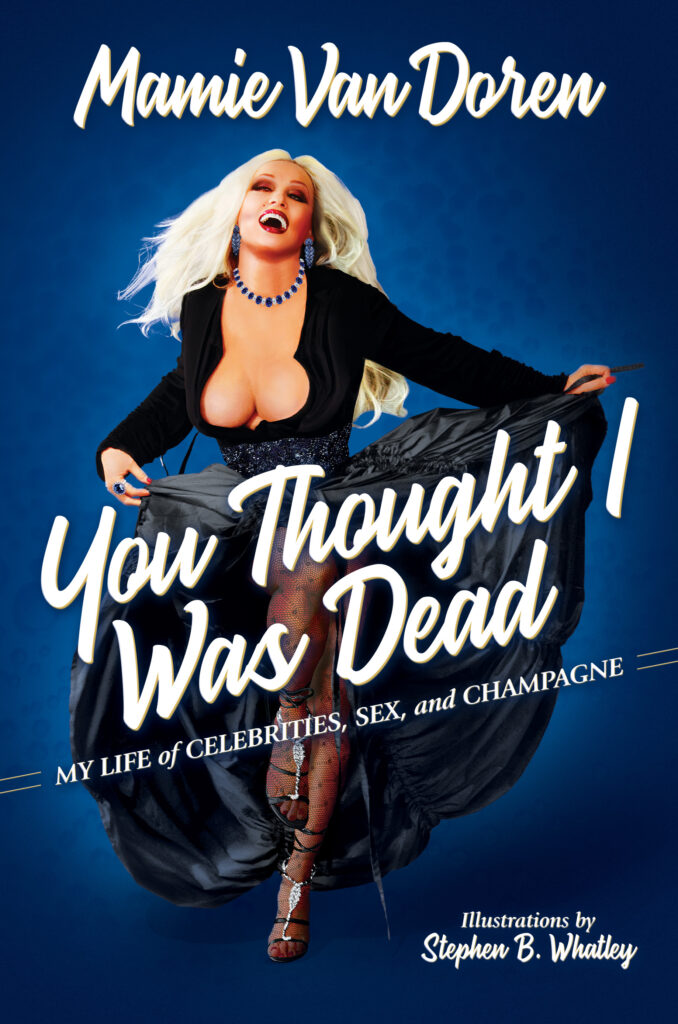
Her revealing new memoir, You Thought I Was Dead: My Life of Celebrities, Sex, and Champagne, straddles nearly a century of American life.
Part confession and part Hollywood oral history, it moves through stories involving everyone from Clark Gable and Tony Curtis to Quincy Jones, Che Guevara, and Buzz Aldrin.
But the book positions Van Doren as far more complicated than the rebellious blonde-bombshell image Hollywood spent decades projecting onto her.
“I wanted readers to know me the way I am—outspoken, truthful, and kind,” says Van Doren, initially discovered by Howard Hughes in the late ‘40s and later signed by Universal Pictures as its answer to Monroe. “I wanted to leave a legacy I could be proud of.”
During the ‘50s, Van Doren became one of Hollywood’s defining bombshells through films like Untamed Youth, High School Confidential, and Teacher’s Pet, often playing rebellious, hypersexual women at a time when studios were still figuring out how to market rock ’n’ roll youth culture.
Unlike her first tell-all, Playing the Field, released in 1987 and heavily softened by publishers wary of its more scandalous revelations, this new volume arrives uncensored.
“My memoir is a little different than most because everybody makes themselves look good,” she says. “I try to make myself as bad as I can.”

That refusal to sanitize herself gives You Thought I Was Dead its unusual power. Van Doren writes openly about exploitation, loneliness, and survival inside an industry designed to manufacture fantasies while destroying the people trapped inside them.
It begins far from Hollywood, in rural, Depression-era South Dakota, where Van Doren spent much of her childhood living with relatives on isolated farms without electricity or running water.
“I was born almost a hundred fucking years ago,” she says, laughing. “I mean, when I think about it, I’m looking at history. Honey, I have experienced everything.”
One of the account’s most haunting early stories recounts six-year-old Joan Lucille Olander—not yet Mamie Van Doren—staring at a newspaper photo announcing Jean Harlow’s death in 1937.
“The platinum blonde woman was the most beautiful thing I’d ever seen,” she writes in the book. “I felt an eerie connection to that face.”
Van Doren describes dreaming about Harlow and imagining escape from the brutal isolation of farm life.
The emotional center of the memoir arrives in Van Doren’s early days in Hollywood, in the ’40s, with her recollections of Elizabeth Short, later immortalized as the Black Dahlia, who was brutally murdered in 1947. To Van Doren, Short was a hardworking young woman trying to survive.
“She was not a prostitute,” she says firmly, rejecting the popular characterization of her friend. “She worked her ass off as a waitress to make a living.”
The two knew each other through the Florentine Gardens, a popular Hollywood nightclub, where Short worked in the wake of the loss of her fiancé, a fighter pilot killed during World War II.
Van Doren recounts the time she helped a distraught Short find her engagement ring, her last connection to the late Major Matthew Michael Gordon Jr., after it had disappeared into a sink full of soapy dishwater.
“She would have had a beautiful life,” says Van Doren, thinking of an alternate ending where Short and Gordon could have achieved their happily ever after.
Even now, nearly eight decades later, the memory of her long-lost friend shakes her to tears.
“I’m crying because it was such a shock to me when I went out and got the newspaper,” Van Doren says, remembering seeing a dead Short splashed across the cover. “It was a horrible time in my life.”
That empathy toward outsiders and discarded people runs throughout the account.
Again and again, Van Doren aligns herself with marginalized communities: struggling actresses, queer people, Black musicians, Native Americans, and war veterans.
Long before Hollywood publicly embraced queer culture, Van Doren says she instinctively connected with LGBTQ communities because she understood what it felt like to be judged and objectified.
Her friendship with Rock Hudson—whom she also once hooked up with—becomes one of the memoir’s warmest recurring threads.
“To have to hide his sexuality from the public in those days was so sad,” says Van Doren. “But we all knew.”
Van Doren also reflects on her longtime support of queer audiences and nightlife communities decades before mainstream Hollywood became comfortable publicly associating with them.
She traces much of that empathy back to her childhood in South Dakota and her early exposure to Native communities.
“We actually created genocide in this country,” she says bluntly. “We treated them below humans. It’s very important to be kind to people. People are hurt.”
Music forms another major thread running through the book. Van Doren’s introduction is titled “The Girl Who Invented Rock ’n’ Roll,” reflecting how deeply she associates herself with the birth of early rock culture.
Long before rock ’n’ roll exploded into mainstream America, she was sneaking into Black clubs in Los Angeles to hear artists like Lena Horne, Dinah Washington, and Thelonious Monk.
“I just loved that sound,” says Van Doren. “It was inside me.”
Her brief romance with Quincy Jones becomes one of the memoir’s most unexpectedly tender sections. The two were teenagers when they met, both dreaming of becoming something larger than their circumstances would normally allow in a world that wasn’t yet accepting of interracial relationships.
“We only had a 10-day romance,” she says. “But it was spectacular. I have nothing but praise for Quincy Jones.”
Elsewhere, Van Doren recounts affairs involving everyone from Che Guevara to race car drivers Graham Hill and Bruce McLaren.
About Buzz Aldrin, whom she briefly dated after the moon landing, Van Doren is somewhat reticent out of respect for the living moonwalker.
“This is the guy who went to the moon and took me along with him for a while,” she says, laughing. ”You’ll have to read between the lines for the rest.”
Van Doren also dismantles the mythology surrounding old Hollywood itself. She recalls being underestimated as an actress because of her sex symbol image, despite studying constantly during her studio years.
“I took my acting craft very seriously,” she writes.
At the same time, she remembers watching older Hollywood stars become bitter and paranoid as the industry moved on without them. She recalls having dinner with Joan Crawford, who angrily complained that Monroe was “prancing around” and stealing attention.
“I said, ‘If I get old, I will not be like that,’” Van Doren says now.
But after the tragic deaths of Monroe in 1962 and Jayne Mansfield in 1967, Van Doren began to wonder if she would survive long enough to grow old at all.
“I went through hell at the time,” she says. “And I said, ‘Well, when am I going to go? I’m the last one.’ But here I am.”
Over the last few decades, Van Doren has embraced reinvention. She laughs proudly while calling herself “the first sex kitten in cyberspace,” recalling how she built her own website long before most celebrities understood the internet.
“I put up things nobody would dare do,” she says.
For all its glamour, though, the memoir is haunted by violence and instability.
One of its darkest passages involves being drugged and raped by “Dragnet” creator and star Jack Webb. At the time, Webb’s power in Hollywood and close ties to the LAPD made accountability nearly impossible.
Van Doren reflects on how the industry has changed since then, while arguing that exploitation and abuse remain deeply embedded in Hollywood culture.
“The casting couch was, and is, part of Hollywood’s shameful legacy,” she writes. “But through all the tears and fears, I am living proof that it is survivable.”
Another dark section of the book chronicles Van Doren’s experiences entertaining American troops in war-torn Vietnam near active combat zones.
“We lived on the edge,” she says. “If they shot down the helicopter, I was to take a bullet. I did not want to be taken alive.”
Those experiences permanently altered her worldview. She remembers young soldiers dying around her and still keeps in contact with one medic she met there, now suffering from complications related to Agent Orange.
“War is so useless,” says Van Doren. “You can’t keep doing this and killing innocent people.”
Whether she’s discussing jazz clubs, Hollywood sets, or war zones, she speaks with the same certainty and emotional immediacy.
San Francisco also looms large in the memoir, where Van Doren recalls performing at Trocadero Transfer and building a loyal queer following over the years.
“I always loved San Francisco,” she says. “It’s completely different from Hollywood.”
Now approaching her 96th birthday, Van Doren remains restless.
She talks lovingly about her fifth husband, Thomas Dixon, her partner of more than five decades, and her son Perry—whose father, big band leader Ray Anthony, turns 104 next year—who remains fiercely devoted to her.
She follows contemporary pop culture, praises Margot Robbie, is confused by Sydney Sweeney, and swoons over Jacob Elordi, calling him “my cup of tea,” before casually mentioning she’s writing a book about Monroe.
“I’m telling all the secrets,” she teases.
It’s this kind of creative fulfillment, along with her supportive family, that keeps her going.
“I got a good man and a wonderful son,” says Van Doren. “So I think that’s what’s keeping me alive. I’m climbing the ladder, honey. And I want to get the 100.”