Staunchly feminist aerial dance company Flyaway Productions is celebrating its 30th anniversary, and artistic director Jo Kreiter is doing whatever it takes to keep “making dance that pulls you up—literally and figuratively.” That includes free and accessible public performances, of course, with plenty of gravity-defying feats of choreography. The company is debuting part one Kreiter’s latest creation, Freedom Comes When One Walks Through It, in collaboration with the San Francisco Library.
Freedom Comes explores the intersection of libraries and prisons as opposite ends of the route to freedom. “Libraries are designed to freely nourish people and inspire belonging, while prisons do the opposite through punishment, ostracism and cruel indifference,” says Kreiter. She has addressed these issues before in The Decarceration Trilogy: Dismantling the Prison Industrial Complex One Dance at a Time (2017-2023) in collaboration with community organizations and people directly impacted by incarceration including herself.
Utilizing three of the city’s libraries (the Visitation Valley branch, the Main Library, and the Ortega branch) as “stages”, the free performances will run over three Saturdays October 3 through 17, with two 30-minute shows at each location. In order to accommodate the varied physical layouts of the buildings and surrounding outdoor space each show will be somewhat different from the others, while maintaining the overall meaning of the work.
The inspiration for this latest project came from the dove-tailing of two events: “In 2023 I worked with Tamika Johnson, who is incarcerated at the Central California Woman’s Facility (CCWF)”, explains Kreiter, “and after working with me, she now wanted people to know what it takes to get out of prison, how to get free. The second was when Jay-Z took over the Brooklyn Library in 2023, inside and out, with all his artifacts in a massive public public art project. I wondered, what if incarcerated voices could animate a library?”
Even though Johnson decided she didn’t want to work with external artists and bowed out, Kreiter compensated her for the idea. She found another writer through incarcerated artists program Empowerment Avenue, April Harris, who is currently in the California Institution for Women (CIW). Kreiter sent her several interview questions, Harris recruited four other women she is incarcerated with, and they all answered. Kreiter and composer Kalyn Harwood went through the responses, then they structured the selected material into three sections to create the score.
Several weeks ago, Harwood (from Chicago) and Kreiter flew down to see Harris in prison in Corona, California, for the day. It was an emotional moment; Harris said no one had ever traveled that far to see her. “She went in when she was nineteen”, Kreiter adds. “Now she’s 50 and has been in for 30 years. She would have been paroled by now, but she declares innocence, and they won’t parole you unless you claim guilt. She had three kids by the time she was nineteen, so she has a family.”
Even in prison, Harris “designed and teaches a course that’s really fantastic, and works with a project out of UCLA that pays her”, Kreiter adds. “There’s five tenets to her teaching, which include repair, restoration—it’s a course on finding your depth and overcoming. So she’s done the best she can under the circumstances in a phenomenal way. It was so great to meet her in person.
“When I asked April, what’s a book that has kept you a little bit free? She gave me a few titles, but the one that I liked for its content was author Shel Silverstein’s The Missing Piece and the Big O. Basically, the Missing Piece feels really lonely and is trying to find something to fill it out. Then the Big O says, you have it in you already. So the Missing Piece transforms into a circle. And a circle is also endless. I think of it more as like yourself contained and no one can take anything away from you.

“That’s how I think of April. She’s very graceful emotionally and I’m amazed at her equanimity and her generosity given the struggle that she’s lived.”
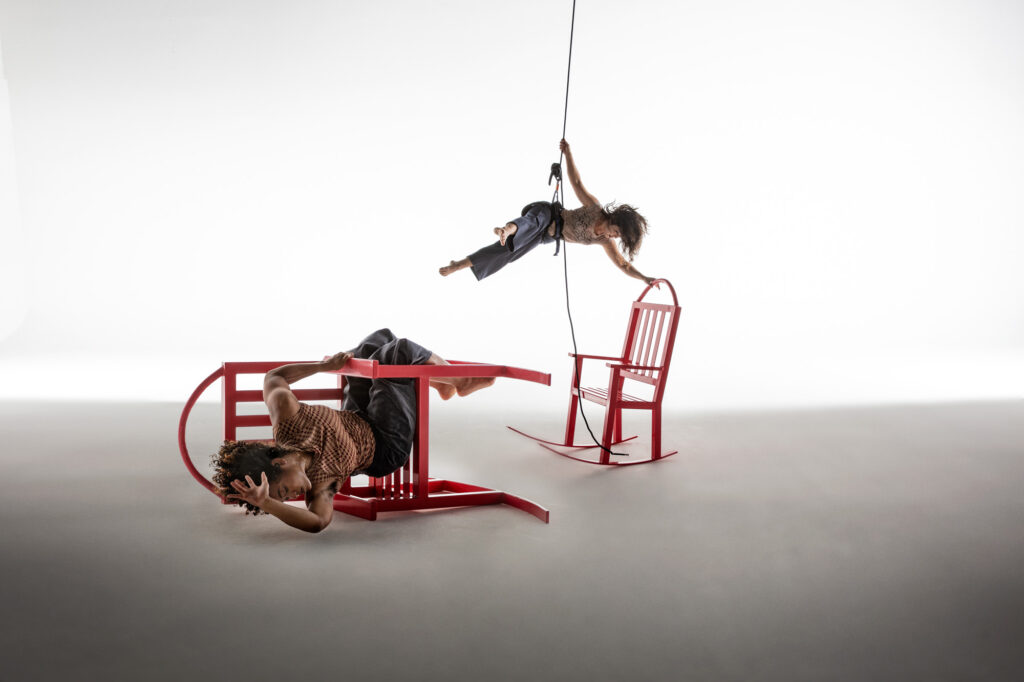
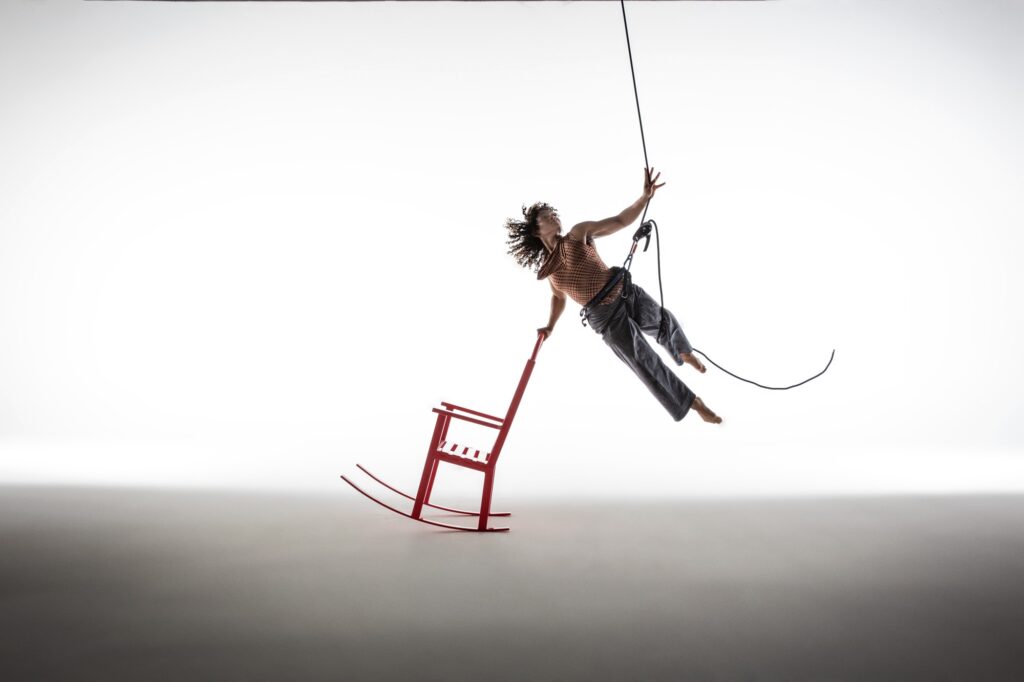
Kreiter drew on a physical metaphor with surprising resonance: “I inserted a rocking chair into the piece because to me, the repetition of the rocking is a basic human comfort. But when I asked April, what does it mean to you? She said it’s kind of like where I’m at. You never go forward, but you never go back. It was a whole different lens on what a rocking chair is.”
In the piece itself, the dancers—Ai Yin Adelski, Quinn Dior, Clarissa Rivera Dyas, Emily Hansel, Jhia Jackson, Megan Lowe and Saharla Vetsch—use the rocking chair in exhilarating ways to launch themselves into space, while skillfully avoiding crashing into each other as they rehearse..
“April wrote this beautiful poem that became the second section,” Kreiter says. “It was just a perfect fit of where I started with the chair, where April took it, and then where Kalyn made it a sonic reality.”
Rocking chair
The time ticks forward to the rocking of the chair
tick – tock – tick
The minutes waste away
To the wooden curved arcs sway
tock – tick – tock
The thoughts wonder in the breeze
That these half moons bring
tick – tock – tick
Lost in thought
Like this chair I never advance,
But like this chair at least I never go back
Stuck in movement but I can only go so far
If I stop swinging and give up
I will realize that life and this chair is really hard
Keep going, although I know I will never go anywhere
But if I keep going,
I know that this chair will force me to live in the moment.
Is that what I fear?
tock – tick – tock
The time winds down, the chair loses its swing
As the passing of the last minute arrives,
I find my momentum as I stand and sing.
tick – tock – tick
FREEDOM COMES WHEN ONE WALKS THROUGH IT Sat/3-October 17. Locations and more info here.