Without any particular intention of doing so, last week I found myself watching five science-fiction movies within 48 hours. One opened last Friday (see our review of Onslaught here), while another was a belated view of this spring’s hit Project Hail Mary, which turned out to be way too cute for my tastes… I mean, it really does star Ryan Gosling and a puppet. But the others were all new, or at least newly re-released.
One realization from that accidental overload was that where sci-fi was once a relatively special occasion onscreen—certainly major-studio entries were less than plentiful until the Star Wars effect hit warp speed around 1980—now it is practically the industry standard. Comic-book movies are usually at least sci-fi adjacent, and few story settings are more common now than “the future,” whether it’s “near” (as in Hail Mary), space-operatic, or dystopian.
But the imaginative leaps that once would have signaled are not necessarily present. Commercial features are more expensive to produce than ever, and computer-generated effects have not lowered those costs as continually promised. Still, CGI is pervasive in bigscreen entertainments. Rather than widening the mediums’ creative horizons as once promised, for the most part they have simply shored up the most basic fantasy cliches, with inventive narratives and fresh ideas surfacing less frequently than ever. The fantastical has become banal.
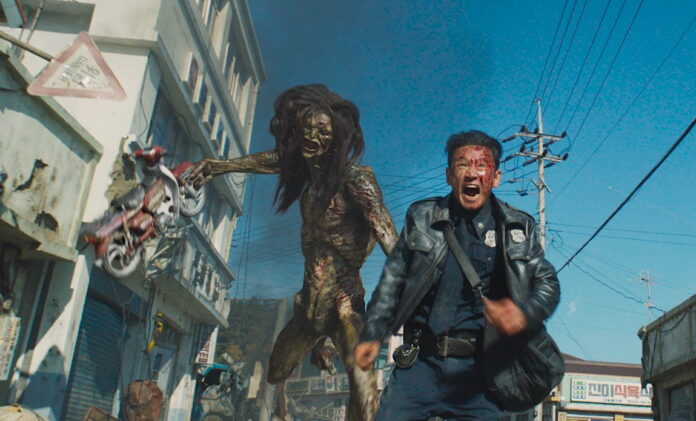
That increasingly extends to movies made around the world, as particular sorts of popcorn entertainment look more and more alike regardless of where they originate. Hope is the first film in a decade from Na Hong-Jin (The Wailing), opening this Friday on a record-setting number of US screens for a feature from South Korea—a nation that’s made big strides in exporting commercial cinema of late. While the most conspicuous example of that was the atypical one of Bon Joon Ho’s Oscar-winning 2019 Parasite, an intricate social satire, this latest is a lot closer to that same director’s The Host 20 years ago, being another “rampaging giant monster” flick.
On the outskirts of a small town not far below the North Korea border, several hunters and local police chief Bum-seok (Hwang Jung-min) find a cattle carcass, the animal looking to have been mauled, and perhaps dropped from above, by some predator. A tiger? A bear? Those seem the most credible explanations, even if the huge claw marks don’t really fit either scenario. The five hunters soon decamp to search surrounding forests, while Bum-seok heads back to hamlet Hope Harbor.
There, he finds rampant destruction—the mystery creature has already wreaked havoc, careening through buildings, killing many citizens in the process. And in fact it is still at it, with Bum-seok, his rookie subordinate Sung-ae (Jung Ho-yeon), and various heavily armed residents doing their best to stop a seemingly near-unstoppable whatsit. Eventually the primary action shifts to the woods, where it turns out several of these apparent space aliens have been hiding for an unknown time.
Hope starts out like a turbo-charged update of Godzilla terrain, Na keeping things in near-constant forward motion. In the end (mild spoiler ahead) it shifts towards something more like Avatar, in that we are encouraged to sympathize with the forces humanity is fighting—they too feel themselves under attack. But the explanatory details of where they came from, why they’re here etc. are left for another movie. Which is a problem, because I’m not at all sure I want more. Hope is close to three hours long. There’s never a dull moment, yet the well-staged action and general high energy don’t have any ideas to engage on a deeper level than immediate surface stimulus.
Aiming for a quarrelsome cultural humor a la The Host, the characters are forever yelling at each other, to an effect more irksome than funny. I could have done without one long comedy monologue whose entire gist is “Old man talks about shitting,” but that’s just me. There is exactly one good plot twist, when we realize all this mayhem was probably triggered by one monumentally stupid human’s bad judgment. But that irony doesn’t do much to heighten the fuzzy fadeout, which makes use of prominently billed western stars like Michael Fassbender and Alicia Vikander—albeit only their voices, speaking a made-up language to boot.

There’s nothing much not to like about Hope, which is big, loud, exciting and fun. It’s accomplished on just every level, particularly in the production design and in Michael Abels’ original score. (The CGI effects aren’t flawless, but they’re good enough.) But it’s not interesting—just 160 minutes of chase and collision, splat, and ick. There is nothing there I’d particularly care to see again (a feeling I had about the first Avatar, too), so as a potential world-building exercise, Hope falls short. It’s like the ultimate Jiffy Pop. Very nice, but… um… still just Jiffy Pop, an empty-calorie snack rather than a meal.
Two revived oldies make at least a stab at more thematically ambitious sci-fi. The more successful one is Gandahar, French animator Rene Laloux’s 1987 film, which was based in turn on a 1969 novel by Jean-Pierre Andrevon. It got released in the US under the title Light Years, redubbed by a starry cast (including Glenn Close and Christopher Plummer), rescored, rewritten (by no less than Isaac Asimov), and cut—one of many cases in which the Weinsteins “improved” a film to its detriment. But the full original version has now been restored and re-released, opening at SF’s Roxie this Fri/11.
It is a thinky, trippy odyssey that’s arguably even better than Laloux’s famous 1973 cult classic Fantastic Planet. The story, which begins in a utopian society and ends many tough revelations (and a millennium) later, is ambitious in the mode of the best literary sci-fi. The rich, painterly backgrounds reflect the input of French comics illustrator Caza aka Philippe Cazaumayou—previously he had collaborated with such notables as as Roland Topor and Moebius. Gandahar is well worth revisiting, or seeing for the first time.
More questionably worthwhile is 1970 Signals: A Space Adventure, which premieres on arthouse streaming platform Ovid the same day. Still, wild horses couldn’t have dragged me from checking out a Polish-East German coproduction from the high Cold War era, originally shot in 70mm and promoting a future of multiethnic space-exploratory harmony a la Star Trek. The problem here is that there’s not enough conflict: One spaceship’s disappearance sparks its investigation by another vessel’s crew, but there’s no real nemesis and not much action, either.
If Gandahar feels dated in its sexiness (female characters always seem to be topless), Signals feels even more so in its sexlessness, offering a very chaste, USSR-approvable vision of dullish professionalism and comradeship. The visuals are clearly influenced by 2001, if hardly on its level, hoked up quite a bit by orchestral-muzak-type scoring, creaky notions of “push-button” age technology, the requisite funny robot, and so forth. It’s an amusing-enough curiosity… but also a bit of a bore. Director Gottfried Kolditz would make a more entertainingly wacky sci-fi feature six years later with In the Dust of the Stars.
Elsewhere:
Incredibly Strange Religions: Other Cinema, Mel Gibson, ‘The Militia’
The crazy is with us, onscreen as well as off, in several forms this week. First off, Craig Baldwin is opening a somewhat scaled-back latest season for the venerable Other Cinema series with its annual “Incredibly Strange Religion” program on Sat/12. Promising “an apocalyptic 99 minutes of spiritual absurdity,” it will feature live rituals and antic music videos from Church of Magic’s Ben Folstein, plus audiovisual errata reflecting the variably sincere beliefs of many a real-life cult. More info (including the full season through Oct. 10) is here.
Because that evening will probably not be blood-soaked enough for some worshippers, you can also revel in the incredibly antagonistic vision of Christianity first brought to you in 2004 by The Passion of the Christ, i.e. The Gospel According to Mel. Gibson’s vision of Jesus’ last hours is singular, with so much attention devoted to sadism, shifty-eyed Jews, the horrors of gender-blur (that’s Satan), et al., you might wonder just where all that “love thy neighbor” stuff came from. Despite the well-deserved R rating, it clicked with evangelical audiences bigtime 22 years ago, and doubtless will again in our climate of MAGA-morphed religious morality. It returns to theaters nationwide for one week beginning Thu/10, whetting the appetite for next year’s sequel (no I’m not kidding) The Resurrection of the Christ: Part One. Proving his steadfastness of character, the actor-turned-director was recently in the news for publicly mocking an ASL translator. As the saying goes, God help us.
Very likely to have been weaned on that movie are the protagonists in a compelling new fiction feature, Dylan King Welter’s The Militia, which got released to streaming platforms this Tue/8. It’s a powerfully low-key tale set in an undesignated dusty rural locale that might be somewhere in Texas or Oklahoma. There, teenaged only child Daniel (Sam Williamson) is being homeschooled by his mother Elinor (Laurel Feierbach) and otherwise schooled by his ex-US Army father Lee (Michael Broderick), who’s taught Junior to be a crack shot. He’s also filled the boy’s head with such wisdoms as “Hunt or be hunted” and “Live free or die.” Dad belongs to a local militia, as do most of Daniel’s friends’ fathers. It is Daniel’s fervent wish to join up, but he’s got another year to wait—they do not take legal minors.
When libertarian Lee needlessly locks horns with Sheriff Webb (Luke Stratte-McClure), however, the latter quickly discovers he’s breaking numerous weaponry laws, and possibly planning some kind of terroristic anti-government action as well. Dad ends up awaiting trial in jail. It is at this point that we realize Daniel, whom you might think would be relieved to get a break from his overbearingly rigid father, is in fact pa’s perfect little fanatic-acolyte. Daniel begins plotting with his peers to create their own junior “militia,” and free his parent by “whatever means necessary.” What can possibly go wrong, with a bunch of 17-year-olds arming themselves to the teeth and building pipe bombs? You guessed it: Everything.
Straightforwardly crafted almost to the point of stylelessness, The Militia nonetheless benefits greatly from holding to a tone so neutral that we must judge actions and events for ourselves—Welter refuses to do it for us. The result is so open to interpretation, it could conceivably be used as a recruitment tool for youths just as misguided and gullible as Daniel. But for those horrified by the paranoid, paramilitary alt-right insanity that’s been sweeping our nation, and is so deftly depicted here, it’s a chillingly insightful cautionary tale.
Golden Oldies: Fox musicals, pre-Code Joan Crawford, more
Viewers who want to escape crucifixions, militias, monsters, and other totems of our moment will find some prime 20th-century diversions available in coming days. The Stanford Theater in Palo Alto is commencing a three-weekend “September Musicals” series drawn from the vaults of 20th-Century Fox. That studio did a brisk nice trade in slick, pleasant, formulaic and tuneful during the period surveyed, which saw the crown of its resident singing queen passed from patrician, often period-dressed Alice Faye (1938’s Alexander’s Ragtime Band) to the very modern, leggy “pinup girl” Betty Grable (1941’s Moon Over Miami).
Naturally enough, those two ladies co-starred at the precise moment of transition, in 1940’s Tin Pan Alley—singing “The Sheik of Araby” in a splashy climax featuring the incredible Nicholas Brothers as tap-dancing harem attendants wearing only feathered loincloths. The 1940 Down Argentine Way introduced Grable to Technicolor, and audiences to Carmen Miranda, the motormouthed “Brazilian Bombshell.” The latter commenced her popular vogue just as the one for figure skater Sonja Henie was ending. Both that Norwegian import’s 1941 vehicle Sun Valley Serenade and the next year’s musical drama Orchestra Wives heavily featured the swing sounds of Glenn Miller and his band. The series’ Sept. 11-27 schedule is here.
Meanwhile at the Roxie, a dose of pre-Code glamour gets resuscitated as of Mon/14 in the form of Letty Lynton (more info here). It’s a 1932 romance seldom seen since, because of a successful lawsuit: A court decided the script had borrowed overmuch from a preexisting stage play, without giving credit. Copyright expirations recently “freed” the film for restoration and exhibition.
What’s emerged is no lost classic, but a sleek MGM vehicle for Joan Crawford, who’s chicly coiffed and clad within an inch of her life as a Manhattan socialite who’s gotten in too deep with a Latin lover (Nils Asther) while slumming in Montevideo. She finally flees homeward on a luxury liner where she meets and falls for a more suitable rich Bostonian (Robert Montgomery) amidst much arch banter. Alas, the possessive rejected party can travel, too, threatening the final clinch before fate intervenes. Letty Lynton has surprising commonality with The Militia: Its “happy ending” also depends on a complete miscarriage of justice.
Clarence Brown, who’d direct Crawford and Garbo several times each before making some memorable family films (National Velvet, The Yearling), was an expert at the kind of genteel, high-gloss good taste that was as close as MGM wanted to get to Art. This isn’t a particularly racy pre-Code, and with her elocution at its plummiest, Crawford is not at her best. Still, Letty Lynton is quintessential Depression-era Hollywood fantasy, affording viewers (particularly female ones) escape into luxe art deco settings and aspirational lifestyles. Apparently some of Crawford’s wardrobe was imitable enough to have lasting ripple effects in the department-store retail world.
Finally, there’s a rare chance to see Twin Peaks as, well, it was never meant to be seen—on the big screen. Which is no reason it shouldn’t be seen that way, of course. The Balboa is hosting a “festival” of David Lynch and Mark Frost’s broadcast magnum opus this Fri/11-Sun/13, with marathon helpings of both the 1990-91 original series and its 2017 “return,” as well as the 1992 feature Fire Walk With Me.
For me, those many hours of surreal neo-noir soap opera ran a gamut from the sublime to the near-unwatchable. But needless to say, opinions vary on that matter, and there are some who consider every moment from every incarnation a lightning bolt of genius. Who’s in for the whole weekend? You know who you are, you freaks. Full info here.