There’s a good chance California voters will be asked next fall to do something that Zohran Mamdani and Bernie Sanders have made the centerpiece of their political campaigns: Tax the rich.
Labor groups are circulating an initiative that would impose a one-time 5 percent tax on fortunes of more than $1 billion. That would bring as much as $100 billion into the state’s coffers.
The Chron is at least covering the Billionaire Tax—although most of the stories are about the poor deprived rich people who have to leave the state to avoid giving up even a tiny slice of their vast fortunes.
I was particularly amused by this Rachel Swan piece, which states that “Taxing the rich to fund social services is not a new idea,” and links to a 2009 story about Sens. Bernie Sanders and Elizabeth Warren offering slightly different versions of a wealth tax.
Taxing the rich to fund social services is, indeed, not a new idea: It’s been around since the Civil War, when President Lincoln signed a bill taxing the better-off to pay the Northern efforts in the war. The bill exempted all income of less than what would be $16,000 today, and had a graduated scale: The highest rate, 5 percent, was on incomes of more than $10,000 (equivalent in purchasing power to about $250,000 today).
By 1932, in the depths of the Great Depression, the highest earners were paying a marginal tax rate of 63 percent. Those taxes on the rich funded the New Deal. During World War Two, the top marginal rate was as high as 94 percent, and it stayed at 91 percent until 1963 (under those socialist radicals Harry Truman and Dwight Eisenhower).
That helped build a modern infrastructure for the US—and created a stable middle class.
So no, Rachel: It is not a “new idea.” Instead, by 20th Century standards, allowing the very rich to accumulate the sort of fortunes they have today is a new idea.
Back to the Billionaire Tax.
Labor groups, particularly SEIU-UHW, are pushing this as a way to make up for Trump Administration cuts to health care. The tax is different from an income tax: It is, straight up a wealth tax, a levy on existing fortunes. That’s a key distinction because many very rich people have little in terms of traditional income, the money you make by working. They get rich by already being rich; their fortunes expand through investments that are not taxed as income until those investments are sold.
(Many people in California already pay a wealth tax. For most non-rich homeowners, that house is their largest asset, and property taxes are a tax on its value.)
Those deeply oppressed tech lords are terrified.
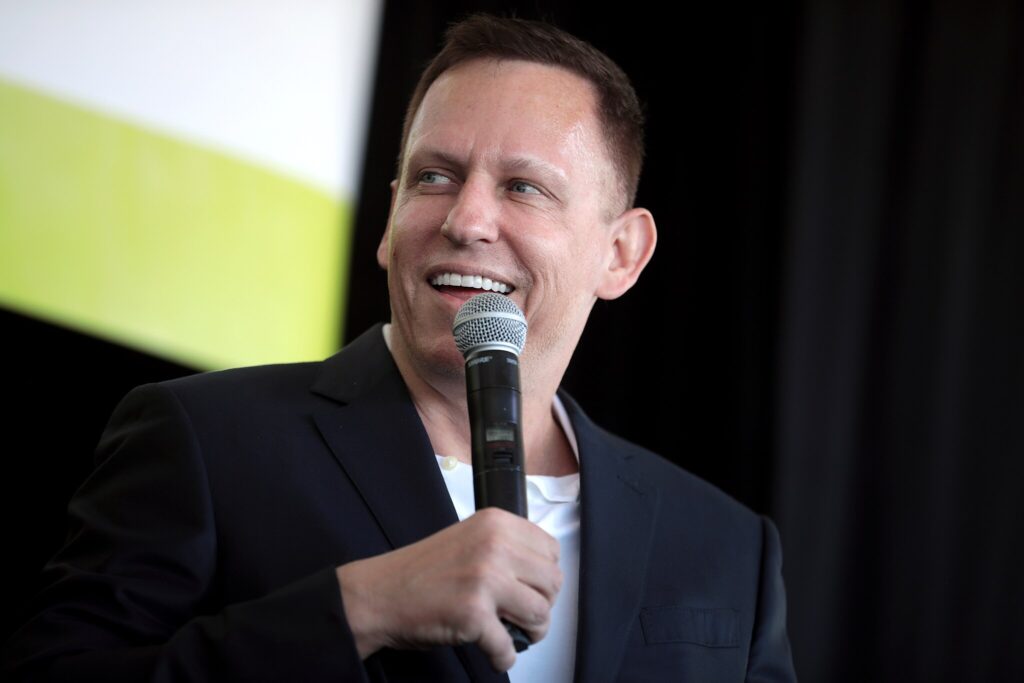
The New York Times reports that some multi, multi billionaires are threatening to leave California if the measure, which isn’t even on the ballot yet, qualifies. Peter Thiel has already moved to Florida, where he is now registered to vote (like his pal Donald Trump).
Then there’s the beleaguered Larry Page, who lives in Palo Alto and is so terrified of the tax that he may become a refugee, fleeing with his fortune to someplace like Texas.
Let’s put this in perspective:
Since 2024, Larry Page has seen his net worth rise by more than $100 billion. Yes, $100 billion. Most of that is linked to the rise in the price of his Alphabet stock, since he doesn’t really work anymore.
Since stock value is treated by law as an unrealized capital gain, he likely has paid no income taxes at all on that “income,” and will pay none unless he sells some stock. But rich people don’t sell stock: They borrow against the stock, then die, and nobody pays any taxes at all.
If he had to pay the 5 percent tax on his $264 billion today, it would cost him $13.2 billion.
That’s the equivalent of a 13 percent income tax on the money he has made not by working but by already being rich—the same rate that people who make between $11,000 and $47,000 currently pay.
So a low-paid worker who can’t afford rent in SF is already paying more of their income in taxes than Page would. This would be so horribly unfair to him that he will have to flee.
Gary Tan, who not long ago said he wanted some SF supervisors to “die slowly,” still seems to have credibility at the Chron:
Among the most vocal critics was Garry Tan, president and CEO of the startup accelerator Y Combinator. In a Dec. 26 post on X, Tan dubbed the ballot proposition an effort to “destroy tech in California,” saying that young founders would have to pay millions before they had any liquid assets.
Wow, that just sounds so dastardly: Someone who just became a billionaire when their company went public has a tax liability. Most of us who earn our money by working for a salary have a tax liability every pay period.
Tan should know how this works in reality: Young billionaires who under their stock option rules can’t cash out until six months or a year after the Initial Public Offering don’t wind up living in a closet and eating canned beans while their stock vests: They borrow against that stock and buy mansions and Lamborghinis. They can pay a little tax.
The apocalypse that Tan (and by the way, Gavin Newsom) are predicting is unlikely; even Forbes, which used to advertise itself as a “capitalist tool,” agrees:
Opponents of California’s proposed 2026 Billionaire Wealth Tax Act repeat a familiar warning: tax the wealthy and they will leave. The claim has rhetorical force; it makes sense on the surface — don’t billionaires make most decisions based only on money? It turns out billionaires aren’t one-dimensional or solely motivated by money. They care about home, long-term personal and business relationships, and some care about improving the lives of the poor and workers.
That there is little to no economic evidence showing that billionaires will move to avoid a small and one-time wealth tax — dedicated to a specific humanitarian cause — is no surprise.
Decades of economic research show that billionaire “flight” is rare, exaggerated, and often confused with tax avoidance through accounting maneuvers rather than physical relocation. That distinction matters. Policymakers who mistake avoidance for exit risk misdesign taxes and leave substantial revenue on the table. The proposed one-time wealth tax in California is exceptionally well-designed.
But maybe Forbes and the Wall Street Journal and Robert Reich and everyone who has every studied the data is wrong, and lots of billionaires will pack up and leave California. That, Newsom worries, will lead to a loss of income tax revenue and even worse budget problems.
That argument assumes that these people with vast fortunes are paying state income taxes. Many of them are not; in fact, many of the richest US residents pay little or no income taxes at all.
The next tech boom doesn’t seem to be happening in Austin. Maybe it’s Miami, which is regularly devastated by hurricanes and likely will underwater in the not-too-distant future (plus: oppressive heat and humidity, giant bugs, and alligators).
Would that really be so bad?
Would most San Francisco residents be better off if the Twitter Tax Break hadn’t set off a boom in this city that drove up rents and home prices and force thousands of workers out of the city?
Would most of us be better off if we were not becoming the AI capital of the country?
Would the city be a better place if some of these greedy, nasty, Trump-supporting tech billionaires decided to leave? (Or should we say: “Bye. Don’t let the door hit you where the good lord split you?”)
I could certainly make that argument.