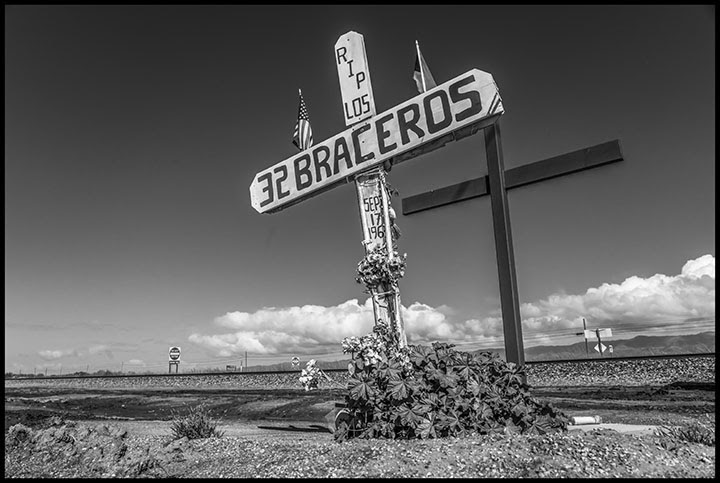
I was driving on the frontage road beside Highway 101, just south of Salinas, looking for the memorial to the braceros killed in 1963.
Fifty-eight workers had been riding in the back of a flatbed truck, where their labor contractor had bolted down two parallel benches for them to sit on as they rode to and from the fields. The truck’s driver, Francisco Espinosa, couldn’t see a train coming at 67 miles an hour, as he inched slowly across a railroad track on Thomas Ranch Road in Chualar.
When the lead engine hit the truck, almost all were thrown into the air, many crushed beneath the steel wheels, and 32 died.
Because they were braceros, they were only identified by a number that corresponded to their work contract. It took weeks to know their true names. More than 9,000 people came to their funeral in Salinas.
Espinosa was charged with manslaughter and acquitted. The grower and labor contractor were never charged, although Southern Pacific Railroad, the Growers Farm Labor Association, Harden Farms and the Myers Corporation were sued and settled for $1.5 million.
The terrible crash, the anonymity of the workers, and the disgraceful conditions in which they worked and died, led to a huge outcry. Ernesto Galarza, the longtime opponent of the bracero program, wrote a damning report to Congress, to assign responsibility. That helped end the program two years later. Today, two crosses erected at the crash site remember the dead.
As I drove with one eye on the road and another on the tracks, I passed a muddy field. Deep inside I saw a harvest machine with workers spread out around it. I stopped and headed for them, looking for the foreman to ask about taking photographs.
At first I thought it was a broccoli field, but when I began walking, trying not to trip on the plants and fall into the mud, I realized they weren’t broccoli but broccolini.
I found Joel, the foreman, next to the typical white truck of a field supervisor. After a call to his boss, he said we could take some pictures and gave me a hairnet. Concerned to keep the vegetables free from human contamination, he supplied gloves as well. Joel even offered boots, but by then my shoes were already encrusted with mud.
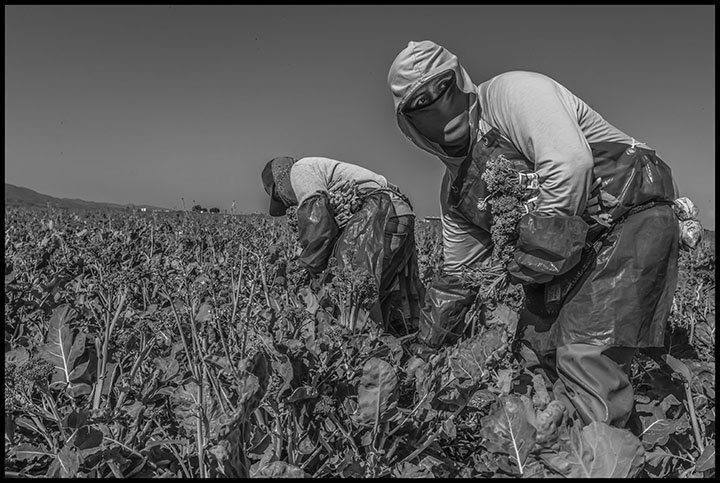
Walking and joking among the workers, I began to take photographs that would show the way they worked. When I made my corny joke that I’d only take photos of the mas guapo, the handsomest ones, Daniel, Ignacio and Felix all pointed to each other, laughing. Of course we couldn’t tell who the good-looking guys were, since they were all masked with bandannas. Everyone wore long plastic aprons to keep their clothes dry in a very wet field, even Daphne, working up on the moving platform.
As the machine slowly trundled along, each person labored in their assigned row. When a field of broccolini is ready to harvest, a crew first goes through it and breaks off the crown of each plant, which looks like a small bunch of broccoli. The crown isn’t what the grower wants, however. After it’s gone, the plant then puts out thin stalks with a much smaller flower crown at the top. That’s the broccolini stalk you see in the supermarket. A field keeps producing these stalks for months, so the crew and the machine go through several times before it’s all harvested.
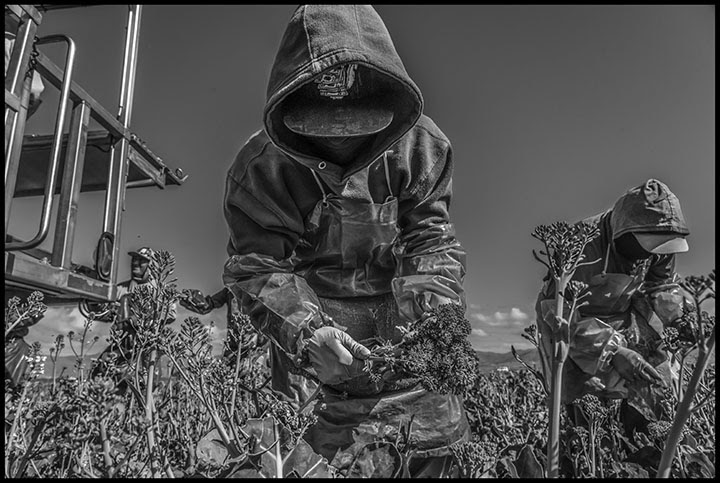
Workers don’t need a knife to cut the broccolini stalk. Instead, they break it off as they go down the row, bunching the stalks together into a handful. When the bunch is big enough, they put a rubber band around it. It takes experience to know when you have enough stalks, and all the bunches have to be pretty much identical. These workers knew their job, and could make up their bunches without even seeming to think about it.
The workers closest to the machine threw their bunches up on the steel counter above them as they worked. Some workers were too far away, so they would keep making bunches until they were holding several close to their chest, and then run over to the machine to toss them on board. Up on the moving platform workers like Daphne then packed the bunches into boxes, twelve to a carton. It was a smooth operation, dependent on workers’ experience, skill and coordination to make it run.
Broccolini is a hybrid plant, a cross between broccoli as you buy it in the market, and the Chinese broccoli called gai lan. It was first developed in Japan, not by genetic experiment, but by careful cross breeding. The Sakata Seed Company, the Japanese company that produced it, then went into partnership with Mann Packing, a California grower, to plant and market broccolini in the U.S.
I remember Mann Packing from my years in the United Farm Workers. It was one of the first companies where workers voted for the union, after the passage of the Agricultural Labor Relations Act in 1975. The company then had a union contract. As an organizer I’d show it to workers at other companies, an example of what they could win if the fought for one of their own.
I’m not sure what happened to that contract. Perhaps it was one of the many lost in the years when growers got control of the Agricultural Labor Relations Board, and simply stopped negotiating contracts.
Mann Packing was bought by Del Monte Fresh Produce in 2018 for $361 million. Last year, the new owners agreed to sell Del Monte’s Mann Packing division to Church Brothers Farms. Mann Packing had a union contract with Local 5 of the United Food and Commercial Workers for the workers in its Salinas packinghouse, and the workers there still belong to the union.
The field workers for Church Brothers Farms have no union. The Church brothers, Tom and Steve, are the nephews of Bruce Church, who found a way decades ago to ship lettuce in train cars filled with ice, and made millions. His company in Salinas fought the United Farm Workers for years before finally signing a contract in 1996. By then it was called Fresh Harvest, and later disappeared in a series of corporate mergers. Meanwhile the nephews’ new company, Church Brothers Farms bought Mann Packing, and with it, the broccolini.
Joel and the workers were happy to show the way worked, and the human effort it takes to get broccolini onto our dinner tables. Farmworkers know that consumers have no idea how this happens. Although they labor in so many layers of clothing and plastic aprons, they feel invisible, or at least unacknowledged. So appreciating the taste of broccolini, somewhat sweeter than regular broccoli, should mean giving credit to them.
In our house, we often cook the broccolini in a pan with a little oil until the stalks start to soften and char a bit. Then we put them on a plate and squeeze a lime and dust the spears with garlic powder. We like a sauce Lillian taught me to make when we first started living together. You start stirring a couple of big spoonsful of mayonnaise in a small bowl, and slowly add soy sauce and a little sesame oil. It tastes really fine on top of that broccolini. ¡Buen provecho!

David Bacon is a photographer, labor activist, and former farmworker organizer.