
Who knew an aspirin factory could cause such a headache? “I walked onto the floor of the Bayer pharmaceutical plant and it was so loud, just constant noise, that I was worried I wouldn’t be able to use any of my recording,” composer Pamela Z said. “I was trying to do things like hold my microphone up close to a little medicine bottle, but the sound was overwhelming. My thoughts obviously turned to the workers. Even with safety equipment, how do they put up with this? Do they like the sound of their work?”
After winning the 2025 Berlin Prize, San Francisco-based Z was in Germany collecting materials for new work Arbeitsklang (WorkSound), which she’s premiering at legendary “theater of sound” the Audium through March 28. For Arbeitsklang, Z visited six specific German worksites, including a kitchen and futon maker, to capture “the rhythmic strike of knives on cutting boards and the mechanical whir of sewing machines, the industrial thrum of factory floors and Gutenberg printing presses,” stitching her samples together and interweaving her own voice and live-MIDI sonic manipulations to thread an industrial tapestry through the darkened Audium’s 176 speakers.
Z is no stranger to handiwork herself; among the innovations she’s known for over her five decades of experimental composing and performing are her gestural sonic controllers, which manipulate sounds with a wave of her hands, her fingers capped with futuristic-looking gadgets. For her, the Bayer wall of sound became another tool in her arsenal: “I actually found there was a lot of that recording I could use,” she said. “It became a bed of noise I could play with as another layer of the composition.”
Another Arbeitsklang recording experience Z highlighted was a visit to a printer who used an actual Gutenberg press. “I got a terrific interview with the guy at the printing place, who wanted to go back to this old school process because he was over computers. It was very poignant in terms of how we are living now. He talked about how saddened he was that people were so buried in their digital devices, that they’re actually retreating from the world around them. He wanted to use this press because you had to physically roll out the actual ink, and place the type one letter at a time. You design by doing, by physically interacting with it.
“It was quite lovely, you could tell he had great affection for the machine. He said he would invite classes of computer programmers in to show them how it worked, people who were used to laser printers. They would be skeptical, but by the end of the visit they wouldn’t want to leave, they loved it so much. They all wanted to make more posters! And of course, the sounds the actual press made were fascinating.”
Berlin, with its industrial past and artistic fetish for machine music—it’s one of the global techno and industrial music hubs, after all—seemed perfectly fertile ground for a soundwork like Arbeitsklang. But the idea has been germinating in Z’s head for more than a decade. “I had a McNight Foundation composer residency in the Twin Cities in the 2010s, where I proposed this very work. Part of the residency was engaging with the community at large, something beyond just the art world. I came up with the idea of going to all kinds of peoples’ work, and hearing what that was like.
“They liked the idea, but wanted to hone it down to something more specific, to focus on one industry that had a deep history in the region. One of those is agriculture, and the farm-to-table things was really big back then. So I concentrated on that. I interviewed farmers and their animals, restaurant workers, people along the whole system. The piece was called Closed Loop, which was about the cycle: They grow the food, it goes to the restaurants, the restaurants cook the food, the restaurants send the compost back to the farm. It ended up being a really nice piece. But I still had this idea in my quiver, and Berlin was the right place and time.”
Some workspaces took a little convincing to let an artist with recording equipment come in. “The Germans seemed a little nervous about it. I needed help from the Berlin Academy [which awards the Berlin Prize]. At Bayer, they assigned me a kind of companion, someone who interfaced with the public, and who trailed me as I worked. At one point I started to take a selfie in front of one of the big machines, and that was not going to happen. I ended up taking one in front of a big blank, white wall,” she laughed. “Some of this project was pretty tricky.”

Z has been deeply rooted in the contemporary music and arts scene here since she moved to San Francisco in 1984. The miraculously idiosyncratic Audium, opened in its current location in 1975 by visionary composer and sound-sculptor Stan Shaff—for decades he would perform cosmic scores using early spatial sound technology—attracted her almost immediately. “I’ve been going since the ’80s. Stan used to advertise the Audium in travel brochures, as an interesting thing for people to visit—something San Francisco and quirky. I found out about it right away and it was excellent. His son Dave has recently opened up the Audium to new composers and residencies, and I was very excited when we started talking about doing something together,” Z said.
“The challenge with making a piece for it, and I love it, is that you can’t overestimate how much time you’re going to need to just learn how to play this massive, room-sized, one-of-a-kind instrument. You’re using technology that really exists nowhere else. There are 176 speakers, and you’re actually playing each one of them. That gives you almost infinite options for color, and richness, and position of the sounds. It’s truly remarkable and very cool. But it’s also hard!”
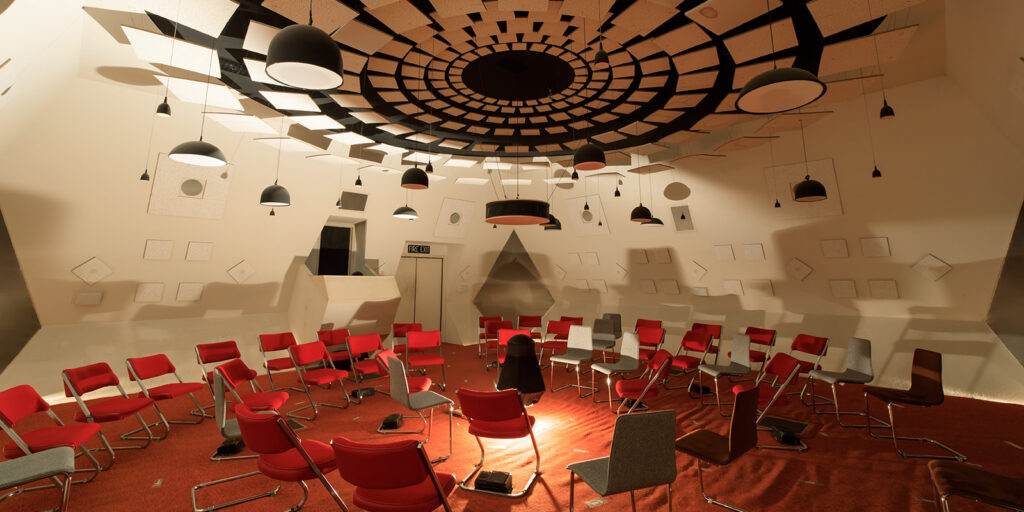
There are automatic subtexts to Arbeitsklang: the disappearance and value of physical labor in the Digital Age, the power of workers in a time of wild economic disparity and endless surveillance, a nostalgia for the communal factory floor and its physical products—even the naked plastic medicine bottle shivering in an ocean of industrial noise. There’s a metatext, too, when half a major company’s digital workers are capriciously laid off to make room for more AI. (“I thought about sampling a tech company,” said Z. “But what would you get? Occasional text notifications?”)
Yet Z is letting the inner mechanics of her composition do its own talking. “I like to work really abstractly. I do use entire phrases and sometimes even sentences from people. You do get a thread of somebody’s story here and there. But a lot of times, I’m just abstracting the sound of their voice and just individual phrases, and sometimes even just phonemes or mouth noises. It’s never my aim to deliver any kind of a message, as much as it is to just make people be curious and want to explore these things in their own minds.”
PAMELA Z: ARBEITSKLANG through March 28 at the Audium, SF. More info here.