
A San Francisco judge today ordered Public Defender Mano Raju to pay $26,000 in fines for refusing to take cases that his office can’t handle because of crushing workloads.
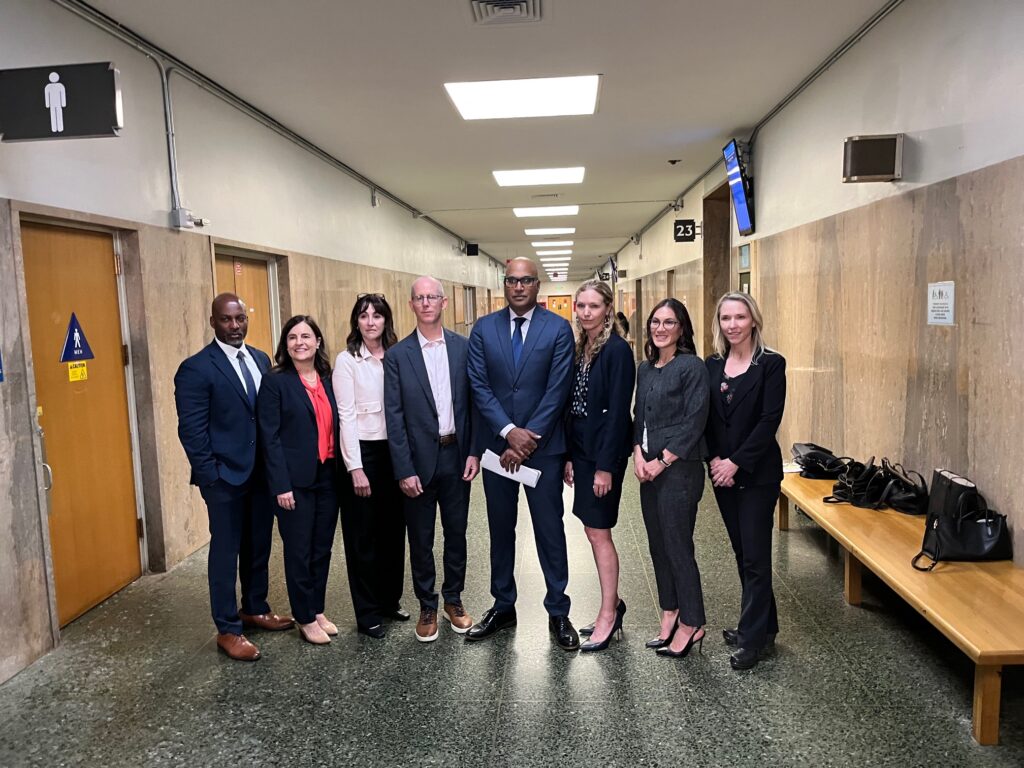
Public defenders from seven California counties stood with Raju before the hearing, and argued that legal ethics and constitutional law require attorneys to have the training—and capacity—to aggressively represent their clients.
Caseloads around the state have soared since the passage of Prop. 36; courts are clogged, jails are overflowing, and public defenders don’t have nearly the staff to handle all the new cases.
In San Francisco and Alameda counties, the crisis is particularly severe since voters recalled progressive DAs who were replaced with prosecutors determined to appear “tough on crime.”
Rajo immediately announced that he’s appealing the sanctions, meaning the appellate courts, and maybe even the state Supreme Court, will have to deal with a key issue:
Can trial courts require public defenders to handle more cases than they believe their staff can handle without sacrificing the quality of the representation?
The political issue is even more important: When voters put in office a mayor or district attorney who vows to address crime by arresting and prosecuting more people, do those jurisdictions not have a responsibility to fund adequate defense for the larger caseload?
There are, Raju notes, Constitutional issues that come up downstream when politicians demand more arrests and prosecutions:

Sanctions cannot change the reality that more cases are being filed and they are taking significantly longer to resolve. In San Francisco, active cases have risen 65 percent since 2019–due in part to cases being mischarged or overcharged and ever-expansive surveillance evidence to review. The absurdity of being fined when we are already underfunded is counterproductive and a further injustice to our clients and our office.
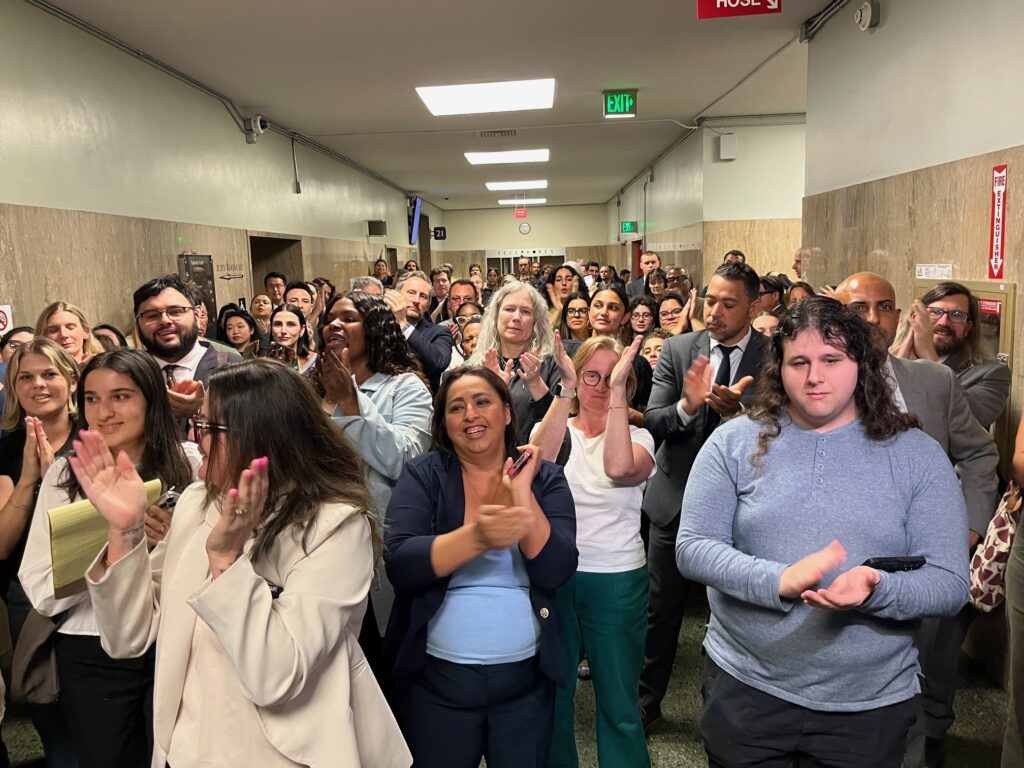
The public defenders at today’s press conference noted that District Attorney’s Offices are generally much better funded that public defenders. In San Francisco, Raju said, the DA has $35 million more a year than the PD.
At budget hearings, DA Brooke Jenkins has noted that the PD’s Office doesn’t handle every criminal case; some defendants have private counsel. “But we handle 84 percent of all criminal cases,” Raju said, “and we don’t have 84 percent of the DA’s budget.”
More: The San Francisco police do a lot of the investigative work for the DA, particularly in more serious cases like homicides. The DA’s Office also has its own investigative staff. The PD has only a relatively small number of investigators to review what are increasingly complex cases, with body-worn cameras, social media profiles, DNA testing and other emerging technologies.
Judge Harry Dorfman ruled that the public defender does not, on his own, have the right to decide which cases to take; the court can order Raju to take cases, even if he lacks the staff to handle them.
Raju argues that he, as the elected PD, is the best person to decide what his staff can handle—and by all accounts, the caseloads today are far above the levels that every legal entity that has studied the issue and set standards accepts.
An elected district attorney, on the other hand, has complete discretion which cases to file, which to settle, and how to charge each of them. An overworked DA’s Office can, without court oversight or intervention, simply decide not to file charges in cases that have little chance of winning a jury verdict, or diverting cases, or negotiating plea bargains that the accused can accept.
That’s not happening under DA Brooke Jenkins. Jenkins, Raju said, is filing cases that are, at best, marginal; half of the cases that went to trial in the past year wound up without guilty verdicts. That’s a shockingly low success rate for a district attorney; the statewide average is more than 80 percent, since most DA’s don’t go to trial unless they have a very strong case. Jenkins has pushed to trial, at considerable expense, some very weak, almost silly cases.
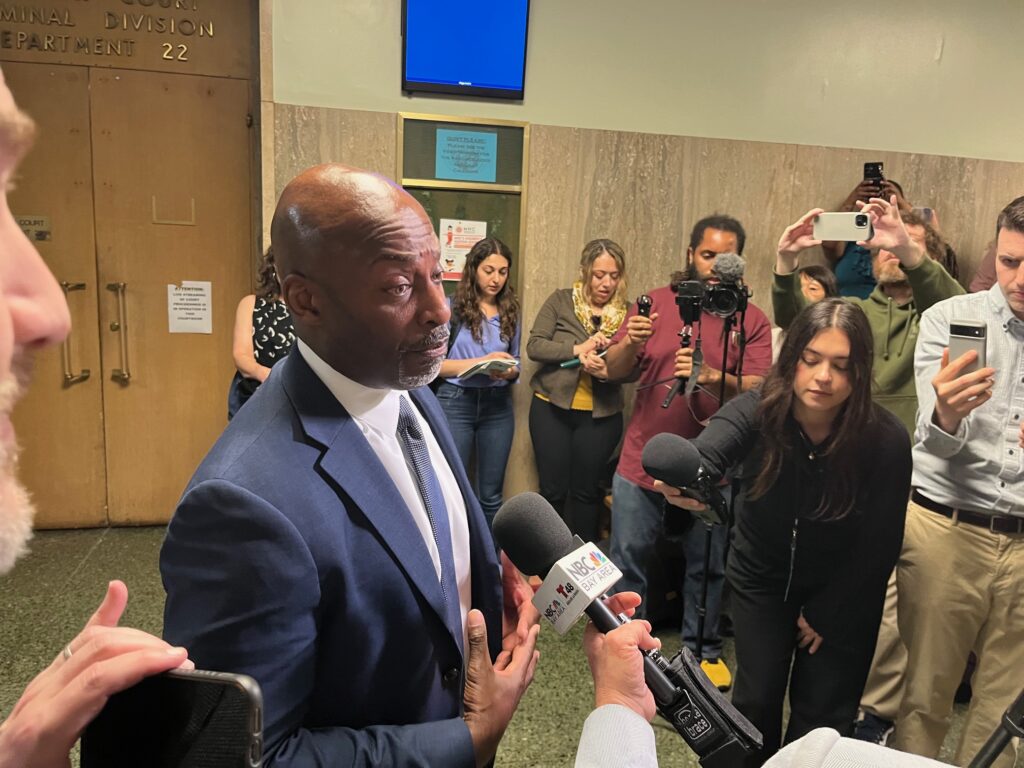
Brendon Woods, the public defender in Alameda County, said it’s “completely unheard of” to hold a public defender in contempt for doing his job. In his county, like San Francisco, a progressive DA was ousted in a recall and replaced with someone determined to appear “tough on crime.”
Since then, he said, his office has been forced to defend 700 additional felony cases; 62 percent of the defendants were Black in a county where only 10 percent of the population is Black.
Ellen McDonnell, public defender in Contra Costa County, said that she is “deeply concerned that the judge is replacing [Raju’s] judgement with his own.” The judge, PDs at the press event agreed, is far less qualified that Raju to determine how many cases his staff can handle.
The right of every accused to qualified counsel is a bedrock of the legal system. If an office lacks enough lawyers with the proper training and experience to handle serious felony cases, the defendants lose that right.
When the PD’s Office can’t take a case (often because there are multiple defendants and representing all of them could create a conflict) the judge assigns the case to a private lawyer. But the private lawyers who handle these cases also are overburdened by all the new filings—and unlike public defenders, they bill by the hour.
As Raju said repeatedly, access to counsel means access to a lawyer who has the time to properly handle the case. Dorfman agreed that the public defender was “between a rock and a hard place.”
He still insisted on sanctions that will only make the situation worse: Paying $26,000 means even less money for adequate criminal defense.
It seems to me this is pretty simple: The mayor has allocated tens of millions of dollars to hire new cops, to make more arrests. He’s allowed the cops to run up more than $30 million in overtime costs (public defenders don’t get overtime). The District Attorney’s Office is working with the mayor to prosecute as many cases, including drug cases and silly cases, as possible.
There’s a price to that policy, and part of the price is funding the Public Defender’s Office at the level required to handle the load.
That has to be as much of a priority as funding police. Since Raju has made this an issue, it’s possible the courts will conclude as much.