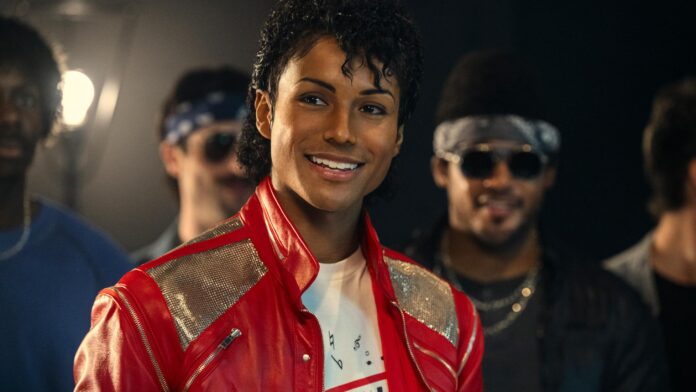
It didn’t matter. It did not matter. Despite including no characters named Diana Ross, Randy, Rebbie, or, more importantly, Janet in the movie (she’s not even mentioned; Janet Jackson does not exist), the Michael Jackson biopic, Michael, grossed an estimated $97 million domestically and $217 million worldwide during its opening weekend, setting a new record for the highest-grossing opening weekend for a music biopic.
Which you can read in so many ways, but for the sake of having a compelling piece of art documenting the ultimate pop star of the ’80s, it solidifies this sadness: We will never get a complex character study of this legend’s artistic development done with integrity.
All of the controversial allegations that have been attached to the Michael Jackson estate are sidestepped in this two-hour, color-by-number, highlight reel. Leaving a hole of emptiness.
Michael never lets us in on said King of Pop’s creative engine, beyond being motivated to get out from under his monster-type father figure, Joe Jackson, who uses his children like prized cattle. Directed by Antoine Fuqua, Michael serves up Joe Jackson as the big bad dad, played quite chillingly by Colman Domingo, who does, in fact, beat those Jackson boys into becoming millionaires. It’s a horrible statement to make, but that’s what’s displayed in the film.
Actress Kat Graham was cast as Diana Ross and filmed scenes, but they were removed from the final cut due to “certain legal considerations” and creative changes, according to Graham and industry reports. Who knows what happened to the rest.
We do get to see the landmarks and touching moments of Jackson’s career, beginning with the “Who is that little boy dancin’ onstage?” phenomenon (played convincingly by Juliano Valdi, communicating from scene one that all little Michael wanted to do was just throw snowballs on a snow day like a child). Later, Jaafar Jackson—Jermaine’s son and Michael’s brother—does spot-on vocal justice to “Beat It,” “Don’t Stop Till You Get Enough,” “Thriller,” and a great deal more of Jackson’s hits, which sounded wonderful in the ScreenX Theater multi-projection system at AMC Metreon this past Sunday.
The three-screen experience is built for concert-type performances while also capturing some of the emotionally arrested development of said MJ.
Yet this film Michael is a transparent cash grab, fan service on high: estate profit, a discography regurgitation aimed at a new generation to purchase not just Michael’s catalogue, but also the Jackson 5 and later Jacksons’ as a whole. We’ve seen this play before. Following the massive success of the Bohemian Rhapsody Queen biopic, where Rami Malek won a best actor award for his portrayal of Freddie Mercury, Queen, the band, sold their music catalog to Sony Music for over $1.27 billion in 2024.
Last year, the estate of Prince successfully blocked the release of a nine-hour documentary directed by Oscar-winner Ezra Edelman, which was set to stream on Netflix. The cancellation, announced in February 2025, was the result of a long legal dispute. In March 2025, Edelman publicly criticized the decision, calling the cancellation of his five-year project “a joke” and accusing the estate of censoring his artistic vision. He stated that his goal was to capture the complex humanity of Prince, and a new estate-controlled project is likely to be “propaganda.”
Edelman’s doc, according to those who saw it, featured not-so-happy points of the artist’s life.
It seems the estate is looking to turn Purple Rain into a live musical on Broadway, monetized, if you will, with a happier version of the film. Another example of commerce blocking truth. Also, a new Prince doc, as part of a mutual agreement between Netflix and the Prince estate, will now develop an estate-approved documentary featuring exclusive content from the archive.
So two of the 20th century’s most relevant pop stars will never have a committed, imaginative, aesthetic-driven film doc about their lives or creative process as long as both Prince’s and Michael Jackson’s estates maintain control of those artists’ legacies.
Don’t both deserve better?