This is Drama Masks, a Bay Area performing arts column from a born San Franciscan and longtime theatre artist in an N95 mask. I talk venue safety and dramatic substance, or the lack thereof.
I like a break from my usual routines. Any professional trainer will tell you that plateaus are inevitable, but they’re more likely to happen the more comfortable (read: “complacent”) you get. Even after a lifetime in, I love that this place can still surprise me.
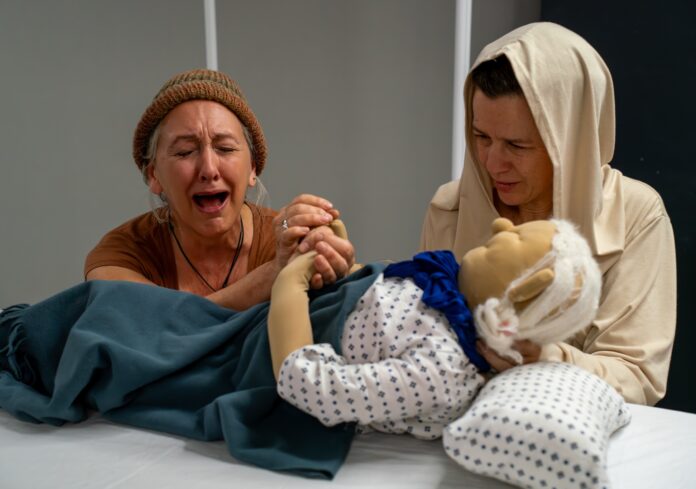
It was a bit out of the blue when I got an invite last week to a short-run show. I’d planned to spend the weekend running errands and taking some much-needed mental health down time, but I’ve come to recognize why local artists seek out me specifically to take a look at their work. So, that’s how I wound up in the rec room of a senior community center to see a brand-new play about end-of-life care. With puppets.
I figured I was finally ready to see such a piece. Before I wound up paying too much rent for an unheated room in a Sunset flophouse, I lived with family members, one of whom died shortly before we were all kicked out of the house. Caring for an octogenarian with deteriorating health isn’t something the average person is trained for, and it’s an experience I wouldn’t want to repeat if I didn’t have to.
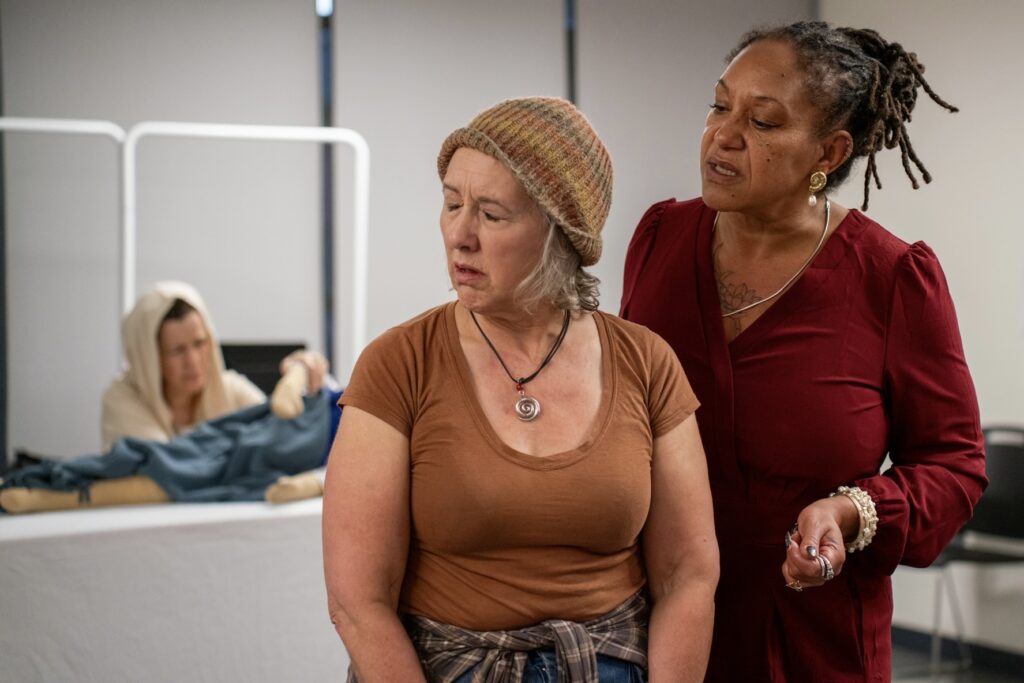
As someone who has to review a lot of art on a regular basis, I’m actually pretty grateful that the topic hasn’t come up too often, as it’s still a sensitive spot for me. Sure, there’s been the occasional Alzheimer’s comedy at Berkeley Rep, but this piece—Elizabeth Gjelten’s Lay My Burden Down, part of the San Francisco International Arts Festival, which ran May 8 and 9 at Ruth’s Table—actually benefitted from its smaller scale.
It was the story of Mama Vim, a woman near death (puppeteered by Sheila Devitt) being cared for by lawyer Diana (Cat Brooks). Knowing that Vim isn’t long for this world, Diana’s kicked over every PI stone she could to find Phoebe (Valerie Fachman), Vim’s off-the-grid daughter who hasn’t seen her ex-con mother in 40 years. Oh, and Diana and Phoebe used to be a couple way back when. Toss all of that into a story about repressed sexual trauma and the callous US healthcare system—and that’s before Bobby Brainworms Jr. made it even worse—and you have a rather squirm-inducing 90 minutes to sit through.
But it was a necessary journey for me to personally take. Having known Val Fachman for years, I surmised she’d bring an energetic neuroticism to the bi-polar Phoebe; and I so often think of Cat Brooks more as activist that I forget how great an actor she is. (I think the last thing I saw her in was Shipping & Handling?) So, the duo’s “tennis match” chemistry is a helluva thing to watch up close.
What induces the squirms isn’t just the talk of repressed trauma and racism (as well as the fact that Diana and Phoebe’s early relationship was an age-of-consent “gray area” common in the ‘60s and ‘70s), but the fact that everyone feels the need purge themselves before Vim leaves this world. What little dialogue the puppet has mostly consists of painful moans, but she has to listen to her prison-era apprentice and her estranged daughter lay their titular burdens down. For them, there’s catharsis; for her, it’s just cruel. If you’ve ever been in rooms where this conversation has happened, the verisimilitude is bound to sting.

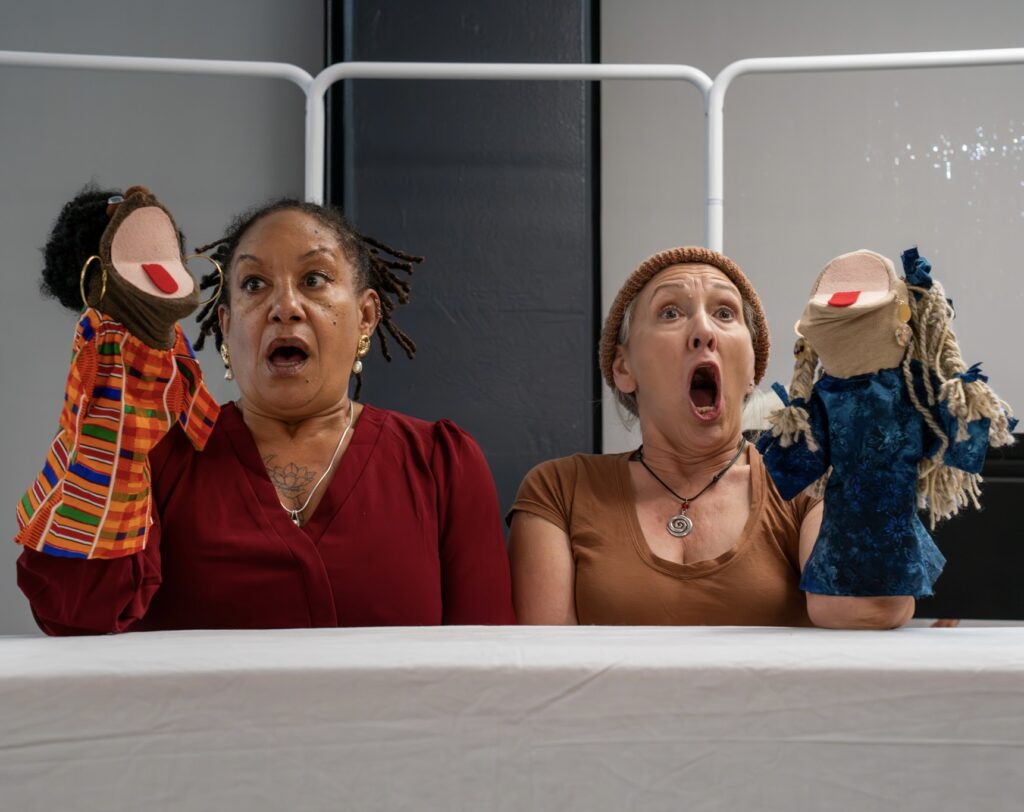
Yet, if they don’t let it out now, when will they? Vim is directly related to the duo’s trauma: She killed Phoebe’s preacher father for molesting their other daughter, which left Phoebe with one parent dead, another incarcerated, and her remaining family in the wind. As a teen, she runs away with aspiring singer Diana, but the latter’s activist-infused music (only briefly hinted at in their own sock-puppteered flashbacks) may send the wrong message to someone dating a white girl.
Cut to law student Diana interviewing prisoner Vim when both are caught up in a prison riot. In short, that’s a lot of personal baggage to carry around for four decades, but when is “the perfect time” to let it go? And who’s to say what should and shouldn’t be let go? In the days since watching the play, I still have conflicting thoughts, but it was intriguing to watch.
It was also nice to see that I wasn’t the only one masked in that tiny rec room. With Covid, measles, H5N1, and now hantavirus floating around (to name but a few), I’m glad nearly half the audience took care for the sake of the venue’s elderly residents. In fact, an audience member seated next to me saw my Flo Mask and asked if I’d be more comfortable if she masked, too. I said it was entirely up to her (as I rarely try to convince people anymore in COVID Year 7), and she gladly did. CO² levels on my Aranet4 peak around 1,789ppm by the final bow.
I was surprised to get the invite to Lay My Burden Down, and even more surprised by how deep it cut. It’s as much an admonishment of poor US healthcare and our medieval-style prison system as it is a compelling drama about unacknowledged trauma. It’s too bad it only ran one weekend, as it’s still under my skin. Then again, it’s one of stories that’s good in a way that I’m cautious before seeing it twice.

Hell’s Kitchen at The Orpheum
It’s weird, but I kinda thought Alicia Keys’ career was too young for her to get a jukebox musical. Pondering the genre, my mind immediately went to Broadway hits based on songs by Gloria Estefan, The Temptations, and Neil Diamond. But seeing as how Keys has now been at this for 25 years—yes, “Fallin’” first dropped in March 2001— I guess Hell’s Kitchen (through May 24 at the Orpheum, SF) contains enough material to be nostalgic.
It certainly must be for Keys, what with the story being a none-too-subtle roman à clef about bi-racial HK resident Ali (Maya Drake) living with her overly-protective white mother (Kennedy Caughell), falling under the tutelage of a gifted pianist (Roz White), and meeting all manner of colorful characters in the infamous borough, including a romantic interest that also sees that age of consent lines blurred—what the hell?

Keys’ songs are as entertaining as ever, but they’re all awkwardly jammed into Kristoffer Diaz’s “totally not trying to be In the Heights” script. Said script aims too earnestly to render all of its characters angelic, which makes them not quite real. If HK had a tourism board, this musical would be their calling card. The cast are all excellent singers with show-stopping moments, but the acting can be scattershot.
Still, if all you’re looking for is Alicia Keys karaoke in a venue with great HVAC (CO² levels only peaked around 773ppm by the final bow), then Hell’s Kitchen will deliver. It’s not as offensively hagiographic as the last Orpheum show I saw, but it doesn’t break the mold either.
HELL’S KITCHEN runs through May 24 at the Orpheum Theatre, SF. Tickets and further info here.