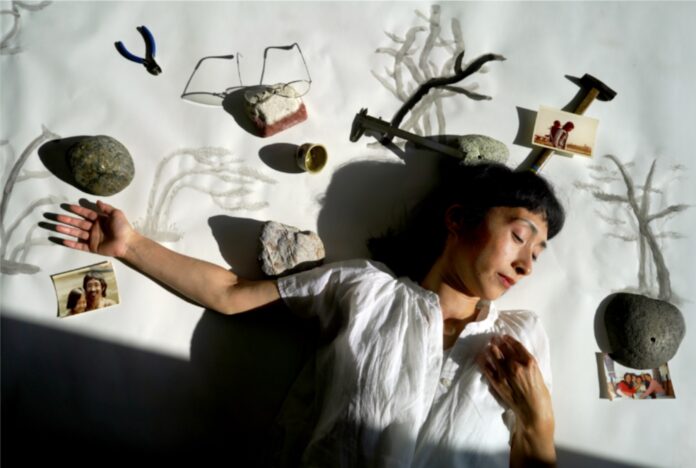
At some point in our lives, we all begin to grapple with the death of loved ones. For San Francisco contemporary dancer and choreographer Marina Fukushima, the loss of her father a year and a half ago is even more complicated. Having collaborated with both her parents, first in a piece called Family Seasons in 2016, then again in Relative Audience in 2023, she wasn’t certain when she would be able to make new work amid her deep grief.
Marina’s parents were both artists, but not dancers. “They were open-minded enough to be on stage with me,” she acknowledges in an interview with 48hills. A native of Yamaguchi, Japan, Hiroki Fukushima worked in metal—mostly iron, copper and aluminum—to make both free-standing and hanging sculptures. After moving to the Bay Area in 2012, he worked in sculpture and taught blacksmithing at The Crucible in Oakland. Her mother Michiko Fukushima, born in Tokyo, was a ceramic and visual artist and a teacher specializing in Chinese painting and drawing. She had a background in jewelry and doll-making, which influenced her work in fine arts, and she also worked and taught at The Crucible.
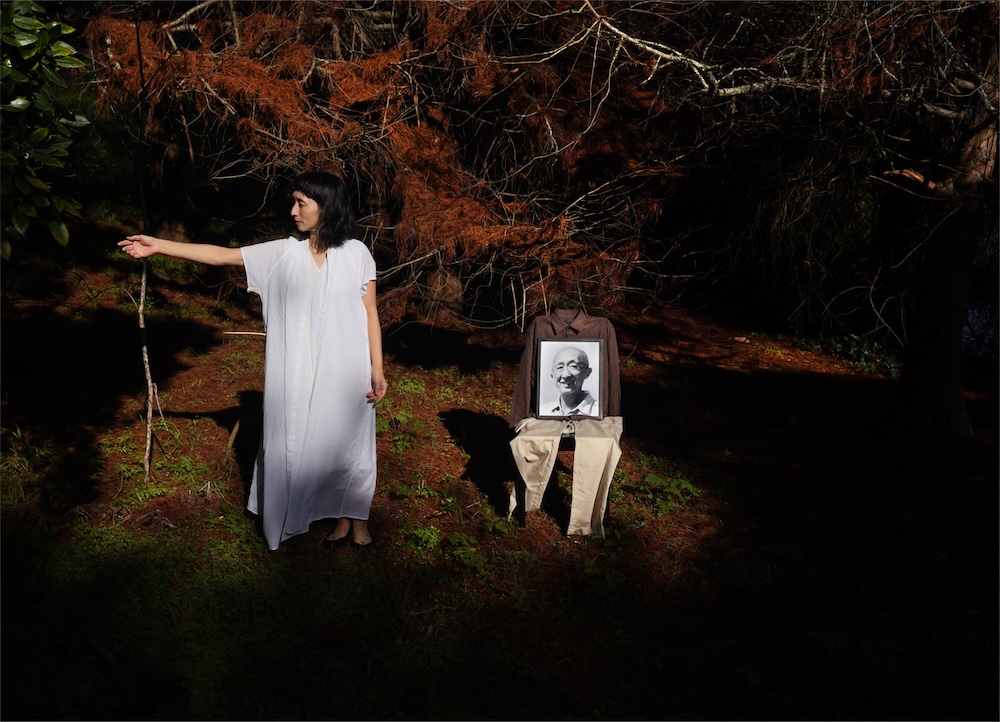
Fukushima’s latest piece, Memento Forest—katami (形見) (Fri/5 and Sat/6 at Theatre of Yugen at NOHSpace, SF), is very much “my personal journey”, she confesses. “I was overwhelmed with so many things that he [my father] left, including objects, emotions, even people—my mother—to take care of. Whenever I see the places, it’s so many memories and I feel like I was in the forest. It seemed to be comforting also, yet I was really lost. The best thing is if you can use a memento, that’s really the best way. You can actually give some of the mementos to somebody to be used, or you can throw them away.”
“So, I was thinking that all the things my father left has a purpose. So, I wanted to use them. Even emotions are a trigger or inspiration for me to do something, and that made me motivated to make this piece,” she continues. “I wasn’t sure—I felt like I couldn’t make a good piece. I was not ready because it was too emotional, but I felt like it could be a good process for my grieving and it gave me the drive to do something. Bringing people into this process was quite surprisingly helpful for me. I saw how beautifully people opened up. I felt like it was not only about my father, so they helped us to make a workshop.”
A series of workshops titled “Memento Archive—First Rainbows” was developed through the Japanese Cultural and Community Center of Northern California and Kokoro Assisted Living.
“We just opened up about each individual story,” Fukushima explains, “and then bringing mementos, and using a pretty simple score, people were really open, and we were able to share something deep. In Japan, from what I know, there is a grieving process, not only personal but also communal. There are many rituals and practices where you don’t really talk about the details, but you do some actual rituals every summer, winter, spring, and fall. I think it is helpful to do this process together. I didn’t really have that sense, but somehow my instinct told me that working with that community might be enriching for this piece.
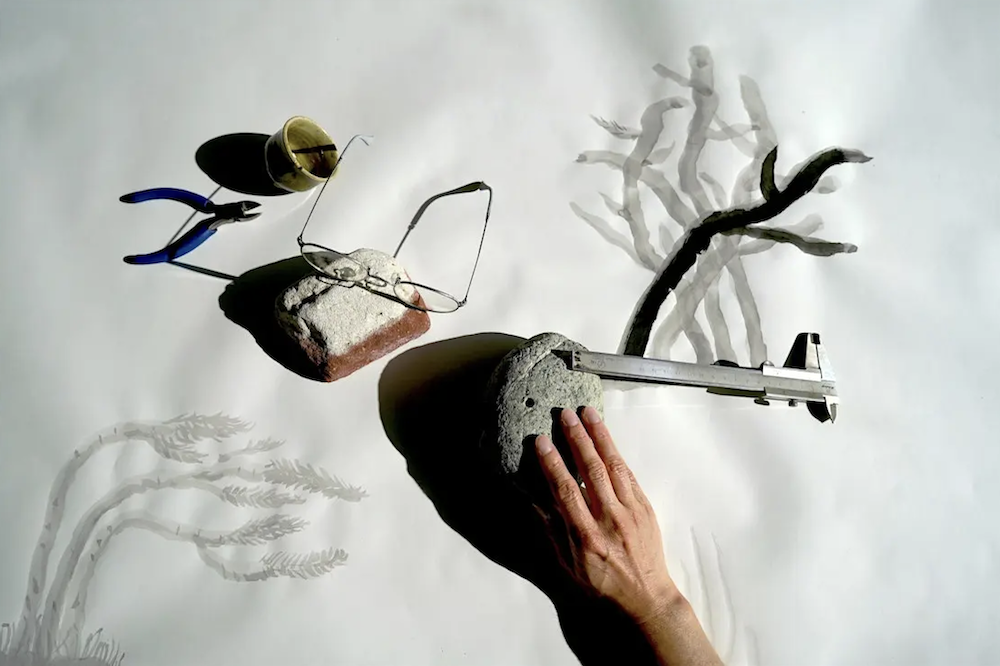
“At the workshop, we also talked about how such personal peace can become public peace,” she says. “There’s not one answer to it, but for the creators to open up that conversation to the participants who wanted to bring their memories of their loved ones to the table, that was really creating a safe and healing place in the community, too.”
For this writer, watching a rehearsal at Theatre of Yugen’s NOHSpace was a profound experience. Isak Immanuel’s scenic design with Hiroki’s mementos and sculptures, and Michiko’s drawing and performance for video contributed immensely to the atmosphere. Overlaying static photos and film sequences, interspersing ambient sound with silence, alternating movement with stillness. Trees trembling in the breeze, dried plants casting delicate shadows on the walls, stones resting stoically, and an empty chair holding a photo of the person who used to sit there. The entirety of the piece allows the viewer be immersed in an environment in which each person will react in their own personal way, while also having a sense of a shared experience.

The artist gets the last word in as she dissects the meaning of the title of the piece. The “memento” and “forest” are obvious, but the word “katami” remains ambiguous. “When written in Japanese with Chinese characters, kata means ‘shape’ or ‘form,’ and mi means ‘to see,’” Fukushima explains. “What are we seeing or feeling through these shapes, forms, and memories? For me, they have become a source of inspiration, resilience, and support.”
MEMENTO FOREST—KATAMI (形見) June 5-6. Theatre of Yugen at NOHSpace, SF. Tickets and more info here.