On Wednesday, July 15 the SF Police Commission approved a $3 million gift from the San Francisco Police Community Foundation (SFPCF), Silicon Valley billionaire and surveillance enthusiast Chris Larsen’s nonprofit. The Board of Supervisors will vote next week on the issue.
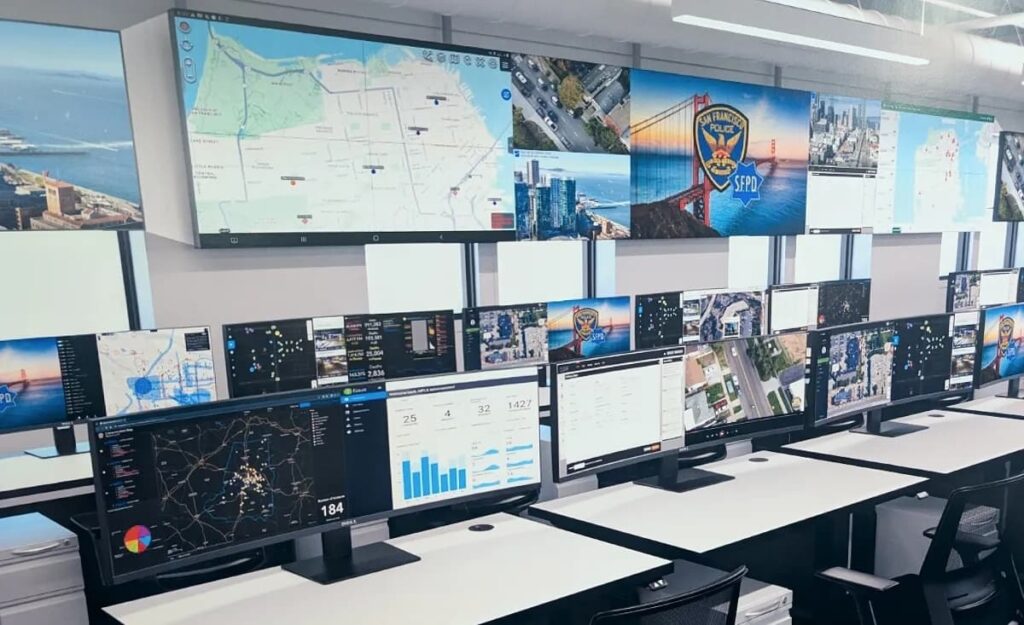
SFPCF is the same venture Larsen used last year to donate nearly $10 million to support the San Francisco Police Department’s Real Time Investigation Center (RTIC), a centralized surveillance policing hub that tracks license plates using hundreds of street cameras and dozens of drones. Notably, the RTIC is housed in a building complex partly owned by Donald Trump; Larsen’s Ripple Labs leases out the space to the city “rent free” for the investigation center.
The gift will be dispersed into roughly $1 million allotments over three years. According to the resolution, roughly $540,000 will go to purchasing “two drone docking stations,” roughly $375,000 will be for “counter-drone technology” and the remaining $2.085 million will be for RTIC tech, software and infrastructure including “hardware purchases, upgrades, maintenance, and replacements; software licenses, subscriptions, upgrades, and maintenance; facility-related technological enhancements.”
Larsen’s recent donation is striking, given the extensive privacy and security risks posed by San Francisco’s drone program and the city’s Flock cameras.
In mid-July, WIRED reported on an extensive leak of the drone footage from the city’s first responder program. That reporting detailed the pervasive powers that San Francisco police now have, and the inherent risks that come with such sweeping power.
Two security researchers were able to watch the feeds of five surveillance drones in real time, from take off to landing, without bypassing any encryption. Said researchers were also able to access the police pilot’s names and email addresses on the public host site.
This breach came from SFPD’s misuse of the Skydio (the company that makes the city’s drones for the first responder program) software. Skydio generates sharable links to its drone’s feeds and one of those links was shared to the open internet last December with a 12-month expiration. Thus, five of SFPD’s drones have had their feeds easily accessible on the internet for more than seven months.
The city’s drone as first responder program is run through the RTIC. As is the data from the city’s 400 Flock ALPR cameras.
A police audit recently revealed 299 illegal searches of San Francisco’s license plate data over a year—and this is not the first instance of legal violations. The Standard reported out of state agencies accessed the city’s Flock data 1.6 million times between 2024 and 2025. San Francisco inked its contract for 400 of Flock’s ALPR cameras in March 2024.
Larsen’s penchant for surveillance is well-documented. He is the harbinger of a new era in San Francisco, one less muddied by the oversight of earlier eras. Post 2020, San Francisco has shifted from a city on the forefront of surveillance regulation into a laboratory for it, and Larsen has led the charge. He spent more than a quarter million dollars to propel Prop E into reality, which eliminated most of the regulations around police powers and surveillance in San Francisco.
This most recent donation is in keeping with his overall goal, namely to foster this new, reactionary era for San Francisco and continue the expansion of the surveillance state.