On July 7, the Board of Supervisors took a monumental step towards actualizing a decade long project—a San Francisco Public Bank. In a 9-2 vote the supervisors approved a City Charter amendment that, if voters approve, would set up Municipal Finance corporation and Public Bank.
San Francisco has the potential to set an incredibly powerful standard, wresting financial control from predatory institutions like Bank of America (where the city’s General Fund money is currently kept) and into the hands of the people.
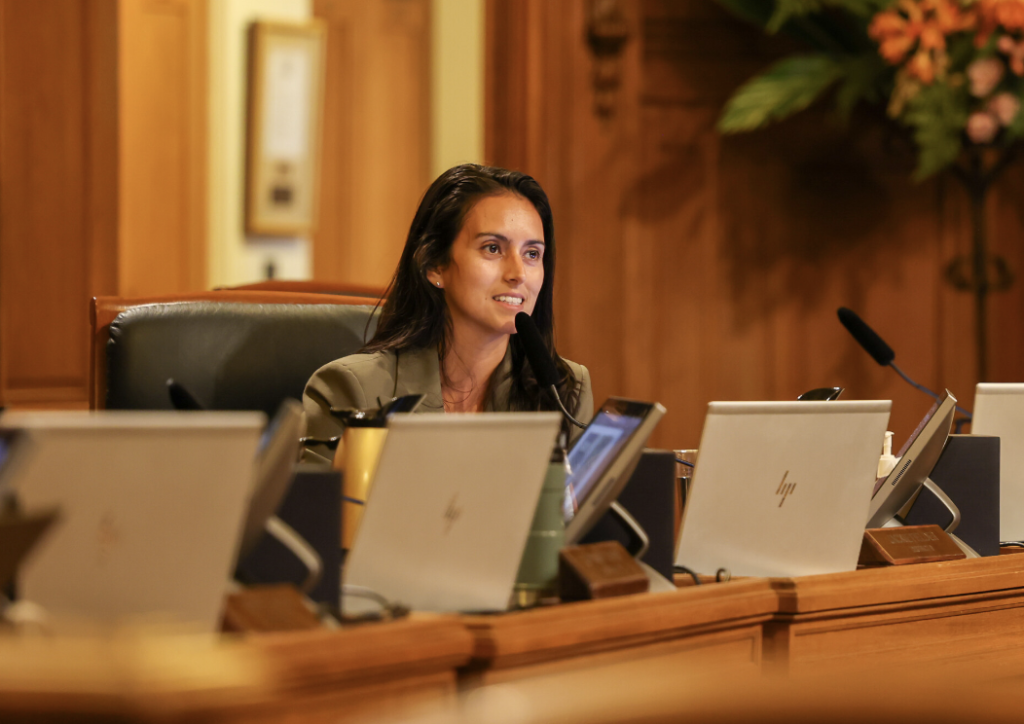
A San Francisco public bank would provide financial support for small businesses and eventually consumer services that BofA and other such companies never would.
“One of the really exciting possibilities is a transition to worker ownership and the current finance system is not really set up to facilitate that flexibly,” Misha Steier, spokesperson for the SF Public Bank Coalition told 48hills.
The arduous process, still in its inception, started in 2017. Organizers in San Francisco, including current District 9 supervisor Jackie Fielder, were disturbed by the municipal misalignment with the city’s values. Her experience protesting the Dakota Access Pipeline brought the reality of climate change into focus and pushed her to begin organizing for more democratic control over the city’s money.
“This is a tool in our tool box that leverages the public infrastructure of SF to support economic development and small business as well as affordable housing and renewable energy,” Fielder told 48hills.
Currently, San Francisco puts its roughly $13 billion of operating money into Bank of America. That money is then used to finance fossil fuels, weapons manufacturers and other hyper extractive industries. So, Fielder and other organizers bonded together to begin the lengthy process of taking back ownership of the people’s funds.
Thus, the San Francisco Public Bank Coalition was born. At the time, it seemed like a Sisyphean task—mostly because public banking was not strictly speaking legal in the Golden State. It took two years to clear that first hurdle, and in October of 2019 AB857 passed. The assembly bill was authored by current City Attorney David Chiu.
“Currently, a portion of our tax dollars go to some of the largest Wall Street banks in the form of fees and high interest rates. I think public banking could provide a more efficient and beneficial avenue to keeping the public’s money safe and investing in worthwhile community endeavors,” Chiu told El Tecolote at the time. “AB 857 is really about making sure that the public’s money is used to benefit the public.”
The next step came in the summer of 2021 when the Board of Supervisors unanimously passed the Reinvest in San Francisco Ordinance, authored by former District 5 Supervisor Dean Preston. That ordinance created a working group, staffed with both financial experts and local organizers, to assess both the viability and the mechanics of establishing a public bank. While that extended process was, at times, marred by some friction between the financial types and the organizers, the group eventually determined that a slow phase-in of an MFC was the most effective way to get to a public bank in the city.
Former District 1 Supervisor Sandra Fewer was also instrumental in getting the SFPBC off the ground.
“We have taken many steps towards a public bank during my three years on the Board of Supervisors, but the next step necessary to move this project forward is the development of a business plan,” Fewer told El Tecolote in 2019.
Now, that business plan is in development.
“Once the funds are capitalized, to bring about an official MFC and eventually a public bank, we’ll have the ability to really make this city affordable,” Fielder said.
Affordability is often at political odds with viability, at least when it comes to any redistributive policies. A single-payer health care system is decried as too expensive, building adequate affordable housing is seen as untenable because there’s not enough money to finance it. With the public bank, San Francisco has the potential to show that in fact affordability is viable and that political will, rather than functionality, is the largest impediment.
“With financialization you just see every available dollar has to account for the potential profit it could earn otherwise. Everything is facing profit and all the money that could go towards meeting people’s needs, the vast majority of it goes towards enriching people,” Steier said.
A public bank offers more funding for affordable housing and renewable energy, and could provide small business owners lower interest rates loans. It would allow the city to empower local credit unions and small financial institutions that could further support working-class communities in the city.
The potential is overwhelming, but at this point it is just that. Compared to 2017 when I first wrote about the public bank, the city’s political landscape has moved to the right. Tech money has infiltrated local elections and Mayor Daniel Lurie has repeatedly shown not just a willingness but an eagerness to strip social welfare programs down to bare bones, if not eradicate them entirely. Political positions once taken as standard, like supporting the unhoused and expanding affordable housing, are now constantly challenged by so-called moderate elected officials.
Notably, the only two dissenting votes last Tuesday were Supervisor Sherrill of District 1, a grad-school classmate of Lurie, and Supervisor Alan Wong of District 4, a Lurie appointee.
Given the city’s move to the right and the ever-expanding political push of San Francisco technocrats, now is a pivotal time to take back democratic control of city funds.
“The best time to start a public bank is 20 years ago,” Steier said. “the second best time is now.”