
Update: Since this piece was published, Saikat Chakrabarti has endorsed Connie Chan in the Congressional race.
—-
The San Francisco election results are pretty much final, and as the later votes were counted, state Sen. Scott Wiener continued to lose ground. With all but a few thousand voters in, he’s now just under 41 percent, with Sup. Connie Chan close to 30 percent.
Saikat Chakrabarti is at 17.8 percent. None of the other candidates are factors in the race, and they won’t be factors in the November runoff.
The Chron noted after Election Day that Wiener had won most of the city’s precincts, except on the far West side of town. But if you look at the map a bit more closely, a very different narrative appears.
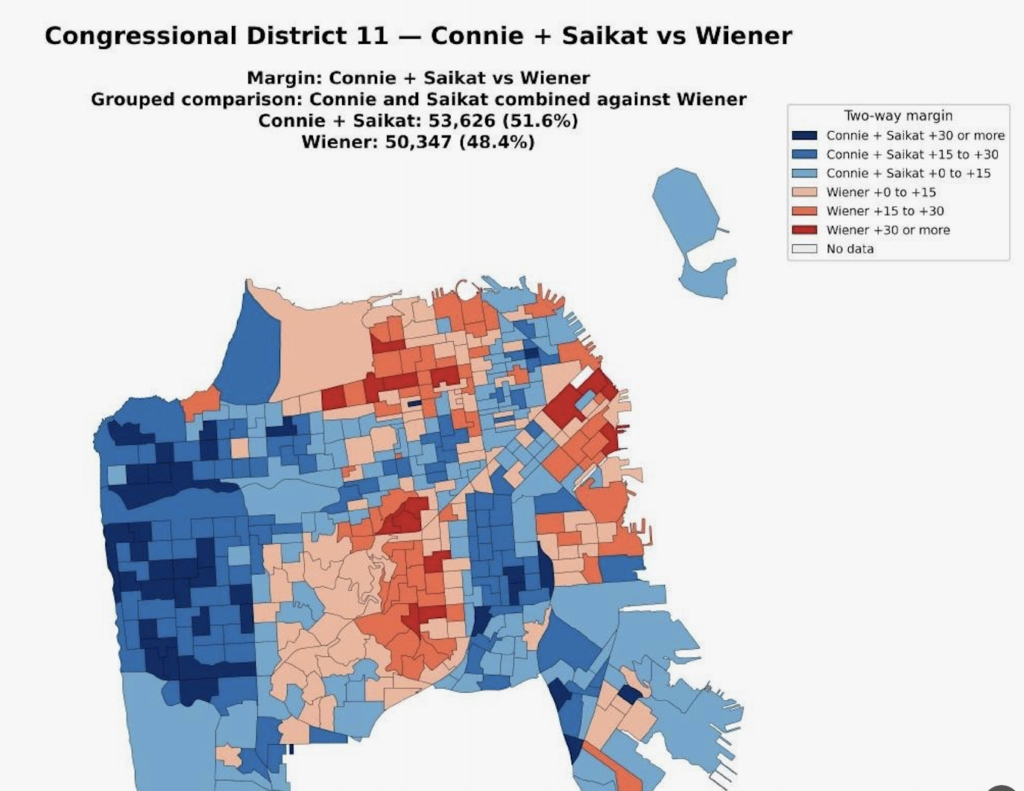
If you add the Chan and Chakrabarti votes together, Wiener loses district-wide by seven points, 47-40. The combination of the two candidates who aren’t Wiener leads in the majority of precincts on both the East and the West side of town.
The turnout in the traditionally progressive areas was fairly low, and that will be a factor in November. I don’t see folks on the left getting motivated to go vote for Xavier Beccera for governor (if Steyer were in the race it would be very, very different). So the final outcome will not be just how people vote; it will be about who votes.
Chakrabarti told me before the election that if he came in third, he would endorse Chan. Neither campaign has made any formal announcement yet, but I am told by a very reliable source who is not employed by either campaign but has a long history in local progressive politics that he is, indeed, planning to follow through on that promise.
Combine Pelosi’s fundraising power (I’ve already gotten a fundraising text from her) and the possibility that most of the Chakrabarti voters will now shift to Chan, and you have a very, very competitive race.
Our next member of Congress is going to be very different from Nancy Pelosi—and not just in Washington DC.
The late Phil Burton, who represented much of the city when I first moved here, kept an eye on local politics. He was a San Francisco guy, who moved here as a teen, went to George Washigton High School, and cared who ran his hometown. He helped George Moscone get elected mayor; he helped Willie Brown get into the state Assembly. He made sure his allies controlled the Democratic County Central Committee. (He also helped Art Agnos defeat Harvey Milk for Assembly in Milk’s first campaign.)
Pelosi, not so much. She was raised in Baltimore, the daughter of Tom D’Alesandro, Jr, who served in Congress and was later mayor. He was the son of a previous mayor; her family was Democratic Party royalty in that town. Then in 1963, she married Paul Pelosi, a real estate developer, and they moved to San Francisco, where they started a family. She got involved in politics through the state Democratic Party, mostly as a fundraiser; she never held local elective office, never worked on a local campaign, never even served on the local DCCC.
When she was elected to Congress, she immediately moved her sights and energy to DC, where she very effectively joined the party leadership and eventually became the first woman speaker. Good for her. But I never got the impression that she cared all that much who ran San Francisco; there was no “Pelosi machine,” and she rarely did more than make a token endorsement in a local race. She brought money home to her district, as any good member of Congress does, but mostly she was focused on national issues.
Wiener and Chan are very different. Wiener came to San Francisco from the East Coast in 1997, and immediately got involved in local politics. He volunteered on campaigns, chaired the Alice B. Toklas Club, and got elected to the DCCC, before running for supe.
Chan arrived from Taiwan in 1991 at 13, learned English in the public schools, and spent most of her career working in public-service jobs. She was an aide to Sup. Sophie Maxwell, DA Kamala Harris, and Sup. Aaron Peskin before getting elected to the board.
Both have deep, strong ties with local politics. Neither is going to forget or abandon those connections if they go to DC.
Wiener is very much part of the so-called “moderate,” neoliberal, Yimby establishment. Chan is very much part of the progressive, labor, and neighborhood community.
So a vote for Wiener is a vote for giving more local influence to his allies, who currently run the city. A vote for Chan is a vote for someone who will work to support progressive candidates and causes. Either will have vast resources to draw on.
Wiener and Chan have different national agendas, but the outcome of the November race in San Francisco won’t determine control of Congress; both candidates are Democrats. It will, on the other hand, help determine the future of politics in San Francisco.
Full disclosure: My daughter works on the Connie Chan for Congress campaign.