After a beleaguered summer, the Georgia-based surveillance company Flock Safety is changing tactics. The CEO, Garrett Langley, spoke to San Francisco media about changes his company made in response to wide-ranging criticisms about data sharing and police abuses.
Langley’s response may also reflect a diminishing bottom line.
A handful of cities are ending Flock contracts and switching to other operators, namely Axon or Motorola. Stanford University recently ended its contract with Flock and hired a different operator, Genetec. The contract cancellations came on the heels of widespread, bi-partisan push back centered on the various abuses by law enforcement and Flock’s facilitation of data sharing with federal agencies.
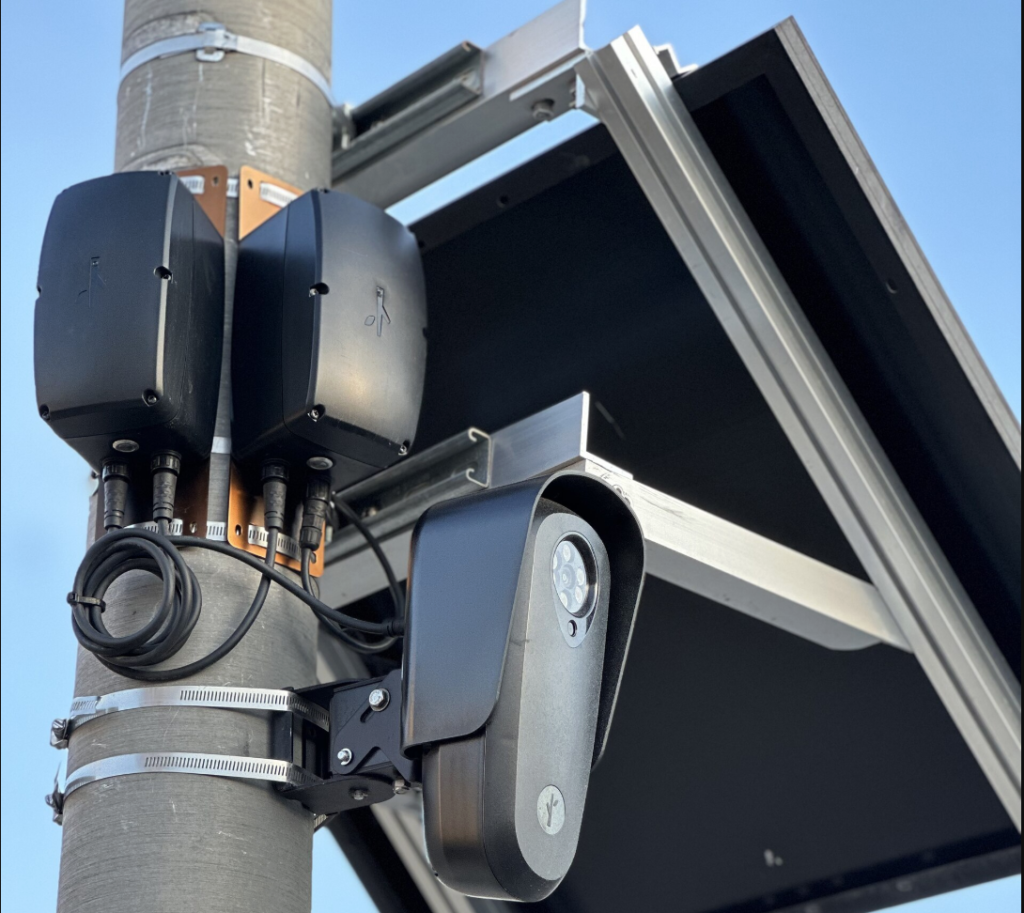
Most of the cities that have switched from Flock cited data sharing issues, specifically with Immigration and Customs Enforcement or Customs and Border Patrol, as a reason for the change.
Flock’s national database became a point of condemnation in city council meetings and protests throughout this populist pushback.
Alternative operators—Axon, Motorola, Genetec and others—are grappling with the same problem. These vendors offer cities and police departments a vertically integrated surveillance system, encompassing both the cameras and drones used to record footage and the tools used to analyze it, housed under one pane of glass. These centralized platforms boost the companies’ bottom lines and are a main tenet in the prevailing critiques against Flock, and the surveillance state more broadly. The more recent integration of AI into these command centers allows users to analyze the mass of data much more simply, and easily keep tabs on a person from the moment they leave their house.
Axon, a company that at least six cities switched to this summer, hosts a platform that it designed to integrate camera feeds from across all its devices and access private security camera networks to create a live-feed database for law enforcement. Motorola, an original player in the market, promotes its “Mobile Companion” that provides law enforcement officers with Automate License Plate Reader technology on their phones and has already shown to have troubling data-sharing standards as Flock. Genetec hosts the Cloudrunner Portal replete with a system called Clearance that allows for evidence to be “quickly and securely … shared with authorized stakeholders, thereby saving time and speed-up investigations.”
While the recent pushback against Flock can be accurately categorized as a simmering popular revolt, elected officials and industry leaders have been quick to divert the righteous anger into one singular operator. But the problems with Flock are representative of the problems with the existing surveillance state as a whole.
“One thing I can say is that where Axon and Flock have become competitors isn’t just in the license plate reader space but in the fact that both are building master platforms,” Matthew Guariglia, Senior Policy Analyst at Electronic Frontier Foundation, said. “They merge and fuse all the data that do the analysis for officers, that is capable of merging information from a bunch of different sensors and sources.”
Flock’s recent public relations problems have been a boon to Axon and its billionaire CEO Rick Smith.
Officials in Knoxville, Tennessee, approved a $9.4 million amendment to their existing Axon contract this summer. Similarly, Douglas County in Colorado ended its Flock contract in July and signed a roughly $22 million contract with Axon, as reported by 404Media. The company also inked a $220 million deal with ICE this year. Notably, President Trump disclosed a $1 million to $5 million stake in Axon two weeks before the ICE deal.
“I think that’s one of the things, when people are moving to Axon or thinking about moving to Axon, it’s not any of these single devices anymore, just body cameras just drones, just license plate readers, just fixed surveillance cameras, it’s all of these things are being integrated and the analysis that can be done on these cameras is pretty extensive at this point,” Beryl Lipton, senior investigative researcher at EFF said. “It’s similar to Flock at this point.”
In the late 1960s, a researcher at NASA developed the taser as a nonlethal option for law enforcement, but sales were generally poor. Nearly 30 years later, Rick Smith and Tom Smith founded TASER International in their Scottsdale garage. The 1990s and early aughts were tough for the company as it struggled to achieve profitability, and took a $1.5 million loan one month before its May 2001 IPO. This changed by 2003 as the company began paying police officers for training on its devices.
“Axon got in with tasers and everybody has their body cameras now and then they provide more and more products,” said Brian Hofer, chair and executive director of Secure Justice.
Five years later, the company, now under its new name, debuted the first body-worn camera, called the Axon Pro. The body-worn camera and its footage were critical evidence in the 2009 police killing of Eric Berry. The officer in that case was exonerated and, shortly after the trial, helped promote the Axon Pro.
With the continued expansion of the company both domestically and abroad, Axon debuted its AI-assisted mobile license plate reader, the Fleet 3, in 2019.
The advent, now ubiquity, of AI-integrated surveillance tech created an unprecedented opportunity for vendors, Hofer explains. “No human is going to remember 100 different data points about Brian Hofer, but with AI you just click and connect the dots, and it summarizes it for you. That level of analysis that we’ve never had before in human history, that puts on a whole extra layer of insight, of invasiveness.”
Over the past seven years, other vendors have caught up. Early this year, Motorola rolled out its so-called “Assist Suites” product, which provides departments with AI-assisted role-based packages. The “Real-Time Operators” suite notes officers can “Find target vehicles quickly using context-sensitive AI-powered natural language search.”
In California and across the country, federal agencies accessing local license plate data has ignited the ire of many citizens. Despite claims from some city officials that Axon does not share license plate data, it functions on the same basic principles as Flock.
“While it’s true that Axon does not have a labeled tool called national lookup, I think it’s a distinction without much meaning,” Hofer said. “Just because you don’t call it a national lookup doesn’t mean you can’t achieve the same thing…There’s nothing prohibiting you from still granting access to all these different agencies, they just call it something different.”
Given the prevalent concerns around Flock’s data security, specifically regarding its National Lookup Tool, and other vendors’ similarly-styled products, competitors like Axon will likely face similar issues over its Fusus product.
In spring 2022, Axon announced a partnership with Fusus in a poorly formatted press release. The statement notes that the Fusus command center — the Real Time Crime Center in the Cloud, as they call it — is designed to aggregate “live feeds from public and private cameras, including closed circuit television,” as well as the Axon devices.
“We see, in general, all these companies are attempting to outsource one another for how many different data streams they can get onto this master Fusus platform,” Guariglia said. “One of the ways that Axon has tried to do it, and the acquisition of Fusus was clear in this, was they want to try to leverage as many private community cameras as possible, to be an extension of police surveillance.”
This leveraging of private cameras, called the Community Connect program, allows for business owners, HOAs and other private organizations to opt-in and allow law enforcement to view their feeds directly.
“Fusus has the ability to truly enable a city-wide mass surveillance system because you can plug in all the Business Improvement districts, the HOAs, the private license plate readers, your repo drivers, your BART/AC Transit Muni cameras, all your public transit cameras, the drone footage, live streaming video, you can integrate that all in there,” Hofer said. “So the cumulative impact of all that data, the ability to profile, that level of privacy invasiveness is massive.”
These myriad private camera feeds are then brought together in a singular command center much like San Francisco’s Real-Time Investigation Center . A centralized location became a key marketing point for these vendors with the rise of inter-operability.
“That’s how Fusus got so popular, real time crime centers abound. My career started back in 2014 fighting the proposal for a real-time crime center in Oakland,” Hofer said. “That was kind of the old days. Now, they’re everywhere, they’re ubiquitous. And Fusus, not that I’m pro Fusus, but it did a really great, elegant job of coding, creating this platform that is interoperable with just about everything I’ve looked at.”
With costs of production and data storage declining, the introduction of AI has allowed vendors to offer a vertically integrated system, from the hardware mounted on city stoplights to the software searching through the footage. Beyond just that, the footage the AI reviews can then be used for training.
“Once you are able to store that much more data, you’re actually able to use that data to train the AI, which is constantly hungry for data, so I think that is also part of it, that law enforcement agencies also had a lot of data and so AI,” Lipton said. “It both can feed the AI and the AI can be used to go through the data again.”
The AI integration is not limited to investigations. In fall 2025, Axon announced it would acquire the Israeli company Carbyne, which hosts an AI-emergency response platform. Carbyne, formerly called Reporty, was co-founded by former Israeli Prime Minister Ehud Barak and received a $1 million investment from Jeffrey Epstein in 2015, facilitated by Barak.
Despite what some city officials have claimed, functionally Axon offers the same vertically integrated, widely-shared, AI-powered database as Flock. A dragnet of this magnitude gives users incredible power that is, as is well-documented now, easily abuseable. The consequences of this kind of mass surveillance far outweigh the benefits, regardless of what company is providing it.
In September, 2004, Motorola debuted a now-legendary cellphone, the RAZR V3, that swept through suburban communities like local rap music. Roughly a year later, the company debuted a mobile ALPR system, similar to Axon’s Fleet 3, designed to be mounted in police vehicles: At the time, it was a revolutionary addition to law enforcement’s toolkit. Four years later it was upgraded and redesigned to be more compact.
“Before Flock, Motorola was the largest license plate reader company and it was only in the last eight or nine years that Flock was able to surpass them,” Lipton told 48hills.
In 2019, with the $445 million acquisition of a Livermore-based video management company, Motorola folded the law enforcement analytics Vigilant Solutions into its portfolio. Vigilant Solutions has provided extensive logistical support, and data, to ICE.
“Motorola acquired Vigilant Solutions. I had a hearing here in the East Bay a number of years ago, Vigilant had supplied agencies like ICE with license plate data for at least ten years, maybe more,” Hofer told 48hills.
Shortly thereafter, in 2020, Motorola announced the addition of an analytics program to the in-car video platform. A year later, Motorola rolled out the M5000, an AI-equipped HD license plate reader (LPR). Similar to Flock’s national look up tool, Motorola offers customers its National Vehicle Location Service which performs the same functions as Flock’s national look up tool.
While Motorola’s lineup of LPR devices is fairly similar to Axon’s, some key distinctions include an LPR app for the cellphone called the Mobile Companion App, a software called LinC that can transform “any existing video cameras and networks” into LPRs, and an analytics tool called VehicleManager that takes LPR data and draws “connections to frequented locations and other vehicles.”
Notably, Motorola was named in a class action lawsuit this May because of state law violations, in Illinois and California, related to its license plate readers. That complaint notes that Motorola “failed to maintain reasonable security procedures and practices, including operational, administrative, technical and physical safeguards to protect ALPR information from unauthorized access…”
In late July, ChicoSol’s Elias S. Myers reported that Chico was sharing its Motorola ALPR data with more than 80 out-of-state agencies—including ICE Enforcement and Removal Operations, Homeland Security Investigations and CBP—in violation of state law. According to that report, ICE had access to Chico’s data since February, 2024. After this revelation, Chico PD reportedly shut down its ALPRs in early July.
Again, the extensive examples of police abuse or operator misuse indicate that the problem is the technology itself, not the operator.
“I don’t think there’s a lot of meaningful differences as to the technology,” Hofer said. “Flock is on the newer end of the timeline but just like Axon, Motorola they’re trying to be this big vertical, a one stop shop to sell you everything.”