
The Chronicle this week did what news outlets typically do when they get access to a poll: They run with the top-level surface information. Sometimes, that’s all the pollsters or campaigns will give you, so you get a horse-race story, in this case state Sen. Scott Wiener has a narrow lead over Sup. Connie Chan in the Congressional race.
But the top-level data in a poll is often the least useful information, and in this case, the University of Southern California gave the public access to everything, including the crosstabs. You can find it here.
The poll was done entirely by email, which makes the results a lot less reliable: The sample consists of people who take the time to respond to a random poll request on their email. It almost certainly undercounts Chinese immigrants; the poll shows Asian voters supporting Wiener 59 to 31 percent, and that would be a radical shift from the primary. The data I have seen suggests that younger Asian voters who were born in the US and whose parents or grandparents were born in the US tend to support Wiener. The results from the June primary showed that older and more recent immigrant Chinese voters overwhelmingly supported Chan.
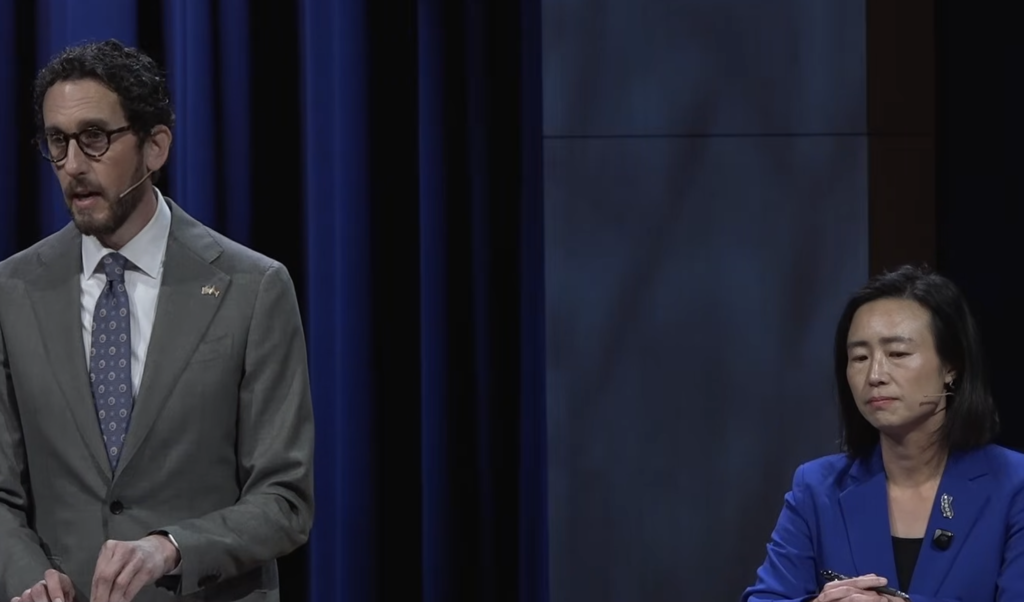
So at most, the poll showed a tied race. It might indicate a slight advantage for Chan.
But the pollsters asked about more than just Chan v. Wiener. Here are some of the things we learned:
Only 30 percent of the respondents “strongly approve” of the job Mayor Daniel Lurie is doing, although 34 percent “somewhat approve.” He’s doing way better than Gov. Gavin Newsom, who wants to run for president: Only 18 percent strongly support him.
More amazing: Only six percent have a “very favorable” opinion of major tech companies in California. A full 25 percent have a “very unfavorable” opinion. And this is a sample in a tech-dominated city, in which only about 50 percent support a moratorium on data centers.
Despite the mayor’s relative popularity, 53 percent say local economic conditions have gotten worse. (Remarkably, 21 percent say things have gotten better; that means at least 21 percent of the people who responded to the poll are very rich; nobody else thinks the economy is improving, here or at the national level.)

Among female voters, Chan leads Wiener 52 to 43; male voters favor Wiener 60-35. People with incomes of less than $100,000 resoundingly favor Chan; people with incomes of more than $200,000 resoundingly favor Wiener.
The poll asked some other fascinating questions. Among the respondents only 45 percent had a strongly (17) or somewhat (28) positive opinion of capitalism. But 46 percent, a statistical tie, has a strongly (17) or somewhat (29) positive opinion of socialism.
Only 6 percent had a strongly positive opinion about the Democratic Party, which locally has been taken over by Big Tech. Only 37 percent had a somewhat positive opinion—in one of the most Democratic cities in the country.
The Democratic Socialists of America had a 14 percent very positive rating and 22 percent somewhat positive—meaning DSA is at least as popular as the Democratic Party.
We can’t have all that much faith in the results; the pollsters say the margin of error is 4.6 percent, meaning Chan and Wiener are tied. Some of the sample sizes in the crosstabs are too small to mean much.
According to the researchers, “The survey was offered in English, and respondents also had the option to take the survey in Spanish, Mandarin/Chinese, Korean, and Vietnamese.” That means a lot of people whose primary language is not English probably didn’t open the email—and Chinese-language voters are among Chan’s strongest supporters.
But in a city with few Republicans, there are some alarming messages for the mainstream of the Democratic Party as we approach the 2028 presidential election. There are also clear indications that voters think Newsom is failing, that the economy is bad—and that socialism might not be such a scary alternative.
Full disclosure: My independent adult daughter works on the Connie Chan for Congress campaign.