This is Drama Masks, a Bay Area performing arts column from a born San Franciscan and longtime theatre artist in an N95 mask. I talk venue safety and dramatic substance, or the lack thereof.
If public perception were to be believed, one becomes a critic is to get into events for free. I’ll admit, it’s a welcome perk when, like me, you’re both broke and poor. In recent years, my patronage of the arts has greatly depended on my getting comped invites to events I otherwise wouldn’t be able to afford. That doesn’t change the fact I’m there to tell the public whether the event is worth their hard-earned money. Several companies will gladly 86 you from the press list without a rave. I’m happy to say that my reviews represent someone who’d rather sit out an opening than fawn all over horseshit just to get quoted in the press materials.
The downside to all the invites is that you’re suddenly aware of just how much material is out there. I usually have a good time at Killing My Lobster’s Sketch on Speed and would love to attend the latest iteration this Saturday. Unfortunately, I’ll likely be across the bridge watching an avant-garde show. Until I get my hands on Hermione Granger’s time-spinner thingie, I’m stuck recommending (or steering people away from) more shows than I could possibly see. C’est la vie du critique.
It tends to linger with me because much of the work I review is that of indie artists and creators. I go into their work knowing that they’re often working with limited resources and renting a space that they only have for a limited amount of time. They’re under far more pressure to make the first impression count because they aren’t guaranteed a second. That’s also why it’s all the more worth celebrating when they succeed and all the more disappointing when they fail. It’s still not worth compromising one’s integrity to put over something you know to be sub-par.
So yeah, the comps are a great perk of being a critic. Being pleasantly surprised is an even better one. But supporting those who at least take risks is up there, too.
Diedrick Brackens: gather tender night and Conjuring Power: Roots & Futures of Queer & Trans Movements at YBCA
At the start of the press preview for these two art exhibits (both through August 23 at Yerba Buena Center for the Arts, SF), YBCA CEO Mari Robles said both were chosen as “an intentional inflection” upon the Center. If that’s her way of saying that opening artistic space is akin to a Native American land tax, I’d certainly say both are the least a colonizing power can do.
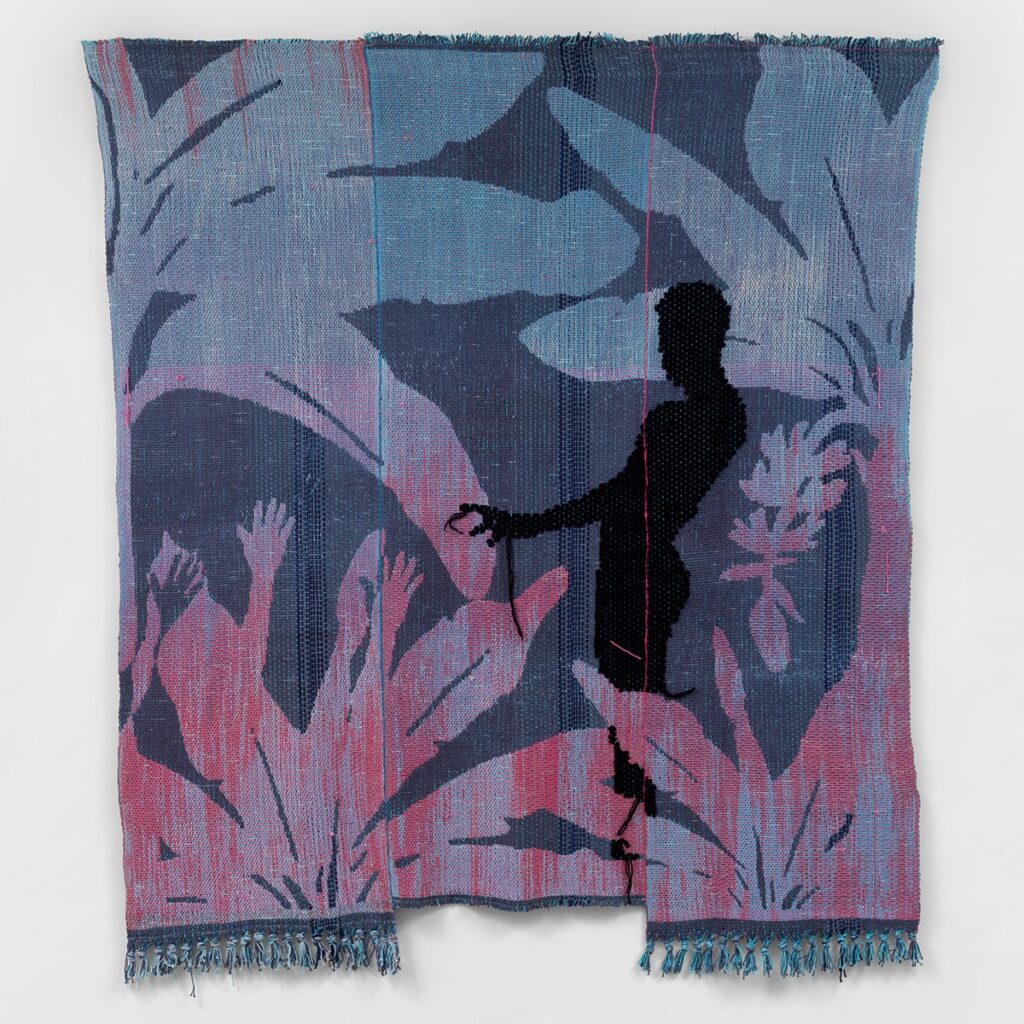
Our tour began with Diedrick Brackens: gather tender night, which brought the eponymous artist back to SF, where he says he “came of age.” Elaborate loom pieces—all made of hand-dyed cotton and acrylic threads—depict silhouettes of Black bodies against various backdrops. Although not all are available to be seen from both sides, Brackens tells us they are all double-layered, making the image of one side different from its counterpart. Doing so often makes the silhouettes disappear from the image which they so prominently occupied on the flip side. One piece, depicting a silhouette chased up a tree by rabid dogs, spurred thoughts of how much one longs to remove Black bodies from certain situations on a broader canvas.

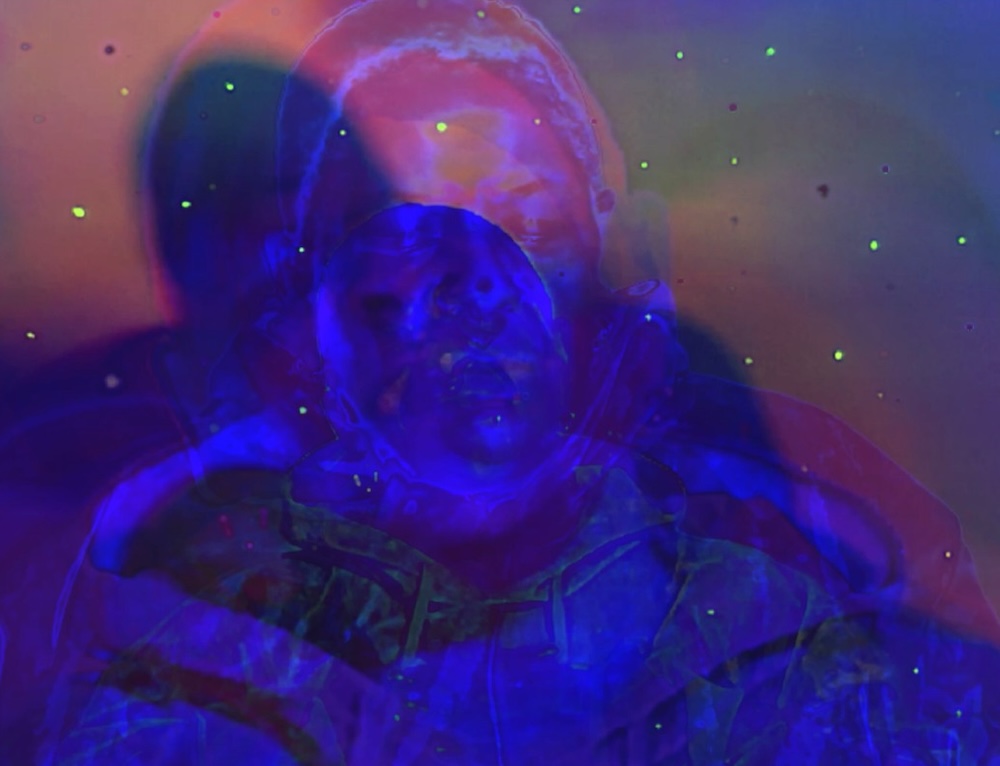
We then followed our guides into the YBCA’s adjoining large space for Conjuring Power, a queer activist exhibit primarily composed of old posters and flyers—check out the old school Dykes on Bikes posters—alongside new works meant to provoke (Sofía Fabio Mendieta’s Trans Tonzantin is a line-cut redux of the classic Virgin Mary image), comfort (Crystal Mason’s video piece, Invocation for a Dream, is practically a motivational tape for queer kids), and dream big.
Conjuring Power succeeds more as a history lesson, appropriate as it’s a collaboration with the GLBT Historical Society, reminding visitors that queer activism is as old as activism itself. It’s a testament to continuing a fight that’s become all the more important in recent years. Whether the works themselves inspire similar activism remains to be seen. One piece is shown to the outward-facing window to catch the eye of passers-by, but the window’s pattern obscures the image to the point that it’s hard to make out.
The high ceilings and wide spaces of the YBCA served it well, as my Aranet4’s CO² readings never climbed any higher than 498ppm during the entire tour. In that sense, the two exhibits succeed in creating a safe space for Black and queer arts patrons. Both exhibits successfully make historical statements on their chosen subjects, but Conjuring Power works better as an historical document than a call to arms.
DIEDRICK BRACKENS: GATHER TENDER NIGHT and CONJURING POWER: ROOTS & FUTURES OF QUEER & TRANS MOVEMENTS both run through August 23 at the Yerba Buena Center for the Arts, SF. Tickets and more info here and here.
God & Monsters West Coast premiere at NCTC
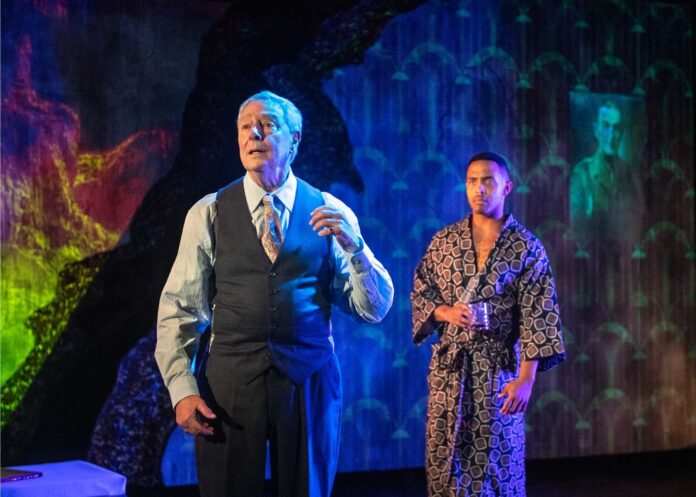
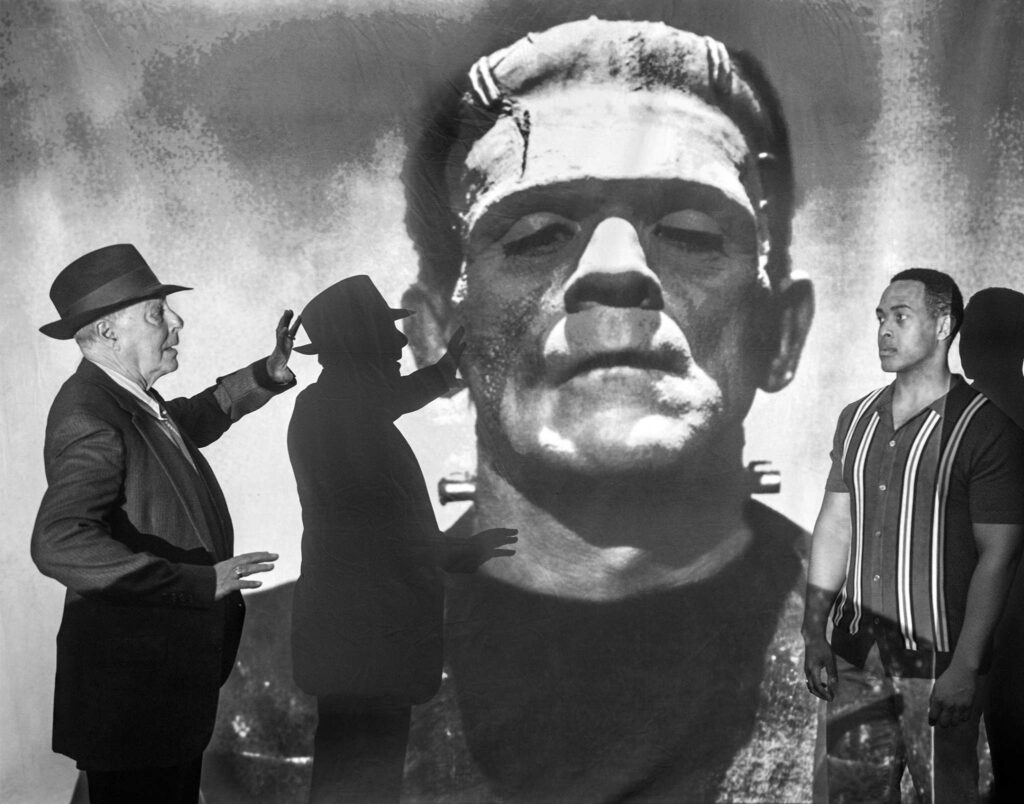
One can see playwright Tom Mullen’s intentions all over his adaptation of Gods & Monsters (West Coast premiere through April 5 at the New Conservatory Theatre Center, SF). Mullen is a white man, but he clearly thought he was making a progressive stride by making Clayton Boone, fictional gardener to Frankenstein film director James Whales, a Black man. The playwright might have thought he’d provoke the very sort of conversation that other storytellers try to avoid when telling these period stories. Unfortunately, Mullen didn’t actually listen to what he was saying, because it’s not as profound as he thinks.
As in Christopher Bram’s original novel and Bill Condon’s 1998 film, the story takes place during the final days of once-revered Hollywood director James Whale (Donald Currie). The gay British director leads a Miss Havisham-like existence in his Hollywood mansion, with only his maid to keep him company (here rewritten as the Latina Maria, played by Francine Torres). The presence of handsome Black gardener Boone (Jason M. Blackwell) piques his interest, but also triggers a series of memories with which the younger James (Tyler Aguallo, who owns the stage every moment he’s on it) has never made peace.
Mullen’s biggest problem is that by trying to make Boone and Maria perfect, he strips the characters of all the, well, character that made them so interesting in earlier iterations. Further, what personality he does add to Boone makes him a paranoiac, drawing absurd parallels between the treatment of Frankenstein’s monster and the lynching of Black men. One could see what Mullen was going for, but he reduces a once-interesting story to a watered-down rehash, to which he doesn’t give the proper care.
The opening night CO² readings topped 1,203ppm by the final bow, which isn’t the highest I’ve seen at NCTC, to be sure. Unfortunately, the show itself is so convinced of its own importance that it doesn’t allow its characters to actually become humans. Isn’t that the point of seeing them as more than monsters?
GODS & MONSTERS’ West Coast premiere runs through April 5 at the New Conservatory Theatre Center, SF. Tickets and further info here.