This is Drama Masks, a Bay Area performing arts column from a born San Franciscan and longtime theatre artist in an N95 mask. I talk venue safety and dramatic substance, or the lack thereof. Read Marke B.’s interview with Burden of Proof choreographer Alleluia Panis here.
Last week was an odd-if-quiet time in Bay Area theatre. As I often do, I recently found myself quoting of Gary Oldman from Léon (released in the US as The Professional): “Death is… whimsical today.”
First, we finally heard from CounterPulse since their “thoughtful pause” back in February. Between leadership shake-ups, labor disputes, a promised town hall never materializing, and their venue closing for over a month, their future looked murky. Last Thursday brought updates through a new e-mail: They’re bringing in Rebecca Novick, formerly of Crowded Fire and Golden Thread, to help put the house in order.
That still leaves lingering questions, but it does quell the growing rumors that the folks were just going to let the company flounder. They spent the better part of a decade acquiring their Turk Street building; it’d be an incalculable loss to let it slip away.
Then, there’s Central Works. Like Aurora before them, CW have decided to close up shop by year’s end, leaving Berkeley short another indie theatre. The announcement (and a subsequent Chronicle interview) made the founders seem averse towards handing over the reins. It reminded me of Nicole Gluckstern’s wonderful post-mortem of EXIT Theatre and my own interview with EXIT co-founder Richard Livingston, both of which make the idea of succession seem like a foreign idea to the founders. Choosing a successor is tough (something both EXIT and CW founders admit), but it’s another thing to hold on too tight. What’s more important, legacy or ownership?
This one went under the radar: AmiosWest haven’t updated their website since the start of this still-ongoing pandemic, so one had long since dismissed a return of Shotz!, their showcase of new short plays. (Think Playground, with a great emphasis on the raucous.) So, it came as a surprise when I—a former Shotz! actor and director—got an e-mail asking to take part in their upcoming show on June 5 at Eclectic Box. Health-cautious as I am, I declined, but there’s something reassuring at seeing a beloved institution like Shotz! announce its return within another (Eclectic Box, the former Stage Werx). I got that e-mail just days after D’Arcy Drollinger announced the saved-from-death Oasis is nearing a re-start and is looking for a Director of Development.
The tenacity of these places and companies proves legacy can extend beyond the tenure of the founder(s). There’s a wonderful risk in letting new blood bring fresh ideas to a place with name recognition. It can be challenging, terrifying, offensive, or even misguided, but creative evolution is like that. It’s a messy process that keeps the art form alive. You might even say it’s “whimsical.”
Burden of Proof world premiere at Bindlestiff Studio
Speaking of longtime indie theatre staples in the Tenderloin, I made reservations for this show after asking myself how long it had been since I visited Bindlestiff. It’s been years. The 6th Street Pilipino company and venue often seems more figuratively underground than even its literal subterranean stage. Still, with so few PoC-owned-and-operated spaces left in SF, it was nice to see that they haven’t succumbed to the same fate as their peers.
I was also glad to show up for a performance that answers our current timeline with nothing less than a call to action. Alleluia ‘Manai’ Panis’ dance piece Burden of Proof (world premiere through April 26) has been percolating since 2011, officially moving forward in 2023. Yet, its depiction of brown people being “disappeared” off public streets could double as footage for any number of current news reports.
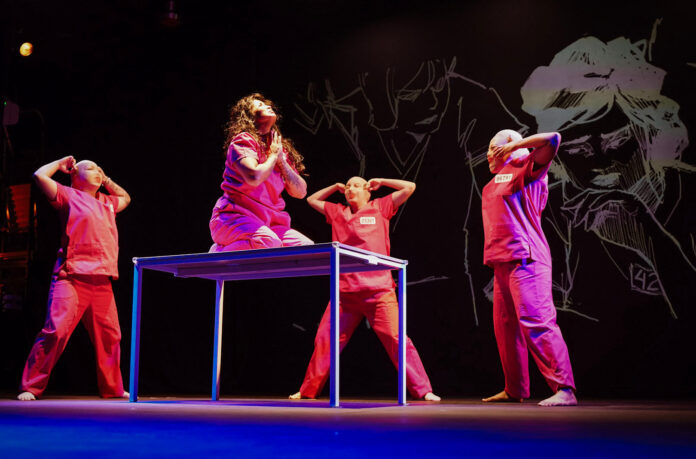
After an outdoor pre-show ritual dance from Bahai ng Mga Anito—House of Spirits, who live up to their moniker by using small houses illuminated from within—and a poem from Jason Magabo Perez (the son of one of the real-life subjects of the piece, celebrating and lamenting the idiosyncrasies of Fil-Am life), we’re dropped into our first vignette. Luzviminda “Vee” Calinao is sweeping her home when a memory hits her light a bolt of lightning, shown through projected static and an audio screech. “July 13,” she recalls through voiceover. “It was a horrible day… they kept trying to get me to confess.”
“They” were the faceless feds who snatched the nurse in broad daylight to make her “confess” to a series of deaths in her ward. She then finds herself stuck in a Kafka-esque nightmare of the US criminal justice system. (The dance is based on the true life case of Pilipina nurses Leonora Perez and Filipina Narciso, who were wrongfully convicted and incarcerated for the 1975 deaths of patients at the Veterans Administration Hospital in Ann Arbor, Michigan.)
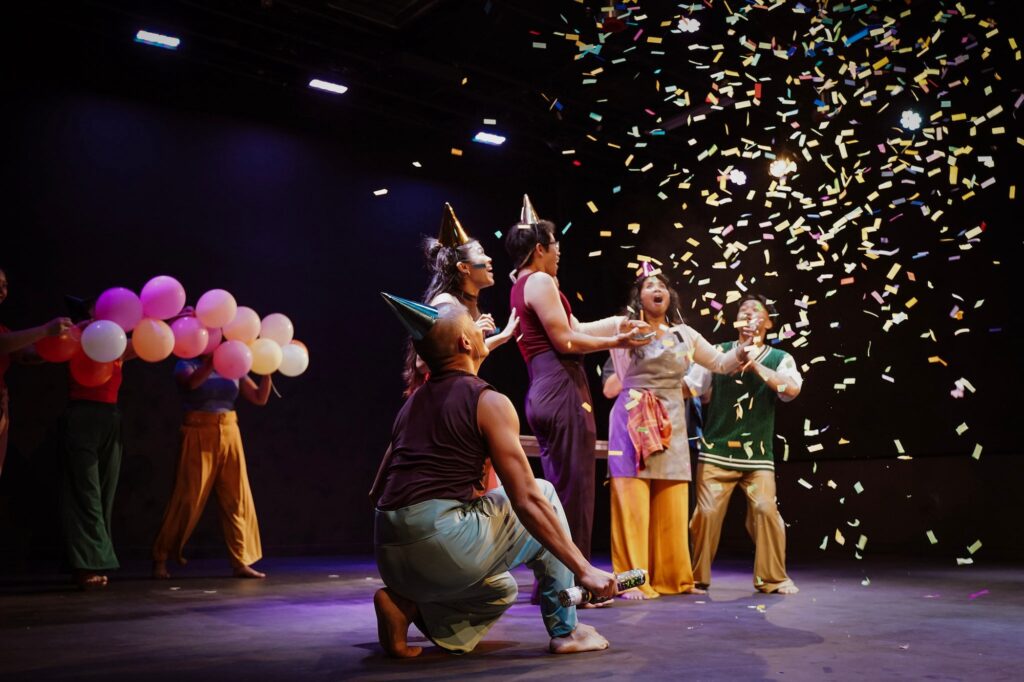
She attempts to move past the memory, as seen through a montage of her birthday party. Her husband, children, and friends are all smiles with her, until the memory hits her again. That’s the thing about PTSD: it doesn’t run on a schedule.
This is just the first in a quartet of sequences that relive Vee’s arrest and the shockwaves it left on her family. It even winds up hurting a drug-addicted witness who realizes he could have helped her when she was snatched, but was stopped from doing so like a mime again an invisible wall. Her husband is beside himself when she doesn’t return home from her shift. Her daughter starts down a path that is nothing short of full-fledged radicalization.
And why wouldn’t someone become radicalized? Panis’ piece seems timeless because it’s not the first time people of color have found themselves helpless under the boot of American law enforcement. If anything, it’s a rebuke to moderates and liberals who only became aware of the danger in the past few months by watching ICE agents shoot white Americans in cold blood. Panis’ piece is grown from the anger of experiences that violence first-hand.
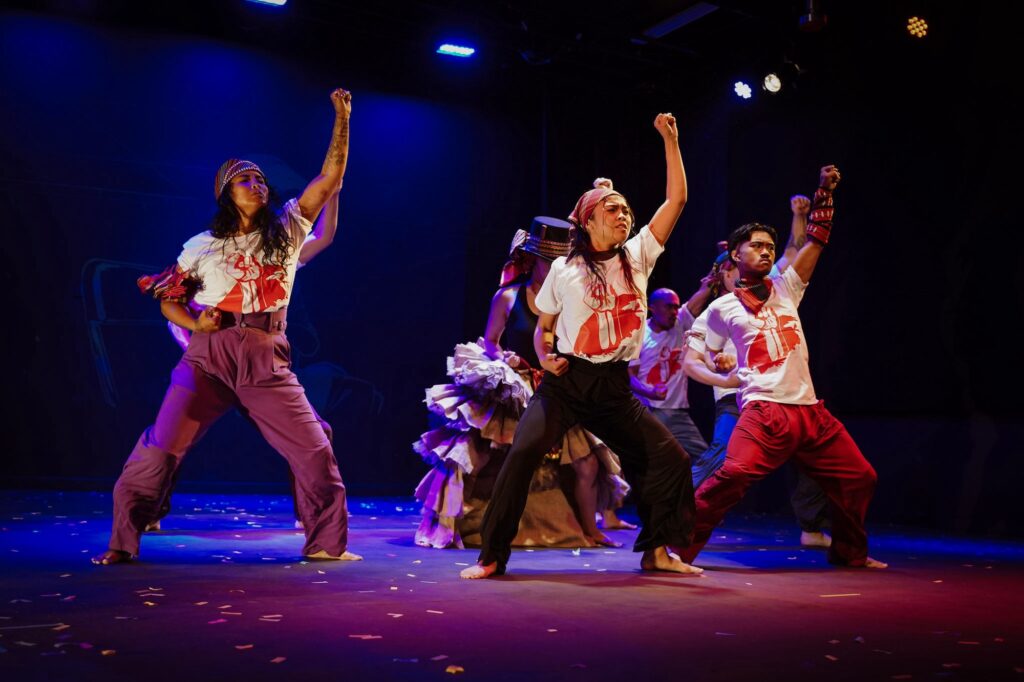
In addition to music, sound effects, and video projection, Panis and her KULARTS company collaborators also incorporate a variety of movement styles into the show. Modern dance and pantomime integrate seamlessly with traditional Pilipino dances and chants, with the confrontational “Makibaka! Huwag matakot! (Fight! Fear not!)” becoming the show’s unofficial closing statement. It all gels organically and never overstays its welcome, giving the show as much a classical influence as an anti-Eurocentric identity.
Since Bindlestiff is an old building, I knew to temper my expectations about HVAC. I saw only one other person masked, and that was a staffer in a gaiter. CO² levels weren’t the highest I’ve ever seen, but my Aranet4 was reading 2,090ppm by the final bow of the intermission-free show.
Most Bay Area theatre folk stay clear of the Sixth Street area due to “skid row” stereotypes. That’s how they miss out on relevant work like Burden of Proof. It’s not just that it’s a strong modern dance show (it is) or that it supports PoC art (it does), it’s the fact that it may be the single most “now” show currently running in American theatre. It deserves a large audience as much as ICE victims—nay, anyone harmed by the current administration—deserves justice.
BURDEN OF PROOF’s world premiere runs through April 26 at Bindlestiff Studio, SF. Tickets and further info here.