
This is Drama Masks, a Bay Area performing arts column from a born San Franciscan and longtime theatre artist in an N95 mask. I talk venue safety and dramatic substance, or the lack thereof.
La Lengua’s El Silencio Árido del Agua world premiere
Timing is an aspect over which an artist has almost no control. All their blood, sweat, and tears can be for naught if their work hits a wide audience at the wrong time. Jordan Peele prepared for the 2017 release of Get Out to flop, what with its ire was directed at white liberals who spent the Obama era boasting of a “post-racial society.” Had Hilary Clinton been elected, the film wouldn’t have resonated the same way. But Hilary wasn’t elected, and suddenly the likely flop became a watershed work. That’s how much the world changed between 2016 and ’17.
The world of 2024 must seem like a lifetime ago for playwright Viviana Calderón. Back then, her home of Puerto Rico was known for two things: a certain “bad” rapper who’d one day headline the Super Bowl, and racist jokes made about the island during a Madison Square Garden klan Republican campaign rally. Almost no one was talking about how the island had yet to recover from recent hurricanes and an oligarch land-grab. That’s when Calderón began writing El Silencio Árido del Agua—The Arid Silence of Water (world premiere through August 16 at Brava! Theatre, SF).
Even before the show proper has begun, Héctor Zavala’s set design has already caught our eye with the countless ad hoc water receptacles crowding the entrance to the Brava! Studio. They continue inside, where the divided set finds one half overrun with jugs labelled “tomar,” “cocina,” “baño,” etc. This is the home Gladys (Keila Michelle) shares with her husband Miguel (Carlos Barón Parra) and their wheelchair-bound daughter Natalia (Antonella Scogna). The labels on each jug are necessary because every drop of water is necessary.

Even if they weren’t in the middle of a brutal heat wave, the privatization of the water system has left them without running taps for the longest time, and calling the water company puts them on hold indefinitely. Not exactly ideal conditions for a family with a myriad of health problems (some of Gladys’s being mental). Natalia would do just about anything to make it to the beach, even if she can’t swim.
None of these problems matter with their rich white neighbors, whose modern McMansion (the other half of the stage) seems to have enough water and power to run the entire island. In fact, their pristine lawn seems to sprout more sprinklers that run 24/7 (courtesy of projections by Gabriel Vallencillo Márquez). This is the home techie Bill (Nic A Sommerfeld, constantly adorned in an Oculus headset) shares with his Puerto Rican wife Sarah (Liris Robles) and his openly racist mother Elizabeth (Val Façhman). Sarah left the island years ago because the felt trapped by poverty, only to return and be haunted by the thought that she’s the one now doing the trapping.
I know, that doesn’t exactly fit the “comedy” description La Lengua advertised, but there are laughs to be had. Whether from the frustration dealing with private entities or just watching rich assholes be rich assholes, there’s actually plenty to laugh at. In fact, the biggest laughs—and the most timely narrative element—is the blatant anti-AI stance it takes. Miguel frequently makes bad suggestions, courtesy of spending hours consulting the chatbot on his phone (playwright Calderón).

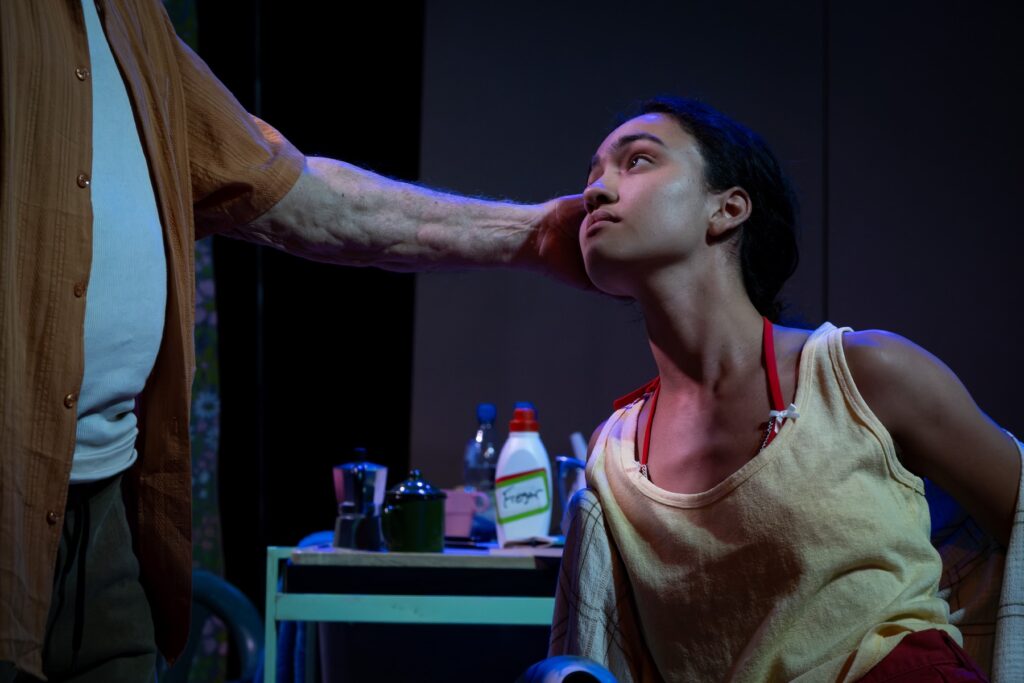
The hypocrisy of asking AI for water tips isn’t lost on Natalia when AI is the enemy of water conservation. This play is the sort of thing every Silicon Valley acolyte should be forced to watch when they falsely claim that more useless tech will save the world. This is a shockingly current tragicomedy about being on the opposite side of what the industrial world considers “progress.”
To my pleasant surprise, the HVAC in the Brava! Studio seems to have improved considerably. I can’t recall anyone but me masked (at first?), but CO² levels on my Aranet4 only peaked around 813ppm during the hour-plus show, which is lower than I recall from the last show I saw there.
At one point, Gladys decides she’s had enough with both US bureaucracy (“I’m not gonna kill myself waiting for this famously-shitty government to help us!”) and the colonizers across the road. I won’t spoil how it turns out, but the sad thing is that no one notices. Gladys makes the boldest move of her life, but the richies are too trapped in their bubble to even register it. That’s the sad, comedic strength of El Silencio Árido del Agua: the idea that even if you did strike back against oppressive powers, that it likely wouldn’t even hurt them. It’s times like that when a walk on the beach could truly make all the difference.
EL SILENCIO ÁRIDO DEL AGUA (THE ARID SILENCE OF WATER)’s world premiere runs through the August 16 at Brava! Theatre Studio, SF. Tickets and further info here.

OTP presents Orpheus Descending
Timing also figures into Oakland Theater Project’s latest show: the timing of staging Tennessee Williams’ Southern Gothic after the company’s Lorca’s The House of Bernarda Alba, with which it shares several cast members; the time in which the story is set; and the “modern times” casting decision that makes it a completely different show. Like most of Williams’ work, Orpheus Descending (through August 23 at FLAX art & design, Oakland) is set in the Jim Crow South, with all the open racism that entails.
The curiosity comes with a crucial casting change. It’s still the story of the mercantile store owned by the put-upon Lady (OTP superstar Lisa Ramirez) and her slowly dying husband Jabe (Robert Parsons). The store is a gathering spot for town gossips (Lizzy Izyumin and Zolboo Namkhaidorj) and local “wild girl” Carol (Natalie Pasquinelli), but everything flips with the arrival of drifter Val (Hunter Bryant). Neither he nor Lady is ready for the changes their lives are about to undergo.
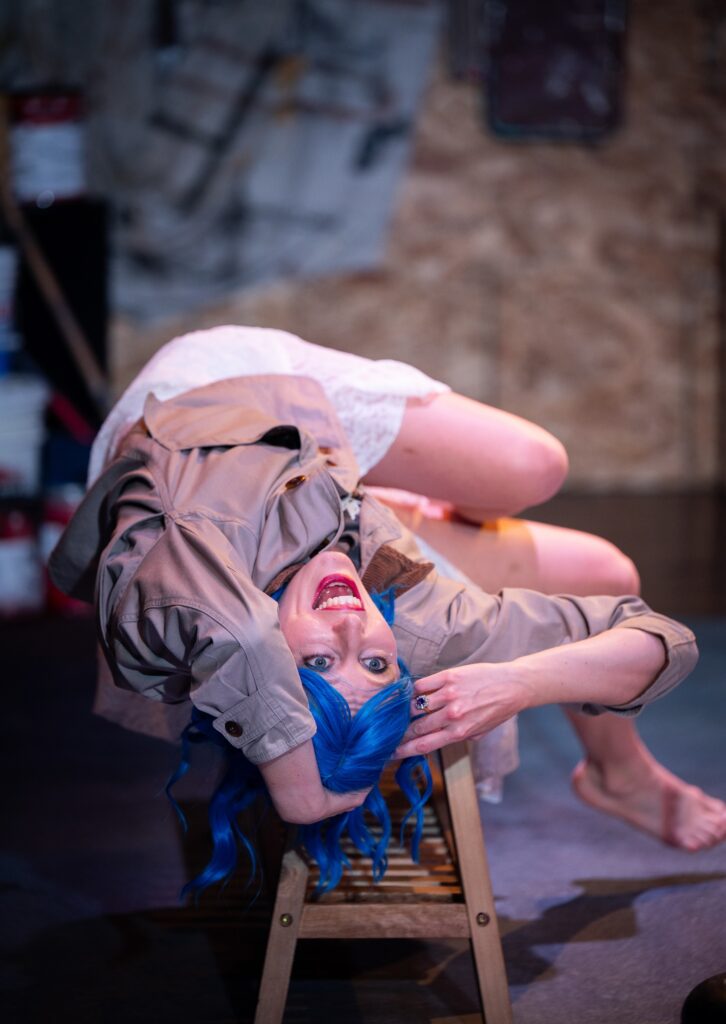
It’s easy to see what director Will Detlefson was going for in casting a Black man as Val, as it highlights the racism usually pushed to the background. The problem in doing so is that it also creates a few anachronisms, as there are plenty of necessary plot points that would never be innocuous when done by a Black man in the Jim Crow South. What’s more, the attempt to change the ending into a racial tragedy seems bold on paper, but comes off as revisionist-Williams in practice.
Though the show boasts another eye-catching set by Sam Fehr, a mostly great cast, and not-the-worst CO² levels (1,849ppm by the final bow), the very social consciousness OTP tries to inject into the show is the very thing that works against it. This isn’t a script that can shoulder this “minor” change without going through a major metamorphosis.
ORPHEUS DESCENDING runs through the 23 of August at FLAX art & design, Oakland. Tickets and further info here.