This is Drama Masks, a Bay Area performing arts column from a born San Franciscan and longtime theatre artist in an N95 mask. I talk venue safety and dramatic substance, or the lack thereof.
Marin Shakespeare Company presents Julius Caesar
The simultaneous gift and curse of adapting Shakespeare is that the cultural ubiquity of his canon make the works incredibly malleable, but not always interchangeable. Romeo and Juliet has been reworked into ballets, operas, and even a Wu-Tang-themed independent film. Yet, a piece like Othello doesn’t work if you try to swap out the racial element for something like classism.
Jon Tracy’s new Marin Shakes adaptation of Julius Caesar (through September 13 at the Forest Meadow Amphitheatre, San Rafael) doesn’t really reimagine the story in the 1970s so much as it uses that decade’s cultural aesthetics for a story that simply utilizes familiar Shakespearean prose. The lyrics are familiar, but somehow you’re not really sure what song you’re supposed to be hearing.
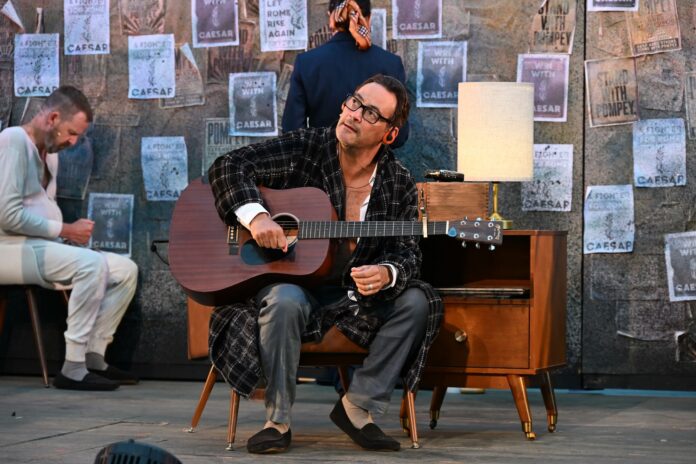
In fact, the era’s music sets the scene early on, when our eponymous lead walks on looking very disheveled before he sits down to play Bread’s “Make it with You” on his guitar. This scene is at odds with the rest of the play, because it shows this version of Caesar as just some average schmuck rather than the charismatic political leader suggested by all the fliers (“Win with Caesar,” “Let Rome Rise Again—Caesar”) pasted onto the walls.
The guitar bits may have been trying to suggest a Manson-like cult leader, especially as his supporters are shown as the pro-peace counter-culture movement—this is the Viet Nam quagmire era after all, although Caesar brags about past military interventions. But Julius spends the most of the rest of the play in tailored suits making campaign appearances. He’s the least-defined character in this adaptation.
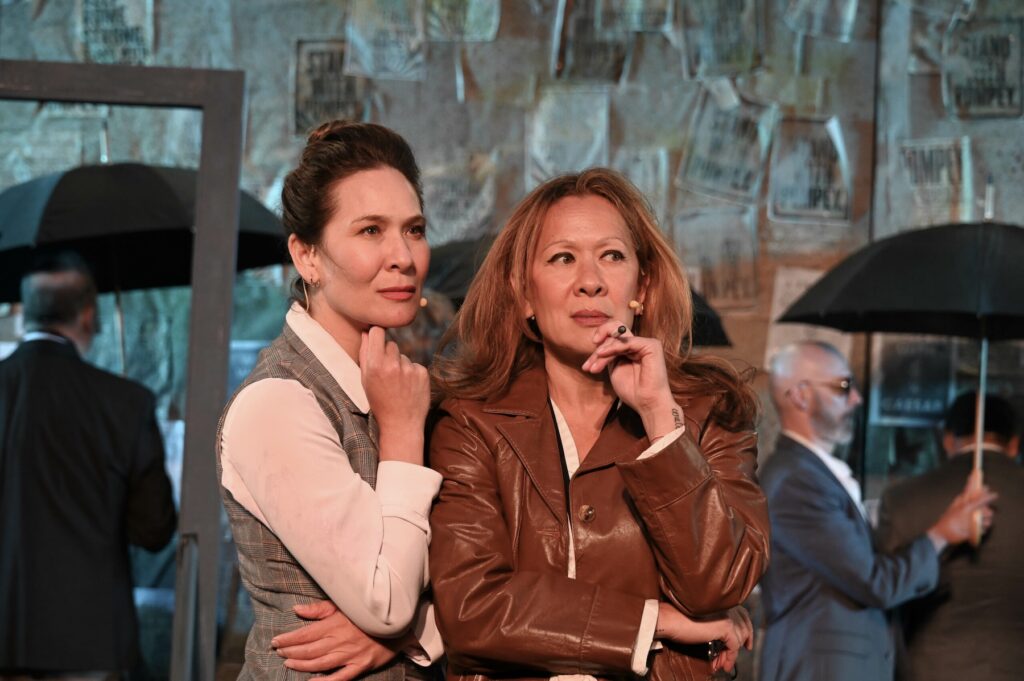
Better elucidated are those around him. His wife, Caldonia (Natalia Adona, in the show’s guiding performance) is so rich with personality that it would be easy to see her leading the people, as her every word commands attention and obedience. It’s quite the contrast to Julius’ BFF Marc Anthony (Brady Morales-Woolery), who’s constantly shown speaking like a grade-schooler forced to give a speech in front of the entire class. Then, there’s conspiring in-laws Cassius and Brutus (here made proper siblings, respectively played by real-life twins Charisse and Bridgette Loriaux), who lead the conspiracy to take down the power-mad emperor, yet question each other and their comrades about whether it’s for the greater good.
This is a repeated problem with Tracy’s adaptation: Not only does it lack any reason for us to be taken in by Caesar’s charisma, it seems desperate for us to feel bad for a man whom history has rightfully colored as a dictator. Yes, dictators are people, too, but that doesn’t erase the damage they’ve done, which will often take ages to repair. Tracy’s clearly aware of this, as he briefly breaks from the original text to have Cinna (Mary Ann Rodgers) quote Lawrence Ferlinghetti’s 2007 protest poem “Pity the Nation.” So, who is Caesar in Tracy’s eyes, someone rightfully mourned or understandably murdered?
Shakespeare’s text humanizes the Roman emperor (possibly too much), but also highlights the hubris that ultimately leads to his downfall. Tracy’s adaptation inexplicably asks the audience to believe that this historical dictator would appeal to the anti-war crowd, and that the same crowd would turn blood-thirsty after his death. Square pegs don’t fit into round holes.
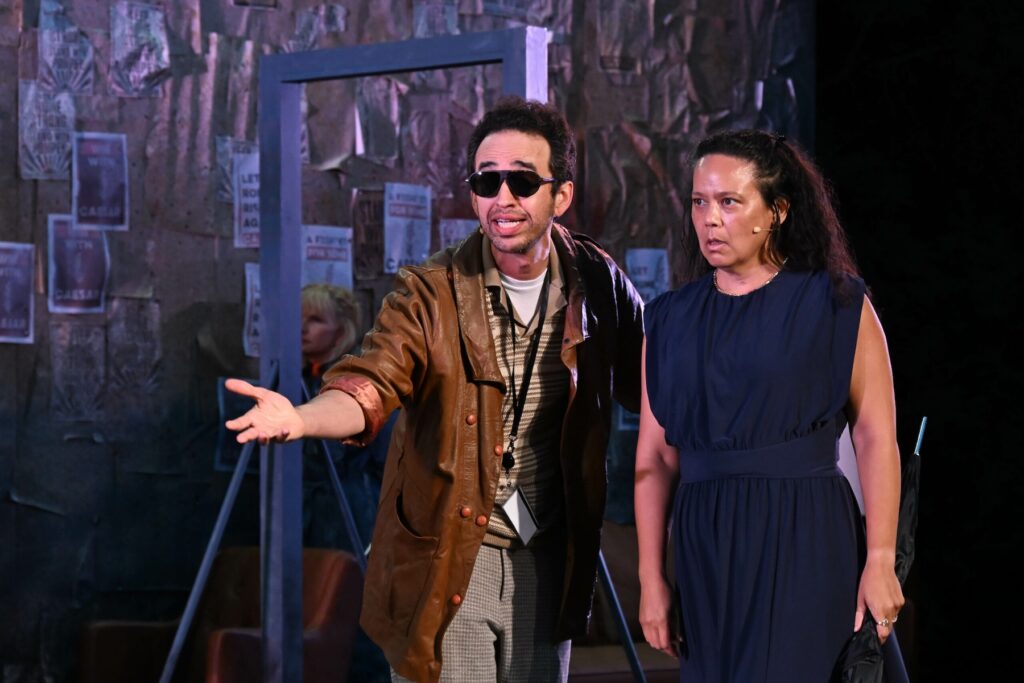
As dodgy as the narrative choices are, the technical aspects are hard to nitpick. Ever-impressive scenic designer Nina Ball outdoes herself with this show, starting with a static wall surrounded by late-‘60s office equipment, before the second half of the show opens the wall to reveal a near-apocalyptic scene in the aftermath of the assassination. It’s impressive in its revelation and astounding in its detail, once again showing why Ball is one this country’s best living set designers.
As with most Bay Area productions, fight director Dave Maier choreographs the onstage violence, but the real question is who’s responsible for the squibs used in every death scene. Going into Julius Caesar is to know the title character will inevitably meet the wrong end of several knives. What one doesn’t quite expect is the Kill Bill-style blood spurts produced by those stabbings. The opening night audience featured more kids than one was expecting, so one can only imagine how their parents felt when the show became a Grand Guignol. In any case, it’s hard to take your eyes off the stage.
Then, there are the performances. Tracy directs everyone to “go big” in their presentation, with nearly every line spouted from the Forest Meadows stage as if it were meant to be heard across the bridge—even without the wireless mics everyone has on. As mentioned, Adona fares best, bringing such electricity to Caldonia that one could easily see her performing the entire text as a solo show, a la Suzy Eddie Izzard. The Sisters Loriaux bring the right kind of steely determination to their roles and Brutus and Cassius, but the over-the-top direction gives them little room for the nuance they’ve shown in other shows.
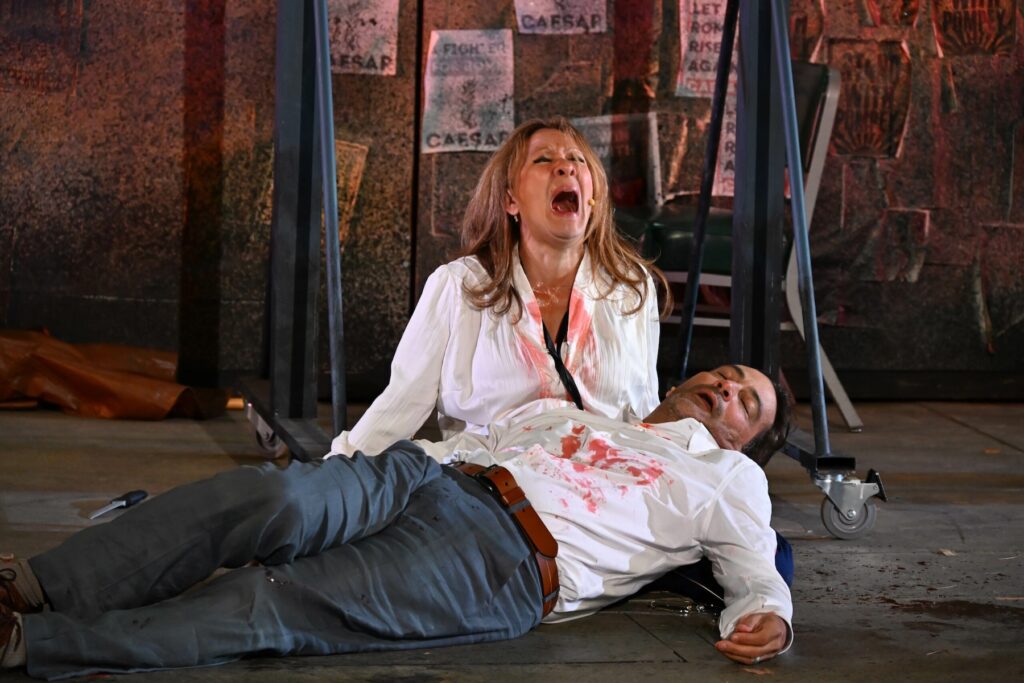
Lost in the shuffle is Caesar himself, as Moreno seems to also be unsure of what this adaptation is trying to say about the oft-played emperor. No stranger to musicals, Moreno easily shines (quite literally) in a surprise re-appearance in the latter-half. Other than that, he seems to appear only so he can die. Most of the ensemble are serviceable in their performances. It’s just that the overall tone was clearly going for “operatic,” but decided to settle on “loud,” which isn’t the same thing.
This being an outdoor production, it’s no surprise that CO² readings on my Aranet4 hovered around 476ppm for the entire show. Given the Bay Area’s recent brushes with wafting wildfire smoke (both local and from other areas), the clean air of this show was a welcome relief.
No one can argue that Jon Tracy’s adaptation is bold. In fact, its ambition occasionally dwarfs that of Marin Shakes’ last show, which gladly swung for the fences. The difference is that, as much as Tracy’s show wants to say something profound, it’s not quite clear exactly what that is. The show has so many conflicting elements that it’s ultimately at war with itself. There’s enough technical skill to impress everyone who sees the show, and the performance by Adona may be one of the year’s best. Still, Marin Shakes’ production of Julius Caesar is a show that could benefit from a bit more clarity to match its lofty aspirations.
JULIUS CAESAR runs through the 13 of September at the Forest Meadows Amphitheatre, San Rafael. Tickets and further info here.