The San Francisco Police Commission, led by two members appointed by the supes, resisted Wednesday approving a new order that critics say would have allowed the cops to use drones for routine patrol and surveillance of activities protected by the First Amendment.
The result could be a new discussion about the role of surveillance activities by the SFPD.
The supes have already approved a general policy allowing police to use drones for chasing suspects in cars, for monitoring crimes in real time, and a few other specified purposes.
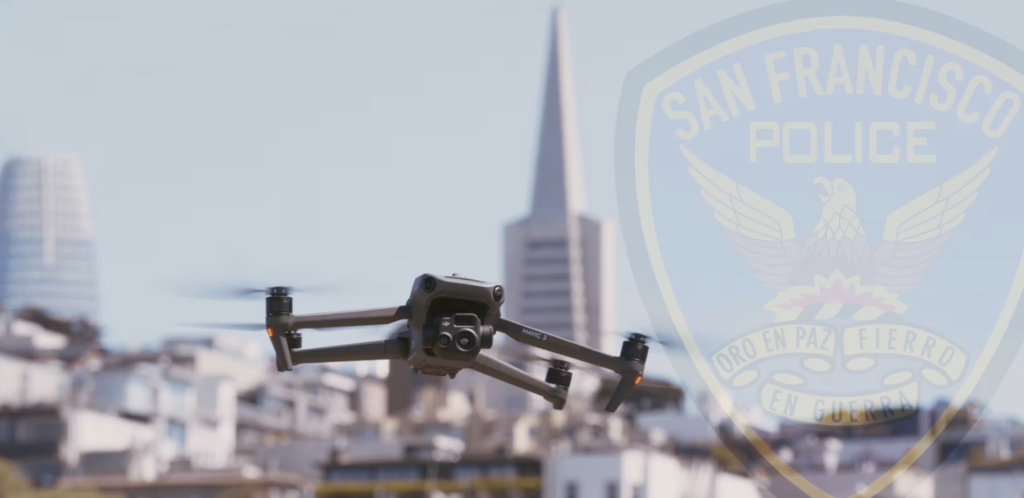
But a new Department General Order, aimed at telling the cops what they are allowed to do, went much further, critics said.
The San Francisco Public Defender’s Office, joined by the ACLU of Northern California and 13 other community organizations, sent the commission a letter arguing that the policy was dangerous to civil rights and privacy:
As written, the proposed policy unlawfully expands SFPD’s ability to use drones, invites invasions of privacy, chills First Amendment activity, and installs a weak data retention and sharing model.
The organizations suggested that the general order be delayed until there’s time for a community process:
A working group can resolve these issues and create a policy that reflects best practices and the will of San Francisco voters while minimizing infringement on constitutional rights. Accordingly, and for the reasons set forth below, we urge you to vote no on this draft of the policy and call for a working group to revise the proposed policy.
The letter notes:
In 2025, SFPD disclosed that drones were deployed approximately 1,122 times for, among other things, patrols, trainings, and simulations.7 In less than a year, the Department moved from roughly 350 deployments allowable under the Board-approved policy to more than 1,100 deployments that expressly included patrol or general surveillance outside the scope of the granted authority.
More:

The draft policy states that SFPD’s “use of UAS will be in strict compliance with constitutional and privacy rights.” Yet, it mandates that UAS operators “shall consider the protection” of those same rights only as “a key component” such that the operations must only “take reasonable precautions to avoid inadvertently recording or transmitting images where there is a reasonable expectation of privacy.” (Emphasis added). The drafted language sits in deep tension with itself: how can a drone pilot both strictly comply with constitutional and privacy rights yet consider those same rights only as a key component of their operation?
Under the new policy
SFPD can deploy the drone first, observe people who are not suspected of anything, and then determine from those observations whether someone warrants further investigation. In practical terms, surveillance ceases to be a tool used in an investigation and becomes a means of looking for something to investigate. It becomes, in short, a surveillance dragnet.
The policy allows SFPD to preserve drone footage for 30 days—but that can allow other agencies, including what one commissioner called a “hostile federal government,” to seek and maybe gain access to video that might, for example, show protesters outside an ICE office.
We know that the data has not been secure: A reporter from Wired Magazine was able to access months of SFPD surveillance data that was hosted on an unsecured web link.
Captain Stephen Jonas told the commissioners that the leak had been plugged—but he admitted the department doesn’t know if anyone else had accessed the data.
SFPD Policy Director Asja Steeves told the commission that the policy had already been through a public process at the Board of Supes. But Commissioner Keven Benedicto, who was appointed by the supes not the mayor, said that “there has been a lot of attention to where the line should be drawn around surveillance,” and noted that the “community concerns are real. … we have a hostile federal government.” He suggested that the policy needed “more robust community involvement.”
Commissioner Cindy Elias, also a board appointee, said it was “really important to have a community process.”
C. Don Clay, the commission president and an appointee of the mayor, is a retired Superior Court judge. He agreed that the process of approving the new policy needed delay, and he directed the department to respond to the concerns of the community groups by Sept. 30.
The policy will be back at the commission Oct. 14.
Mayor Daniel Lurie has pushed to give the cops more authority to use technology. The supes have mostly agreed. But in the wake of evidence that the SFPD data isn’t secure, and an increasingly public backlash against policy spying, the role of drones is back on the public agenda in San Francisco.