
A fashion label can dress Björk, attract prestigious magazine coverage, and still struggle to pay the rent.
That contradiction drives threeASFOUR: Full Circle, Sean Ono Lennon and Brian González’s documentary about a New York collective whose commitment to making extraordinary clothes keeps colliding with the ordinary demands of staying in business.
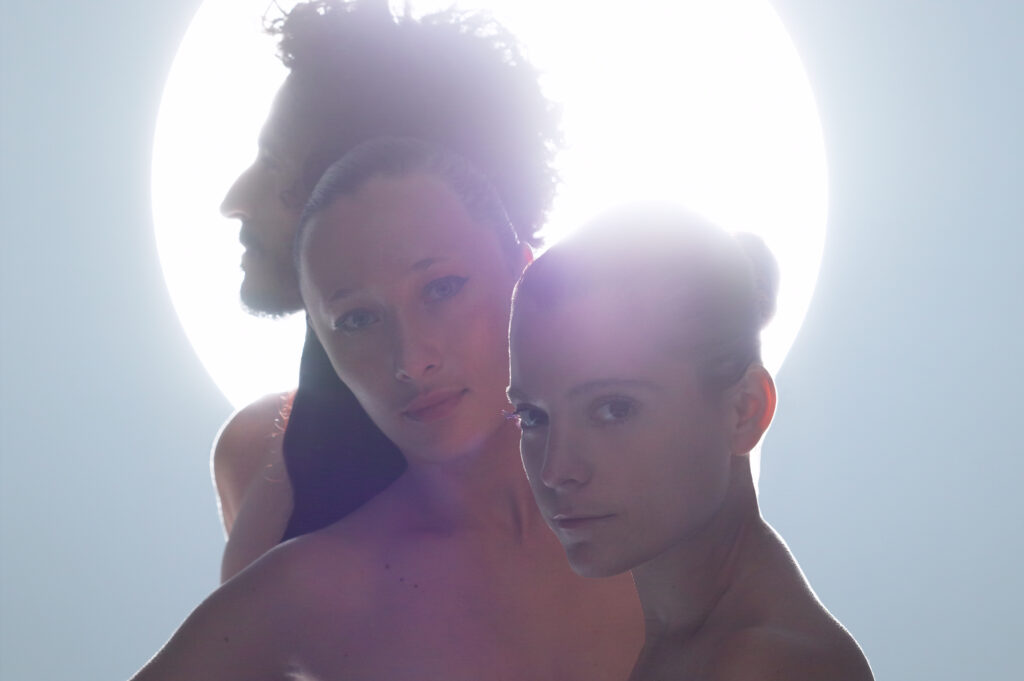
Coming to the 49th Mill Valley Film Festival (on Sat/10), the film follows the threeASFOUR design team—Gabi Asfour, Angela Donhauser, and Adi Gil—through creative disagreements, financial pressures, and the exhausting preparations for fashion shows.
Their idiosyncratic designs explore geometry, the body, nature, and technology. But the most compelling thing on display is their relationship: a chosen family continually negotiating how to keep creating together.
Lennon, a longtime friend and collaborator, connected the designers with his mother, Yoko Ono, to translate her drawings into wearable pieces. The film offered another way to amplify the trio’s work.
“I always felt that the beauty they created didn’t seem proportional to the success they had or the attention they got,” he tells 48 Hills. “One day I woke up and thought, ‘They’re at least as interesting as the subjects of Grey Gardens. Someone should film them.’”
What began as an effort to document friends became an inquiry into his own relationship with art. Lennon eventually recognized something all too familiar in their struggle to be understood.
“I realized that was something I related to personally,” he says. “Not that I think my work is on the level of theirs, but that I spent a lot of time making music and making things and felt unappreciated. So I realized I was trying to understand my own relationship to art by filming them.”

For the designers, letting the cameras into that relationship meant surrendering control over how audiences might see them.
“We had doubts throughout, of course, because it was a very exposing process—like being naked in front of the camera,” says Gil. “But we are thrilled with how it came out.”
The documentary finds its tension in the push-and-pull of collaboration. In one revealing exchange, Asfour presses for greater experimentation while Gil and Donhauser argue for wearability, bringing a central question into focus: How can artists make their work commercially viable while staying true to their vision?
Asfour’s resistance to the ordinary helps explain the stakes. Yet another dress needs a reason to exist beyond filling a rack.
“If you make something, it has to stand out,” he says. “So you create something that doesn’t exist, something completely new.”
Donhauser, however, sees accessibility as part of the artistic ambition. “What we mean by commercial is available for people and wearable,” she says. “Available and wearable.”
The pressure to reconcile those ambitions never disappears. Nor does one designer always speak for experimentation while another speaks for practicality; Donhauser says those roles move among them.
“You know, there are bills to be paid, so you cannot shut that voice off,” she says.
Their new denim line approaches the problem through familiar garments, giving their ideas a life beyond the runway. Funding, manufacturing, and the right partners remain essential, but Asfour sees an opportunity to connect people through clothes they already share.
“Across countries, cultures, and income levels, everybody wears jeans,” he says. “It’s interesting for us to approach unity through that.”
Unity resonates particularly with this collective. Asfour has Palestinian roots and was born in Lebanon; Gil was born in Israel; Donhauser comes from Tajikistan with German and Russian heritage. Their partnership offers a lived example of people creating across identities often treated as irreconcilable.
Asfour says their creative connection came first: “What really matters is that we’re creating together and that we’re also in sync creatively, which is very rare.”
For Donhauser, the divisions people inherit have a common source. “When you think about it, every culture has the same prejudice against everybody else,” she says. “It’s fear.”
Working together has gotten them past that conditioning. Asfour describes finding these collaborators who share his creative instincts as fateful.
As for Lennon, he came to see their partnership as a living expression of the peace activism that shaped his own family: The medium was fashion, but the possibilities extended beyond it.
Founded as As Four in 1998, the group originally included Kai Kühne, whose departure preceded its transformation into threeASFOUR in 2005. His emotional interview in the documentary brings that history back into the room.
Gil recalls crying when she first watched it. Affection and hurt remain intertwined, and she would welcome the possibility of collaborating again, provided everyone feels ready.
“I’d like that, but I want everyone to be in a good place and feel good about it,” she says.
Their struggle to stay together also plays out in their studio’s fate. Leaving their original space—a ruin of a Chinatown loft they transformed into a stylish live-work-show space dubbed The Silver Cage—initially felt like a loss. But an 11th-hour offer to open their own fashion incubator at Jersey City’s Mana Contemporary opened the possibility of renewal.
“I feel like their perseverance is what makes them special,” says Lennon. “Not just their perseverance at work, but their perseverance in their relationship.”
The film’s title, threeASFOUR: Full Circle, carries that tension between recurrence and progress. Circles appear in their clothing, their signature bag, and their fascination with geometry.
The filmmakers also began shooting the documentary during threeASFOUR’s preparations for the 2012 Full Circle show inspired by crop circles and fractals.
“If you look at a circle forming through time, you see it as a spiral,” says Lennon. “You know, a spiral is really a circle in time, right?”
The collective also has ties to the Bay Area, where they have regularly visited their friend Andy Spade, the entrepreneur and widower of designer Kate Spade.

In 2025, Asfour presented “The Possibilities of Fashion Technology” at the California College of the Arts, exploring digital and physical fashion, including AI.
“I found 150 people very engaged in what I had to say, and the Q&A that followed lasted longer than the talk,” he says.
His enthusiasm for technology comes with an insistence on human intention. The programs expand what designers can imagine; they don’t determine what the collective wants to express.
“For us, these tools augment our design capability and enable us to imagine further and explore territories we couldn’t before,” says Asfour.
That combination of experimentation and personal connection makes the Bay Area an apt destination for the film—and a familiar one for its director.
Lennon’s connection to San Francisco began in childhood, when he and Ono moved there seeking refuge from the frightening attention surrounding their family after his father, John Lennon, was murdered. For Ono, it was also a return to a city where she had lived from 1933 to 1937.
“My mom wanted to go to San Francisco because it’s such a beautiful town, and it was a really beautiful city to move to,” he says. “It’s one of my mom’s favorite cities.”
Although the pair eventually returned to New York after encountering unsettling fans in San Francisco, Lennon’s memories of everyday life are warm. He attended San Francisco Day School (the K-8 private school in the Western Addition) and remembers living in an apartment hotel he can still picture but can’t name.
“I remember loving it a lot because the weather was so nice and the city was so beautiful,” says Lennon.
That fondness has continued through adulthood. In 1996, he backed Ono on guitar and keyboards at her Great American Music Hall appearance. In 2002, he appeared alongside his mom during the YES YOKO ONO retrospective at SFMOMA. In early 2010, he performed back-to-back Noise Pop shows with the Plastic Ono Band at Oakland’s Fox Theater and then with Charlotte Kemp Muhl as the Ghost of a Saber Tooth Tiger at The Independent.
His most sustained musical connection is his work with Les Claypool in the Claypool Lennon Delirium, which played Outside Lands in 2016. Recording in the Primus frontman’s Sebastopol studio keeps bringing him back to the region, where the musical culture remains a source of inspiration.
“It’s a really creative area of America, and it’s a really inspiring place to work,” says Lennon. “It’s gone through a lot of changes over the years, but there’s a soul to it that is very unique and beautiful that remains.”
After years documenting what it takes to sustain a creative life in threeASFOUR: Full Circle, Lennon is newly awed by what it takes to bring a human life into the world. Becoming a father has made survival itself feel miraculous.
“I didn’t realize that every single human being on Earth is a triumph,” he says. “Just how much each person has to overcome to reach adulthood—it’s really a miracle.”
Watching his son with his partner, Charlotte, also gives the idea of coming full circle a deeply personal meaning.
“You know, I’m really hoping that this will be my opportunity to give everything to my son that my dad wanted to give to me but didn’t have a chance to.”
threeASFOUR: FULL CIRCLE Sat/10, Smith Rafael Film Center, San Rafael. More info here. A post-screening Q&A will feature producer Beth Levison and Marin designer Simon Ungless.