This is Drama Masks, a Bay Area performing arts column from a born San Franciscan and longtime theatre artist in an N95 mask. I talk venue safety and dramatic substance, or the lack thereof.
I write these words on Election Day 2026, and the country’s in such a shitty state of affairs that even the White House (what hasn’t been destroyed to make the Epstein Ballroom) anticipates massive voter backlash. I voted two weeks ago with progressive righteous indignation. I’m far too realistic for that to think everyone voted the same, so here’s what this arts journalist has his eye on, some of which will be still too close to call on November 4.
There’s Berkeley’s Measure Y, which would directly fund the arts communities. The measure’s been most strongly promoted by Shotgun Players, which has been pushing for votes for months now.
Richies are sweating California’s Prop 40 billionaire tax, even the current governor of California. They’re so terrified of this one-time tax that they’ve spent no less than $1million-per-day trying to defeat it. They even wrote three other Props (41-43) to deliberately sabotage Prop 40 if it does win.
Mayor Bluejeans continues his Trump cosplay by attempting a similar power-grab with SF Props D, E, and F. Mind you, he and his acolytes are the same “geniuses” whose last prop may have opened the door for Aaron Peskin to re-run for Supervisor.
Then there’s the fight for Pelosi’s seat. One candidate hates the homeless, loves cops, plays queer whilst erasing queer history, fetishizes gentrification, used racist AI propaganda against his Asian-American opponent (not the first time), and once faked an endorsement from the SF Bay Guardian, to name but a few skullduggeries.
The other candidate is Connie Chan. ‘Nuff said.
Our own Tim Redmond has already pushed back against one potential ending for this story. It’s far too soon to say how it ends. But I echo Tim’s sentiment that it’s not too late to write our happy ending. Besides, an activist’s story never ends on Election Day.
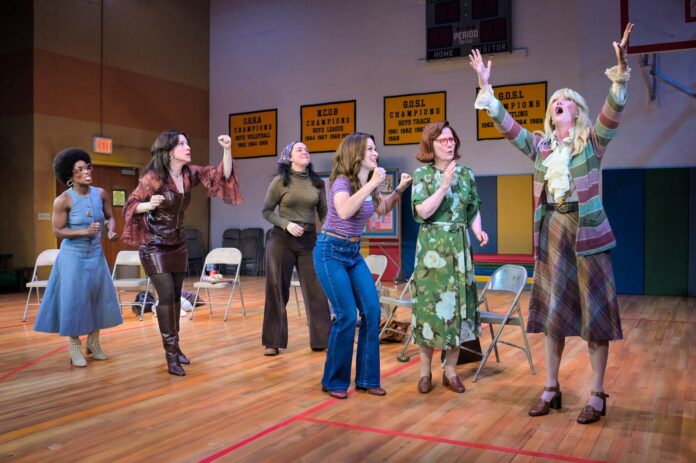
Liberation West Coast premiere at Berkeley Rep
With public funding in mind, I nearly missed opening night of this show because of an incident on the BART tracks, forcing me and other passengers to run back-and-forth to the Salesforce Dildo in the hopes of getting a bus across the Bridge. If you wonder what improvements a billionaire tax could improve, there ya go.
Paradoxically, awkwardly walking in five minutes late to Bess Wohl’s Pulitzer-winning Liberation (West Coast premiere through November 29 at the Berkeley Rep) was probably appropriate. After all, when the members of the show’s second-wave-feminist Consciousness Raising Group introduce themselves, one of them lashes out at the idea that a group of women gathered must automatically be a knitting circle.
The kicker is that one of them actually did attend the group thinking it was a knitting circle. (That joke reminded me of the first episode of Vag Magazine, the short-lived web series that introduced the world to Kate McKinnon.)
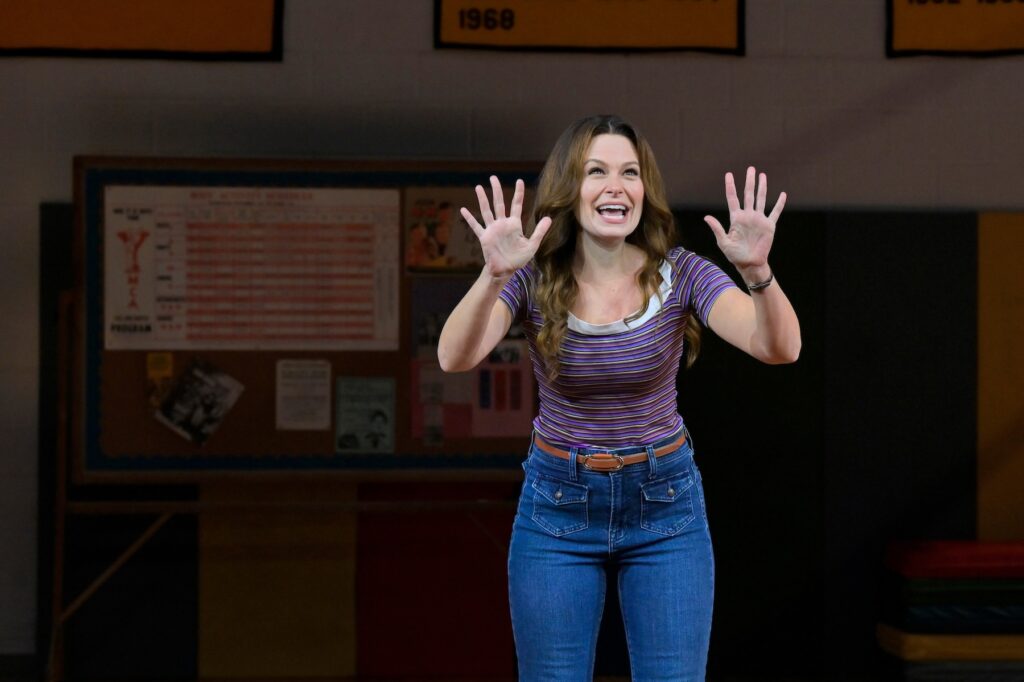
This particular CRG meeting, set in an Ohio gymnasium in the 1970s, has been arranged by Lizzie (Katie Lowes). Its attendees include the Afrocentric Celeste (Felicia Curry), Jewish radical Susan (Evelyn Spahr), housewife Margie (Mary Gordan Murray), liberated Italian Isidora (Irene Sofia Lucio), and office worker “the other Dora” (Britt Faulkner). Through the memories of Lizzie’s daughter (also Lowes), the younger woman strives to find out how complex the Women’s Movement was and whether her journalist mother compromised her own beliefs by adopting the family life.
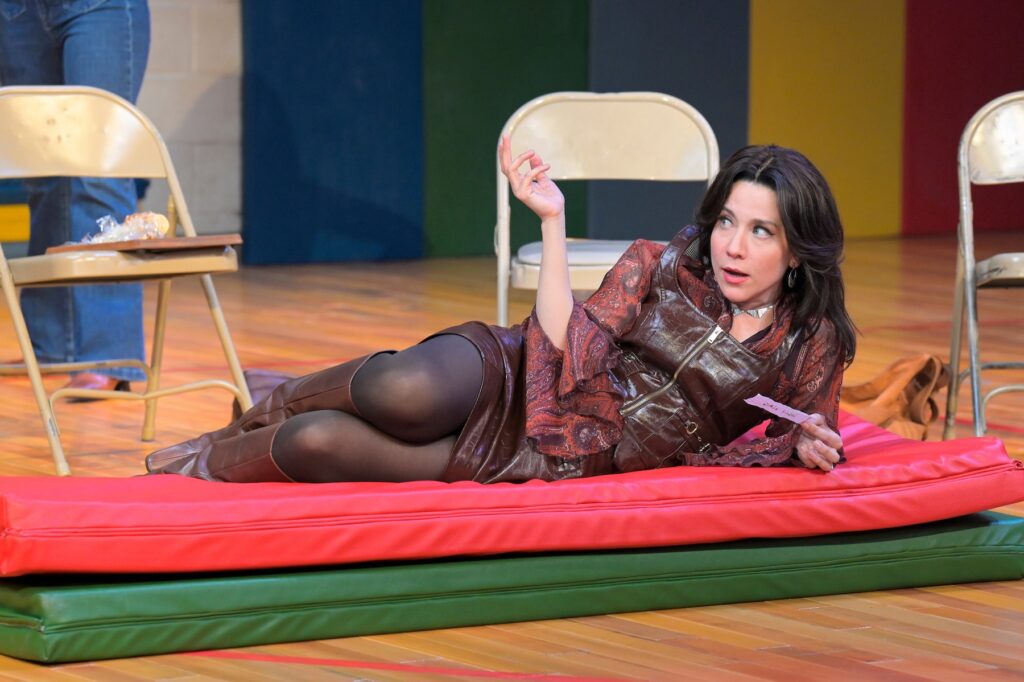
Wohl’s dramedy script is strongest when emphasizing that not every decision is as clear-cut as a manifesto tenet. One of the best scenes has one of the women reveal she voted for Nixon. Why? Because “McGovern sold us out!” You could swap out those respective names for “Trump” and “Biden” without losing the statement’s impact. Where the script wavers is in trying to balance to comedy and drama (both of which are good) without the two having a head-on collision. The script is also pretty self-congratulatory in its inclusion of Black women, but they’re the kind of Black women white writers always include, so as to not be accused of not including them.
Director Whitney White gets a surprising amount of mileage from a play that’s just six women in folding chairs. But if Mamet got a Pulitzer for writing six guys in chairs, why not the all-femme equivalent?
It should come as no surprise that the Rep’s Roda Theatre kept a steady flow of air throughout the night. CO² levels on my Aranet4 peaked around 870ppm in the second act, before dropping down to 839ppm by the final bow. (The final mask-required performance will be the November 8th matinee.)
At times, Liberation seems as confounded as its narrator as to what story it wants to tell. The parts it does tell can be fascinating, but the self-conflict can be frustrating. Oddly enough, that may be the point.
LIBERATION’s West Coast premiere runs through November 29 at the Berkeley Rep. Tickets and further info here.
SF Neo-Futurists present We Bought a Gun world premiere
“I don’t like it.”
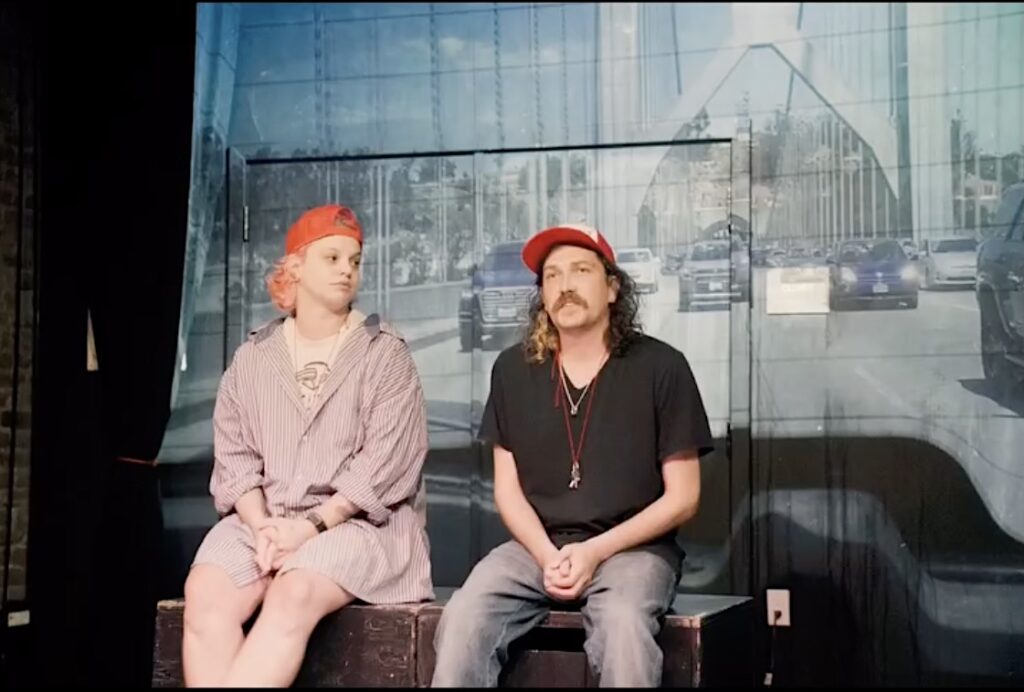
An audience member said that during the opening-day performance of the SF Neo’s latest full-length. It was when writer-performers Jeb and Willie Caldwell used their titular firearm to discuss Shoot, Chris Burden’s infamous 1971 performance art piece in which he was intentionally shot with a live round. One also thinks of the near-shot three years later at Marina Abramović’s Rhythm 0. Jeb and Willie similarly put their trust in one another for the sake of performance art. The tool–nay, weapon–they use is no less dangerous now that it was 50-plus years ago.
The difference between We Bought a Gun (world premiere through November 22 at 447 Minna, SF) and the aforementioned pieces is that no live ammo is ever placed in this gun. Nevertheless, it’s treated as an object of affection (it’s placed in a baby’s crib), an avatar of debate (legislation is discussed at length), and an indisputable symbol of power. They detail the hilarious story of purchasing it at gun shop in Pacifica and whether it conflicts with or supports the couple’s left-leaning politics.
In SF Neo fashion, the audience is not there to casually observe. Again: the gun is never loaded, but we’re invited (under supervision) to take active vocal and physical part in the power the weapon represents. It says a lot that almost no one wanted to at that first performance.
It had been a while since last I visited 447 Minna, but I think the HVAC was working better than last time? Granted, the opening-day audience was about half-full, at best. Still, CO² levels peaked around 885ppm by the end of the hourlong show.
We Bought a Gun has no illusions about ending the country’s firearms debate anymore than EM Lewis’ The Gun Show did. Ending it isn’t the point of the show; understanding it is. The US is the most heavily-armed nation in the world. The point is that we’re all affected by guns, even if we never touch them.
WE BOUGHT A GUN’s world premiere runs through November 22 at 447 Minna, SF. Tickets and further info here.