
Hundreds, maybe thousands of people saw profound improvements in their physical and mental health when they were able to move into hotel rooms during the pandemic.
That’s the conclusion of a roster of medical professionals who spoke at a press conference Thursday urging the city not to close the shelter-in-place hotels.
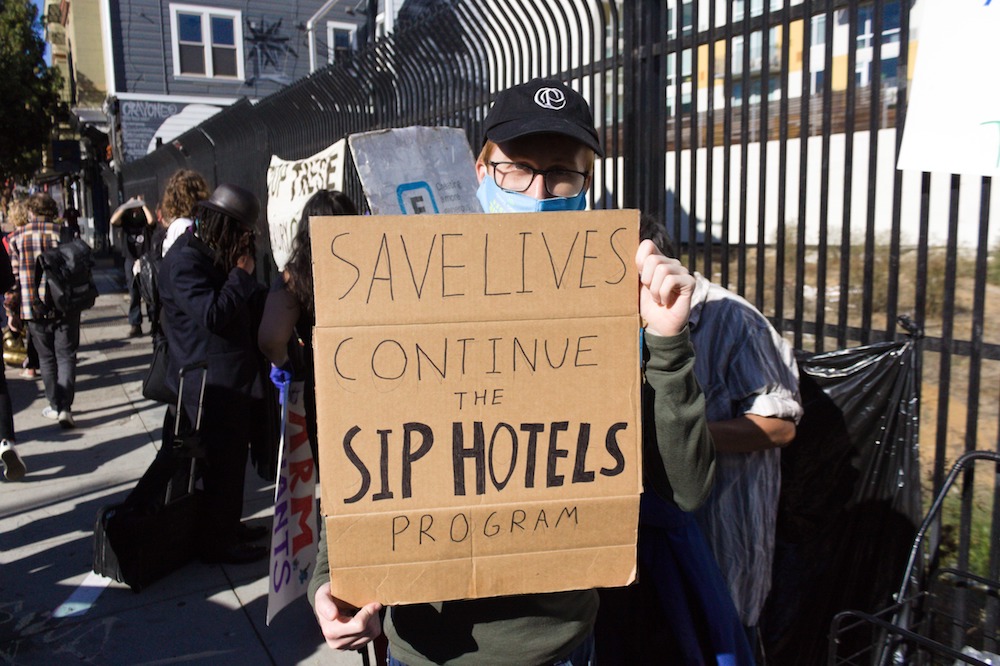
Naomi Schoenfeld, a nurse practitioner and medical anthropologist, said she witnessed “the direct and immediate improvement of people moving into the hotels. They went from street medicine to the clinics.”
She told of a woman who had lingering wounds and deep trauma from living outside—“and in the hotel her wounds began to heal and she is now living independently.”
The SIPs, she said—not congregate shelters of safe-sleeping spaces—“help and heal.
“They have literally prevented hundreds of COVID cases,” she said. “We must not close the SIP hotels.”
Dr. Rupa Marya, a UCSF physician and one of the founders of the Do No Harm Coalition, said that the hotels “provide a structure where healing can happen.” She contrasted that to the sweeps of homeless encampments that undermine the stability of residents and cause repeated and damaging trauma.
Nicholas Garrett, who had been living on the streets, said that with the hotel program, “people are getting care for the first time. People are getting treated for mental and physical issues. The hotels have allowed people to get their lives back together.”
On the other hand, Maria Campos was in a SIP hotel that got shut down. “They did not offer us another hotel,” she said. She wound up moving with her husband and 3-year-old son into a single room with another person—four in the one room.
“My son got sick,” she said. “They told us to isolate, but that’s not possible.”
Suzanne Portnoy, a nurse practitioner who works in street medicine, said that Yolo County offers a cautionary tale. When one city decided to shut down the SIP hotels, she said, “people exited to the street” and there was “deep retraumatization.”
That included depression, anxiety, and suicidal thoughts.
The federal government is still willing to pay the city to keep the hotels open. The public-health data is pretty clear: This is a program that is working, and changing lives.