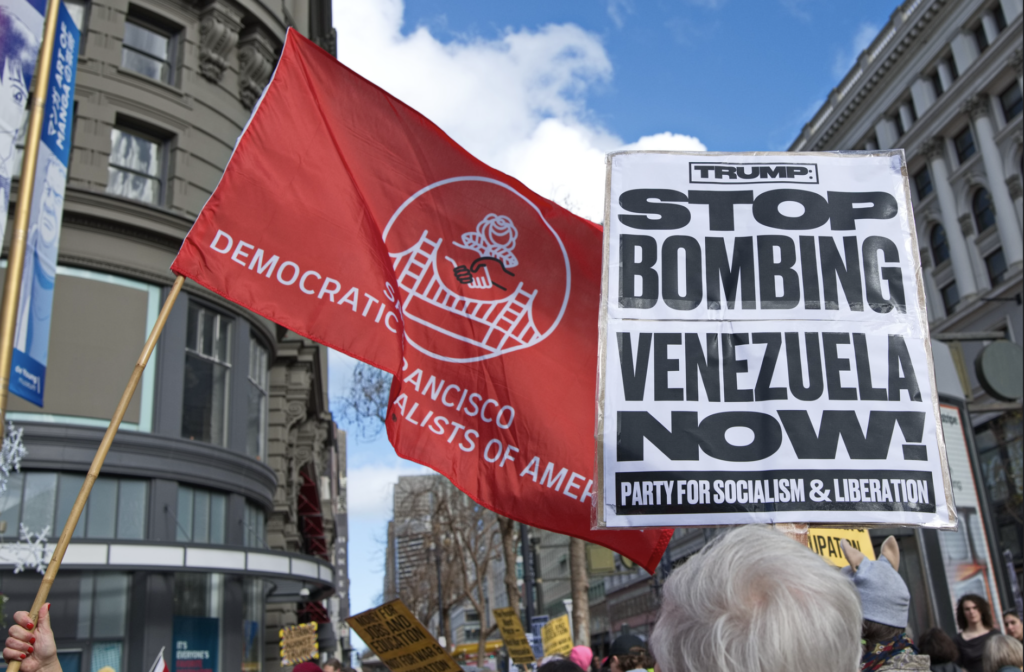
This weekend, Bay Area protesters mobilized against Trump’s illegal invasion of Venezuela, continuing a legacy of local resistance to US imperialism in Latin America.
It’s a long and powerful story.
The San Francisco I saw when I arrived in 1981 was a city seething with protest movements. I worked in the anti-nuclear branch, fighting PG&E and the Diablo Canyon nuclear plant, but many of my friends were involved in Central America solidarity, which became a long, lasting, and effective movement.
The US, under Carter and Reagan, seemed obsessed with fighting “communism” in two small, impoverished countries, El Salvador and Nicaragua. The lessons of Vietnam, where US intervention to fight communism was a terrible failure and the victory of the Viet Cong no threat whatsoever to US interests, was ignored. (Vietnam is still run by the Communist Party, but that nation and the US are now major trading partners and strategic allies, and Vietnam is a huge tourist attraction for Americans.)
Both countries had a history of US colonialism and brutal dictatorship. Both countries depended largely on agriculture, and in both, a tiny fraction of the population owned almost all the land. In El Salvador, a leftist coalition called the Farabundo Marti National Liberation Front (named after a revolutionary hero of the past) fought to overthrow the dictatorship, which launched a campaign of repression that included US-back death squads who murdered civilians with impunity. They killed the archbishop of San Salvador, Cardinal Oscar Romero. They raped and murdered US nuns. (I believe it was the late Abbie Hoffman who first told me: “US guns kill US nuns.”) And still, Carter and then Reagan gave the government arms and training.
In Nicaragua, the Sandinistas succeeded in 1979 in overthrowing the Somoza dictatorship, and established a functioning leftist government. This, of course, was utterly unacceptable to US business interests in the region and to the Reagan Administration.
In both cases, solidarity groups in the US, many of them based in San Francisco, organized against the US role in Central America. Groups like the Committee in Solidarity with the People of El Salvador, New El Salvador Today, and Casa El Salvador held increasingly large demonstrations. Some activists made the dangerous trip to the Salvadoran countryside to offer support.
Thousands of Salvadorans fleeing the violence wound up in San Francisco, mostly in the Mission, where they were welcomed.

There were San Francisco activists, including the late great Vivian Hallinan, in Managua for the inauguration of President Daniel Ortega after the Sandinistas took power. As the new government was trying to rebuild the war-town country (and redistribute land), the Reagan Administration created and funded a group of counter-revolutionaries called the Contras.
Massive protests against federal spending for the violent Contras, who were guilty of multiple human-rights offenses (and Reagan’s decision to secretly mine the Port of Corinto) led to the Boland Amendment, an act of Congress that banned the CIA from interfering in Nicaragua.
Reagan and his CIA director, William Casey, found a way around that, by illegally selling anti-tank weapons to Iran and using the money to fund the Contra war. Eleven senior Reagan Administration officials were indicted in the ensuing scandal.
I relate all this history because 400 San Franciscans protested Saturday against Trump’s actions in Venezuela. Not a huge rally—but the first rallies in solidarity with El Salvador and Nicaragua weren’t huge either. But they grew as the brutality, lies, and futility of the Reagan Administration’s actions continued.
That, I suspect, will continue—particularly is Trump goes forward with his plans to “run” a sovereign nation, potentially with US troops on the ground.
This is not about drugs; it’s all about oil.
Here is some critical background from Stephen Zunes, a professor of politics at USF and an expert on US foreign relations:
The U.S. attack on Venezuela resulted from having an incredibly corrupt and autocratic-minded president using his office to enrich himself and his supporters, deploying the country’s armed forces against his own citizens, abusing the justice system to punish political opponents, and manipulating the electoral process to try to stay in power.
And Venezuelan president Nicolas Maduro was engaged in similar behavior as well.
While there is no denying Maduro’s authoritarian rule, mismanagement, and corruption, that is not why the United States invaded. Furthermore, as with many previous U.S. military interventions, it is based on lies.
First of all, Maduro did not “steal our oil,” as Trump and other U.S. officials have alleged. Even putting aside the question as to whether the United States somehow has the right to another country’s natural resources, Venezuela’s nationalization took place back in the 1970s under the leadership of a pro-U.S. centrist government at a time when dozens of other oil-producing nations were nationalizing their oil companies. Rather than confiscating them without compensation, Venezuela agreed to international arbitration and paid billions of dollars to ExxonMobil, ConocoPhillips, and other U.S. oil companies.
Nor is because of Maduro’s authoritarianism. The United States remains the world’s biggest diplomatic supporter and arms supplier of the world’s dictatorial regimes, many of which are even worse than Venezuela.
More:
Ironically, Venezuela is not a major player in drug trafficking. Despite administration claims to the contrary, they play virtually no role in the manufacturing and smuggling of fentanyl, which is largely made from China and smuggled through Mexico. Venezuela ranks well behind other Latin American countries in cocaine production and is not a major transshipment point of the drug to the United States.
Meanwhile, Zunes says:
The Trump administration has been unable to explain how they will be able to control a country of nearly 30 million people, directly or indirectly. While many Venezuelans, like their counterparts in Iraq, may be celebrating the ouster of an unpopular autocratic ruler, it does not mean they support U.S. control of their country and its natural resources.
Vietnam protests ended the presidency of Lyndon Johnson. The Iran-Contra Scandal deeply damaged the Reagan presidency. I don’t know how far this will go, but the deeper Trump drags this country into an international military quagmire, and the more people are in the streets, the bigger an issue the Democrats will have in the fall.