
In a widely recounted story, the authors Kurt Vonnegut and Joseph Heller were at a party on Shelter Island, in New York, hosted by a billionaire hedge fund investor. Vonnegut tells Heller that the host probably made more money in one day than Heller will make in his entire life from the royalties on his best-selling book (and movie) Catch-22.
Heller responds:
“I’ve got something he can never have.”
And I said, “What on earth could that be, Joe?”
And Joe said, “The knowledge that I’ve got enough.”
That, in essence, is the theme behind on of the most important reports on climate change and global economics that anyone has produced in decades. It’s a model for Democrats to use to challenge the Heritage Foundation Project 2025. It’s written by brilliant and widely respected economists and climate scientists.
And it’s been largely ignored by the news media in the United States.
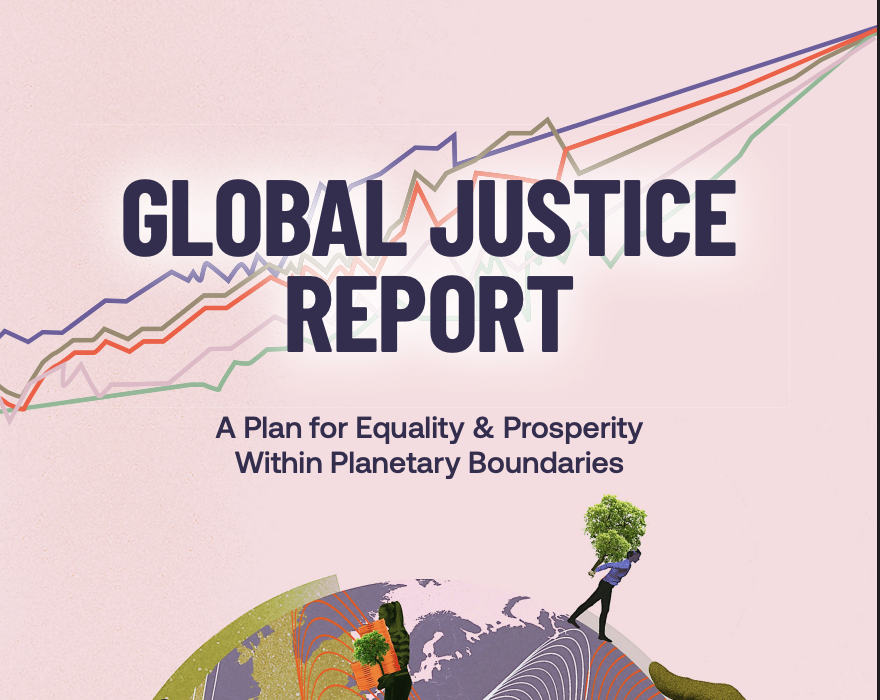
You can watch a video here that explains the basics. The world needs to redefine what is meant by income and prosperity. We need, as a global society, to shift to a model where we don’t consume more than we need, and the bottom half of humanity sees its share of wealth and income rise from 2 percent to 30 percent:
Against the bleak techno-authoritarian futures now being sold to us, a radical new vision for global progress in the 21st century feels urgently needed. The most credible vision is one in which the habitability of the planet is a precondition for human development and equality.
Our new report examines the conditions required for the world to progress towards this ambition on an economically and ecologically compatible path, by the end of the century.
Its conclusion? A global transformation that reconciles planetary habitability and high standards of wellbeing for all is possible – as long as three conditions are simultaneously met. Fast decarbonisation of energy systems is necessary. But we also need a major shift away from overconsumption towards “sufficiency”. This would involve a sharp reduction in labour hours and the use of raw materials, along with big changes in consumption patterns, food habits, land use and forest cover. Financing and politically sustaining decarbonisation and sufficiency will require a drastic reduction in inequality of income, wealth and power, between countries and within them. This reduction of global inequality is compatible with deep decarbonisation; indeed, it is a necessary condition for shared prosperity on a finite planet.
Note that the report does not discuss or demand any particular political system; it’s not about socialism, communism, capitalism, about European or US style electoral democracy … it’s just about economic and climate sanity.
It’s about the fact that nobody needs $100 billion, and that overconsumption is making the planet uninhabitable, and that a much better alternative exists, is feasible, will save humanity, and just takes collective will.
The New York Times has ignored it. The Washington Post has ignored it. The LA Times has ignored it. The SF Chronicle has ignored it. No national TV news outlet has covered it. Only the UK Guardian and Le Monde have reported on its profound conclusions, all of which are backed up by extensive, demonstrative data.

I will be honest here: This is never going to happen when most of the globe is currently living in a state of plutocracy, where a few radically greedy oligarchs control not only most of the wealth but most of the political influence.
Still: Even 20 years ago, the Heritage Foundation Project 2025 would have been dismissed as the works of a few far-right crackpots. Now it’s the law of the land.
I think it is more than fair to ask anyone running for any political office at the local, state, or national level to read the report and tell us if they agree and what they would do to implement its findings.
Sup. Cheyanne Chen has called a hearing Monday/8 at the Land Use and Transportation Committee to consider “the City’s Inadequate Progress in Meeting Mandated Affordable Housing Goals.”
Both the Mayor’s Office of Housing and Community Development and the Planning Department have presentations that, together, say the same thing: San Francisco is badly failing to meet state goals for new affordable housing—not because of community opposition or Nimbyism but because there’s not enough money.
The vast majority of the funding that has paid for affordable housing in the past ten years has been bond money. That’s limited, because the city has a lot of infrastructure priorities and can only issue new bonds when old ones are paid off. (Technically that’s not true; San Francisco could issue a billion dollars in housing bonds next year. But under the City Charter, bonds require the approval of two-thirds of the voters. The only way that’s politically possible is if the bond act doesn’t lead to property tax increases—which means it’s only possible if we keep the existing bond debt at the same level.)
There’s plenty of money from Prop. I, which taxes very high end property sales, for affordable housing, but former Mayor Breed and Mayor Daniel Lurie have diverted that to other purposes, like giving massive budget increases to the Police Department. Sup. Myrna Melgar is proposing a November ballot measure that would increase the Affordable Housing Trust Fund to as much as $125 million a year, and former Sup. Dean Preston and DSA are circulating petitions for a measure that would mandate Prop. I money goes for affordable housing.
Meanwhile, Mayor Daniel Lurie and Sup. Bilal Mahmood are looking to cut taxes on high-end sales (while mansions are going for record prices) in the name of encouraging more market-rate housing.
The transfer taxes have essentially zero impact on new luxury housing construction. Cutting them would just give more money to the very rich, at the cost of affordable housing.
That hearing starts at 1:30pm.
The Budget and Appropriations Committee is now getting into the details of the budget Mayor Daniel Lurie released June 1. A budget is, of course, a statement of policy priorities, and Lurie has made his very clear: The top priority is hiring more cops and arresting more people. The lowest priority is social services that help prevent crime, homelessness, mental health crises, substance use etc.
Several hundred city employees are losing their jobs, and at least 500 more positions that are currently vacant will be eliminated. that doesn’t count the hundreds more jobs that will be wiped out when the mayor cuts funding to local nonprofits that provide a lot of the city’s front-line services.
Friday/12 may be the most interesting day of the week. That’s when the committee will hear from the public defender, the district attorney, the sheriff, and the Police Department.
DA Brooke Jenkins is not only taking more cases, including silly cases, to trial, she is pushing for the courts to hold more people in jail awaiting trial.
Most of the people cops arrest in SF will need a public defender. That office has been forced to decline some cases because of severe staffing shortages. Meanwhile, the jails are an overcrowded mess thanks to Jenkins’ policies and a shortage of deputies.
Put simply, Lurie wants to be tough on crime, but doesn’t want to pay for the spillover costs. The abysmal conditions in the county jails are out of sight fand out of mind for most of the news media and many of the mayor’s supporters. The DA’s Office gets all the money it needs, and the press loves it when someone is convicted of a serious crime, but the lack of adequate legal counsel for indigent defendants isn’t front-page news.
I hope, with all of those parties in the room together, the committee members can ask: How can we fund one part of the criminal justice system and not the rest of it? Why can’t we link funding for the cops and DA to funding for the public defender? And what are we going to do about the crisis in the jails?
That hearing starts at 1:30.
In all the social media chatter about Prop. D and taxes in general, I am seeing a lot of misunderstanding about what taxes are and why they exist. Taxes are, of course, a primary means of funding government services. They are also a tool to discourage bad behavior: High taxes on cigarettes and sugary beverages discourage kids from buying those deadly products. So a tax on companies that overpay their CEO might give those companies a financial incentive to lower the wage gap.
But there’s another reason for taxes, one that most of the debate on the topic ignores. Today, taxes are one of the few effective tools for reducing economic inequality. Taxing the rich isn’t just about revenue; it’s about cutting the wealth gap. The economist Thomas Piketty argues that taxing the rich is the only way to solve the existential crisis of economic inequality. The Harvard scholar Susan Fainstein notes that “equity is by definition redistributive.”
Taking money away from the rich also dilutes the ability of the oligarch class to control politics.
So taxes on high-end real estate, overpaid CEOs, and the wealth of billionaires serve perhaps the highest purpose of government policy today: Promoting economic and political justice.
Just for the record.