San Francisco has changed profoundly in the past 25 years, and not always for the better. It’s safer: In 1990, the city had 102 homicides. In 2024, 35. But it’s also far more expensive, far whiter, far less diverse in general, and lacking in the underground, cutting-edge creative counterculture energy that attracted people like me in the first place.
The roots of that transformation go back to Aug. 9, 1995, when a company called Netscape, that made a browser for the World Wide Web, had its initial public offering on Wall Street. Suddenly, vast sums of venture capital poured into the city as the dot-com boom took over San Francisco life.
Massive fortunes were made over the next decades. Massive numbers of working-class families lost their homes to displacement. Homelessness increased, as even people with jobs were forced onto the streets by greedy landlords and soaring rents.
Tech companies like Uber, Lyft, and Airbnb broke the city’s laws with impunity, destroying the lives of cab drivers and turning rental housing into hotel rooms, while Mayor Ed Lee either looked away or encouraged the illegal startups. Developers built luxury condos downtown, and many were bought by international speculators who never lived there.
Now we’re living through another tech boom, this time in AI—and it appears the people who run the city haven’t learned the lessons of the past.
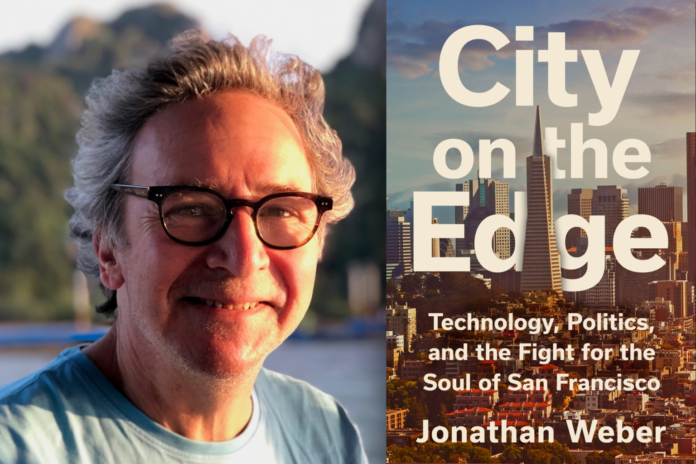
So it’s useful to reflect on that period between 1990 and today, and that’s what longtime journalist Jonathan Weber has done in his new book, City on the Edge. Weber and I don’t always agree on politics, but he’s an old friend and an excellent reporter, and the book covers the period with exceptional detail, told through some of the characters that defined the era.
I got to talk to Jonathan recently about the book and the history that both of us lived through. A transcript follows, edited for clarity.
48HILLS It’s particularly interesting to talk about this because I lived through all of it, and you live through a lot of it.
At one point, I think you talked about how you kind of saw this as a, in a weird way, a sequel to David Talbot’s book, Season of the Witch.
JONATHAN WEBER I never explicitly conceived of it that way. Talbot’s book was great, and mine is similar in that it kind of covers an arc of time the city and, and in some ways, I kind of pick up a little bit where he left off.
48HILLS One of the themes that comes through here that I have found really interesting is, you talk about the birth of the internet in San Francisco, and you also talk about things like Burning Man and how, you know, the early days, the early days of the Internet in San Francisco were a really creative time.
And it was a lot of young creative people, although not all.
My first experience was the internet with the internet was through the WELL, the Whole Earth ‘Lectronic Link, which was founded by Stewart Brand, which is coming out of the ’60s hippies era and the Whole Earth Catalog, and then they got into this technology, and it was all about making connections.
And it was all about doing incredibly cool creative stuff. And then Netscape went public, and Mark Andreessen became a billionaire, and all of a sudden, from my perspective, having been here, the vibe changed completely.
It was no longer about being creative and fun and Burning Man. It was about getting rich and getting rich fast. And that really, that now we’re talking dot-com boom one, but that really changed San Francisco’s attitude kind of dramatically.
The people who moved here were not people who moved here to be creative. There were people who moved here to get rich quick. And the venture capitalists got involved. All this vast amount of Venture capital pours into San Francisco. And so maybe you can talk a little bit about that era and that change.
JONATHAN WEBER Well, I think that’s right. In the very early days in the early 1990s when the Internet, as we know it, first being developed, the World Wide Web, that was a time of great creativity and the kind of cultural dynamics of the city, the kind of tendrils of the counterculture that had marked and developed into a different kind of underground culture.
A lot of people who were interested in technology were also interested in that culture, people who were interested in the Internet often were explorers of some kind. We’re curious, we’re looking for new interesting things. And so there was a real kind of cultural affinity.
In those early days, there was a lot of idealism about what this tech would bring, and it was going to make a better world. It was going to connect and empower people. It was a new kind of economy, the new economy would be less hierarchical and more egalitarian, more inspiring. And then in the mid-1990s, as you mentioned, Netscape went public, and that’s referred to still in Silicon Valley as the Netscape Moment, when venture capitalists realized that this was a gigantic business opportunity.
And so a lot of money began to pour into the business. So, yes, I think that brought a very big and fundamental kind of change.
At the same time, it was a change that didn’t really happen quite overnight. I mean, the Netscape Moment was a moment. And then from that point, Venture Capital and the financial dimension of the tech industry was very important. But it wasn’t really the only thing.
And even in the 2000s, I would argue after the dot-com bust, there was a period of really a lot of creativity that was about the money, but not exclusively, not like it is now.
48HILLS There was a period when people would fly into Burning Man in private planes and have these special rich people camps, where the young people who had made millions of dollars in tech startups would have people cook for them and take care of them. And it became a luxury vacation as opposed to an artist colony.
JONATHAN WEBER That’s why Burning Man is in a sense a character in the book, and it really is such a perfect metaphor for the city in so many ways, with that being one of them.
So in the city, there was a lot of resentment over rich people coming in and buying up the houses and squeezing everybody out and creating this kind of two-tier society in the city.
And so similarly at Burning Man, there was a very, very similar dynamic where, as you say, rich people came flying in with teams to cook for them and their own private camps and this kind of stuff.
And the organizers tried to outlaw some of that stuff. They’ve tried to crack down on that in, in different ways.
But first of all, it’s not that easy to do, right, to enforce certain kinds of rules. And then they do actually need those folks to keep the operation going, so they don’t want to piss them off.
48HILLS In the second tech boom in San Francisco, which I’d like your thoughts on, the city under Mayor Ed Lee stopped enforcing its own laws. I mean, every single Airbnb listing in San Francisco was illegal. San Francisco did not allow short-term rentals. Every single Uber ride was illegal. Every single Lyft ride was illegal. The Google buses were illegal. They were parking in the Muni stops.
I actually cornered a parking control officer at one point and said, look, that bus is parking in the Muni stop. If I do that, I get a$ 271 ticket. Why aren’t you ticketing them? And the guy said to me, because we were told not to. And basically, Ed Lee’s love of tech became this laissez faire thing where basically people were making a fortune by breaking the law. I know the tech industry loves to say move fast and break things, but they were breaking laws that the city had for very good reasons.
There are very good reasons why you needed a license to operate a taxi cab. There were very good reasons why you can’t have short-term rentals. It displaces renters. And, you know, Airbnb probably displaced 10,000 San Francisco renters while Brian Chesky became a billionaire. And that really, that kind of attitude—because we’re in the tech industry and we’re about to get really rich, we don’t have to follow the rules that everyone else follows. And that kind of became the ethos for a while.
JONATHAN WEBER I think that certainly in some of those businesses that you mentioned, the strategy was that cliche: better to ask forgiveness than ask permission. So the theory was that we’re just going to push ahead and, and, and do this stuff. And when people come to stop us, well, we’ll cross that bridge when we get to it.
In the case of, of Uber in particular, you know, I do think that the city made its own bed in many ways because they were just unable to solve the problem of the taxis. Like, you couldn’t get a freaking taxi. Every person in San Francisco had known this for many years, and it was a constant source of irritation that you could never get a taxi when you needed it. And you had this ridiculous system where, they didn’t have a central dispatch, so you had to call, like, the individual companies. And it was preposterous.
And so that fact is what opened the door.
When Uber came along and, and then the city is like, no, no, you know, we got to shut this stuff down. But then the state PUC was like, well, but, but how are you going to solve the cab problem?
48HILLS But the city didn’t say we’re going to shut this down. I actually met with the head of the Taxi Commission when Uber and Lyft were first starting. And she told me, these are illegal. These are dangerous. People are going to get assaulted. We cannot just let anybody drive a cab. And I want to stop this. But my boss Ed Lee said to let it go.
JONATHAN WEBER But again, people liked Uber, you know? People did not want Uber to be shut down. Then finally they hired Susan Kennedy and got the state to write the law that they wanted.
49HILLS But the real killer of this is right before Uber and Lyft started operating. The city shifted its taxicab model. And instead of having medallions issued by seniority, they started selling them. And the city brought in like $50 million and they sold these medallions for $300,000. And the cab drivers took out loans. To buy these, like a mortgage. And then Uber and Lyft came along, and within a year, those medallions were worthless. And I feel bad for the cab drivers because the city didn’t enforce its own laws, but also did nothing for the cab drivers who were now in hock for the mountain of a mortgage that they could never pay off.
JONATHAN WEBER I mean, the city, this was screwed up royally.
48HILLS And landlords really liked Airbnb, too, because it was a way to make money and not have to worry about tenants. You just get rid of your tenants and you turn this into short-term rentals. You can make far more money.
JONATHAN WEBER Yeah. I actually don’t really know why the city didn’t really enforce the law.
48HILLS Oh, I know why. Because, because it was a local tech company and Ed Lee said, don’t enforce these laws. I mean, literally the people in the Planning Department who oversaw this told me: We were not supposed to enforce this law. Because we’re encouraging tech companies and innovative stuff. And that led to thousands of evictions. Tenants lost their homes, but it was popular.
And then, of course, afterwards, after it became popular than supervisor David Chu worked out legislation to regulate it and allow it in certain circumstances. Which they could have done from the start. The first time they saw one of these things, they could have said, OK, no, you can’t do that. We are going to find you. But if this is a model that people want, let’s figure out how to regulate it. Instead, the Mayor’s Office let it go until it was out of control. And then the supervisors had to retroactively try to figure out how to regulate it.
JONATHAN WEBER Right, right. I agree. The law they ended up with is the thing they should have arguably started out with. Or some version of it. It’s not that strict of the law compared to New York. But it still seems to eliminate a lot of the Airbnbs.
48HILLS I want to move on to the latest, the AI boom, because I know we’re both fascinated by this. So now we have another whole tech boom. And it’s creating a different weird kind of problems. I mean, now it’s not apartments in the Mission where we’re seeing displacement. It’s a shortage of mansions. They can’t find enough $10 million houses for people who are coming out here and getting these insane salaries and people are trying to trade their house for Anthropic stock. And in a weird way, I’m reminded of the first dot com boom, when it’s like all these companies are raising money with really little business plan.
It just seems like there’s just an awful lot of VC money and speculation going on here. And it just seems to me it can’t last. What do you think?
JONATHAN WEBER Having seen my share of bubbles, it definitely has the feel of a bubble, if you look at any traditional valuation metrics, they don’t support the valuations of a lot of these companies.
These things are tricky. If you look at it from an investor point of view, the valuations aren’t really supported by any, any traditional metrics and all of this makes no sense. So most of the things that you could say about the current situation, you could also have said 18 months ago. In the meantime, people have made a lot of money.
The fact that it’s a bubble doesn’t mean you should sell everything now, you know, because it could go on and the bubble is where all the money is actually made. If it happens tomorrow, that’s a very, very different thing than if it happens in three years.
48HILLS One of the interesting arguments that I have with people about this entire period of San Francisco history and particularly with folks from the more conservative perspective is they say this was all a failure of the progressives in government.
The problem is we haven’t had a progressive mayor since Art Agnos. All this period you’re talking about, we had, we had Willie Brown. We had Gavin Newsom. We had Ed Lee, we had London Breed. All of them were at best moderates. And the mayor in San Francisco has, as you and I know, because I wrote a piece for you about it, has a tremendous amount of power.
JONATHAN WEBER Yeah, well, I guess, you know, my, my takeaway broadly is that the kind of moderate-progressive debate and the importance of that is kind of exaggerated in a way. My read is that for this entire period, from the election of Willie until 2024, you had his notion of kind of the “city family.”
And the progressives were kind of part of it, too. And so you can say the governance failures of the city are the fault of the city family, which is, which includes both progressives and moderates. You know, it was like a collective, it was a collective failure. Everyone shares some responsibility.
48HILLS I look at the Airbnb thing as a classic example where five progressives on the board of supervisors led by David Campos wanted to strictly regulate Airbnb, more on the level that they’ve done in New York and other places. The moderates, led by David Chu wanted to allow airbnb to, to operate with far less regulation. And that was a huge fight. And it came down to a 6-5 vote. And Airbnb got everything it wanted.
But it’s not because the progressives weren’t trying to regulate. They were just outvoted. They just didn’t have the power to do this. But I think there were a lot of people who are really fighting back against a lot of this stuff. And, you know, David Campos had a bill that would have limited evictions. And he narrowly got it through. And then the courts threw it out.
So it’s not like there weren’t progressives trying to make policy. It’s just they were either overridden by the mayor or they didn’t, they couldn’t, they couldn’t get the six votes. And I think Airbnb was a classic. Big Tech and real estate won. And it wasn’t that the progressives weren’t trying. They just failed. They didn’t have the votes.
JONATHAN WEBER Sure, yes. But do you really think that would have fundamentally changed the trajectory of the city? I mean, the things that people are really upset about don’t have anything to do with that.
48HILLS But at the time they did, because the time we were seeing lots and lots of low income tenants thrown out of their homes so they could be turned into Airbnbs. This Airbnb fight was not about tech. It was about evictions. That’s what it was about. And I think we might have saved five or ten thousand renters if we had more strictly regulated Airbnb. And nobody at City Hall was on the side of the poor cab drivers. And I understand they made their own mess. But for the love of God, you can’t sell them a permit for $300,000 and then turn around next year and make it worthless.
JONATHAN WEBER Again, I would just emphasize that I think that sometimes the liberal/progressive vs. moderate divide, I think it’s outlived its usefulness. For one thing, as a category, especially now, I just never understood what “moderate” was supposed to mean exactly.
I think that in the same way that Gavin Newsom, in response to the criticism that we didn’t really get that much done while he were mayor, he would say, well, it was this obstructionist Board of Supervisors that wouldn’t let me do anything. So, the progressives say, well, there was these terrible mayors, and then the mayors say, well, it was these terrible progressive supervisors… Well, I say yes. It was both of you.
I disagree with my old friend Jon. There are two sides in local politics, and one side has made the situation far worse, and the other side has tried to make it better. But that’s a discussion for another time.