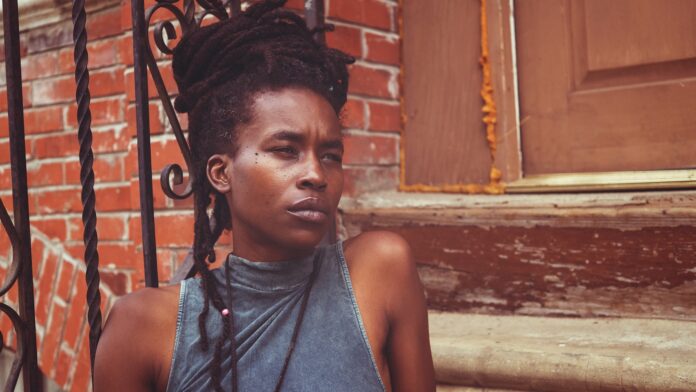
2016 was the first year Camae Ayewa aka Moor Mother performed at the San Francisco Electronic Music Festival. In the decade since, Ayewa has fronted the jazz group Irreversible Entanglements, released solo music, published multiple books of poetry, served as a music professor, and through her work with partner Rasheedah Phillips, offered seekers a new orientation to space, time, and living through their collective Black Quantum Futurism. Most recently, she contributed to a sound installation at the Venice Biennale featuring works by Brian Eno, Kali Malone, Patti Smith, Laraaji, and other revered names in ambient, sacred, and experimental music.
This weekend, Moor Mother returns to headline the 25th annual San Francisco Electronic Music Festival (Thu/14-Sat/26 at The Lab, SF). The three-day event brings together an exciting and eclectic array of performers who push technological and genre boundaries, including Paul Demarinis, Rrose, and The Gleaners. Ahead of her performance, I spoke with Ayewa about her upcoming solo album Translations, working at the women’s prison in Venice, her wish to connect with the Bay Area poetry scene, and how she maintains peace and solidity with the busy schedule of a multi-hyphenate.
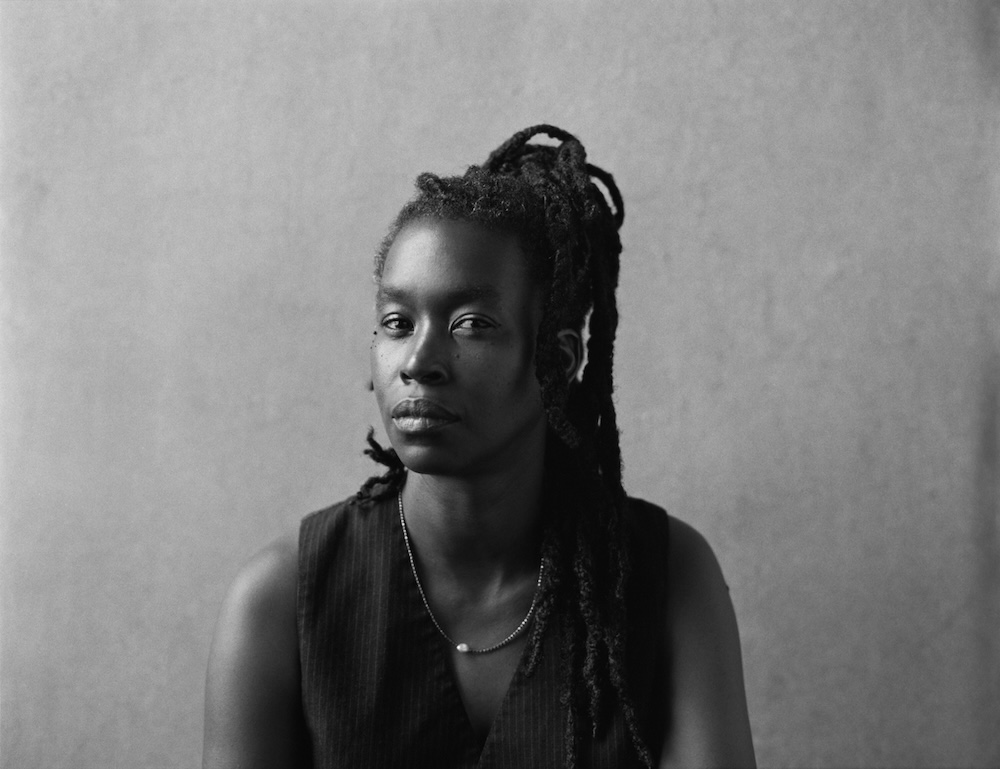
48 HILLS Through November 22, visitors to the Venice Biennale exhibit “The Ear is the Eye of the Soul” experience an outdoor sound installation inspired by the life and work of the 12th century German saint Hildegard of Bingen. The title of your piece, “Spirit Visions,” which plays through the visitors’ headphones as they wander through part of the garden, alludes to the visions of God that Hildegard experienced throughout her life. Had you engaged with Hildegard before working on the piece?
MOOR MOTHER As far as composing around her work, no. I definitely have an interest in religion—hopefully people can see that in my work. I deal a lot with the occult. A lot of people kind of miss that in my work, because it’s really up to what you’re reading. Or, how deep down the rabbit hole you go when we’re talking about the esoteric or spiritual, or prophecy. I’m very interested in those windows of knowledge. I care about mothers and women, and it’s important for those stories to be illuminated, [those of] folks who were spiritual guides or lights in this world that are too many times dismissed and forgotten.
48 HILLS You’re also participating as a mentor and teacher at Venice adjunct program Biennale Musica. Can you share more about your work there, including in the women’s prison?
MOOR MOTHER One of the projects we were doing this year is going into the women’s prison in Venice and creating an outdoor installation using the women’s voices and things that we collected from the workshops there. Whether that’s poems, conversations, or sounds from a jam session, the workshop is a chance to come together.
It’s a lot of consideration with the outside world. In art systems, they will have you believe that there’s no consideration with the outside world. But we don’t pause the outside world, and we can’t see ourselves above nature, and we can’t see ourselves above the past. A lot of institutions would want that. It’s a disservice to artists to have them compartmentalize their work—”Oh, let’s make this more commercial” or “Everyone’s going a little country, let’s do this.” Being reactionary in your art practice versus being a sponge and soaking in everything, all the experiences that are taking place here.
48 HILLS Your Venice projects alone demonstrate how you work beyond the typical models. How do you see artistry?

MOOR MOTHER We say “artist” and we all think that we’re on the same train. Like, it encompasses all of us. It’s so weird. It’s like we say “Black people,” as if it’s all the same type of person. It’s not. It’s many facets of what an “artist” is and could be. You could be a woodworker, a carpenter—that’s artistry.
And then, these women that I meet in this prison. It’s so heartbreaking, because it’s outrageous the charges they have. Basic needs charges, when you’re trying to get clothes, food. You understand when I say “basic needs charges” [essential daily needs incarcerated people must pay for themselves]? It’s nothing violent or hurting systems. It’s just heartbreaking. One of the best poets I heard all year is an older Italian woman in the prison.
48 HILLS You played at the San Francisco Electronic Music Festival in 2016, and now you’re coming back again for the 2026 edition. How was your first experience at the festival?
MOOR MOTHER The experience that I had the first time is so important to me. Moments are very important when they’re well-curated and cared for. When I performed the first time, I was on the bill with Pamela Z and Maja S. K. Ratkje. It was just such a blessing. I will forever be grateful for the experience.
That’s the trajectory that I want to be on: To be seen as a spiritual seeker, a writer, a deep healer, a woman. It’s so rare, but actually the majority of healers are women. We don’t get that story.
I’m going to take an opportunity in San Francisco to do something new, to do something that I’ve been musing over in my mind. And I don’t know how much dedication I will keep to my vision, but I want it to be all voice.
48 HILLS You emphasize the importance of place in your work. When Irreversible Entanglements performed at The New Parish in 2022, you urged the crowd to connect to the space, physically, and see what was happening in Oakland, in the surrounding city blocks. You shared a similar urgent message in San Francisco during a workshop you hosted at The Lab. How do you think about connecting people with place?
MOOR MOTHER: That’s the practice. That’s the framing. We think about frames as boxes, but I’m not a carpenter; I’m a visionary. So the frame is just an idea, and I make sure to focus and work within that frame. So like “space,” “place,” “home,” “mothers.”
I start with “mother,” which is another type of label, but I try to go beyond the American context or world context. Mother, to me, is the first home. I move from that, and understand how the quality of your mother’s home, your mother’s womb, affects your life. It’s very basic. It’s right in the body, the body of the place, space that you’re in.
48 HILLS With such a full schedule, what specific practices keep you grounded?
MOOR MOTHER: I definitely need a lot of doing nothing time. Just spacing out. I’m a big daydreamer. I need time to just look out into nothing and visualize. A lot of things I need to visualize or feel in some way to do it. I’m not very good at things where I don’t have the opportunity to feel it. Admin work is hard for me. Going back over old stuff is hard for me, because I already felt it.
It gets a bit difficult, because you have a family and you have responsibilities, but I just try to create space in the morning. I try to wake up a little bit earlier so I can have time. And it’s great. When I don’t get to wake up earlier, oh my gosh. You know, it’s like I’m already jumping into the pool. But I like to clean the pool, and make things nice before I get in. So that’s been one thing, getting up earlier is a clutch move.
The schedule thing, you got to keep working it to make it better for you. Each year I write down how I can try to make my tour schedule better: How can I make it more impactful? How can I go to more places that I actually want to go? How can I be intentional about the people there? Time management is a big deal. I’m not perfect or even great, but I understand that it’s a work in progress and I make sure to improve on it after every tour.
48 HILLS You’re from the East Coast and have recently done a lot of work in Philadelphia, but you’ve said your next album is California-centric. What does that mean?
MOOR MOTHER California is so tied into it. Is this a musical place? Is this a showmanship place? Has the music industry been tainted by Hollywood? These questions come to me.
It’s so hard to really talk about this place and the record—it’s too deep and layered. You have to go outside here. You really have to go outside and go through the rocks. Go through the rocks of the place. My process is called “Anthropology of Consciousness,” so I’m about getting underground. That’s my life journey even as a Scorpio. I’m very comfortable in the underground. Hades is a friend of mine. But it’s a lot to wade through.
So the simple way of answering that question: The album, yes, uses California personnel and a California studio, but it’s really about making the whole world smaller. It’s called Translations. And I have people from all over the world translating my words and adding to the music. It’s just my journeys of the past 10 years as a touring professional. All the people that I met, they all made a big impact on me. And I bring in as many of them as possible.
So that’s the record. It’s about making the world smaller and going towards a human language, not a language bound by borders or war. Human language where we all are connecting.
48 HILLS Anyone who has listened to your music or read your poetry knows you’re an optimist. But when you led a poetry workshop at The Lab in San Francisco in 2022, you sensed something was off. You noticed we were in our heads a lot, that we weren’t in our bodies. Instead of just being able to write freely, you said we were “too smart,” overthinking and trying to intellectualize everything before putting pen to paper. Four years later, what would you say to the poetry-minded folks still living here in the Bay Area?
MOOR MOTHER: My perspective was that the workshop was so pessimistic. It felt like I was wrestling with positivity or this optimistic vision. That’s why I ask a lot about what’s happening in California whenever I’m there. I don’t know the poetry scene there.
I want to get more into the poetry scene in San Francisco and Oakland. Because after that workshop, I was wrestling. Tell them to bring me to San Francisco and Oakland more, OK? Put out an SOS.
And shout out to my Oakland friends, and shout out to the DIY scene in general. When I first went to Oakland and San Francisco, it added to my optimism and it made me feel like how I described that first concert, that I could be amongst the changemakers, the lightbearers, no matter where I am, not just on the East Coast. I want more of that.
MOOR MOTHER AT SAN FRANCISCO ELECTRONIC MUSIC FESTIVAL Sat/26, 8-11pm. The Lab, SF. Tickets and more info here.