This is Drama Masks, a Bay Area performing arts column from a born San Franciscan and longtime theatre artist in an N95 mask. I talk venue safety and dramatic substance, or the lack thereof.
That election didn’t turn out as well as it could have, did it? Sure, Connie Chan’s off and runnin’ to November, and election-meddler Chad Bianco (who should have been disqualified for stealing ballots) came nowhere close to winning. But Danny Denim got pretty much everything he wanted for his rich handlers.
That means the rest of us may get even less than we were before. He won’t tax his fellow richies, but somehow expects money to magically appear for his multi-billion-dollar city budget? If he thinks SaaS arms dealers OpenAI and Anthropic will use that IPO cash* to invigorate us, think again. The only possible place to make cuts are essential services and the arts. That won’t come anywhere near to balancing the budget, but he’s likely to do it anyway. Arts communities, already having a tough go of it, are about to have it even tougher in The City by the Bay.
(*Incidentally, I glanced past a story about OpenAI’s upcoming IPO to read this story about the rapid rise-and-fall of a Dot-Com “unicorn,” also based in SF. I remember the Dot-Com boom and bust, and I remember the market collapse of 2008. The sooner the AI bubble bursts, the better.)
As is often the case, goings-on in SF tend to overshadow things that happen in the East Bay. Hey, when your region is called “The San Francisco Bay,” it monopolizes the conversation—it’s not the East Bay’s fault (unless, of course, they do something like rename an airport to something stupid and confusing). Nevertheless, there’s always something going on across the Bridge that’s worthy of your attention.
Things have been as grim for their theatre scene as it has for SF’s. Recent years have seen the shuttering of Bay Area Children’s Theater, Cal Shakes, PianoFight-Oakland, and Aurora, to name a few. This is especially precarious for the East Bay because SF not only benefits from an eclectic mix of arts, but also the fact that the city’s small size means that traveling within it to venues is relatively easy. The East Bay has no shortage of arts, but its large size can be intimidating. The fewer options in one particular area, the less likely one is to travel to that area at all.
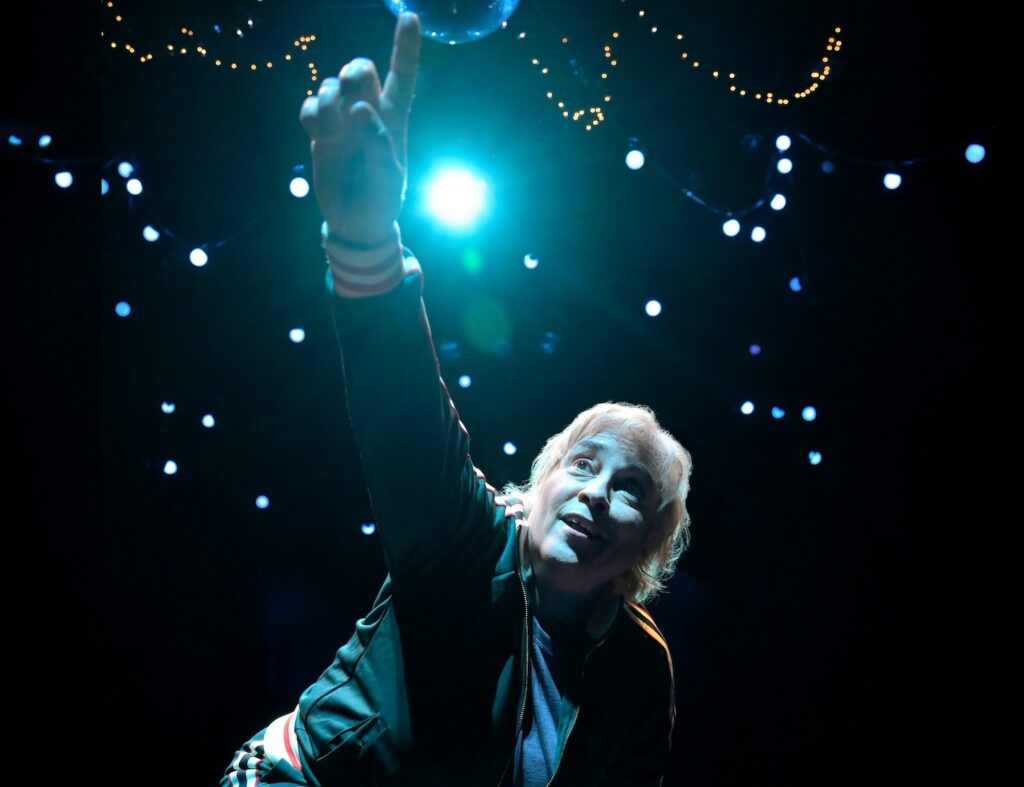
That’s why it was a pleasant surprise this week to see that Berkeley’s Aurora Theatre—which announced its closure over a year ago—announced its pending return… sort of. The company itself is coming back, but things will be different: They’ll have a new AD in Jennifer King, and they’ll be renting a space rather than performing in their namesake Addison Street address, two doors down from the Berkeley Rep.
Not much else can be made out from their announcement, but one can’t deny the significance of the return of the company that world-premiered the excellent Eureka Day (written by my former boss, no less) and staged razor-sharp Noël Coward productions. It’s tempting to think that they’ll follow in the footsteps of Oakland Theater Project and use the loss of a permanent home to free them from the restrictions of operating in the same venue over and over.

Yet, this week’s Aurora news was tempered by subsequent news that their former Berkeley neighbors, Central Works, have begun prep work for their final show: a two-part, repertory production based on Machiavelli’s The Prince. One can’t help but ponder the paradox of one’s swan song being a work about not going down easy.
As much as I despise the new name of Oakland’s airport, I have to admit that it does illustrate the odd symbiosis between SF and the cities surrounding it. They exist autonomously of SF, yet everyone major satellite entity (be it the Niners or Silicon Valley) knows the power of having SF on your address and mailing material. As I read this week’s back-to-back announcements about Aurora and Central Works, I wondered what this said about the East Bay as a whole in terms of its artistic away from SF. I figured I may as well put the question to the folks themselves. Fortunately, I got an answer before filing this story:
“The East Bay has always been home to extraordinary artists and adventurous audiences,” said Aurora’s new Managing Director Jenn Ruyget. “We believe that Aurora’s announcement reaffirms that there is still a deep hunger for intimate, artist-driven theater and a community willing to come together to sustain it. Aurora’s next chapter is being built on that belief.”
Here’s hoping that next chapter features more openings. Lord knows they’ve got plenty of space across the Bridge.
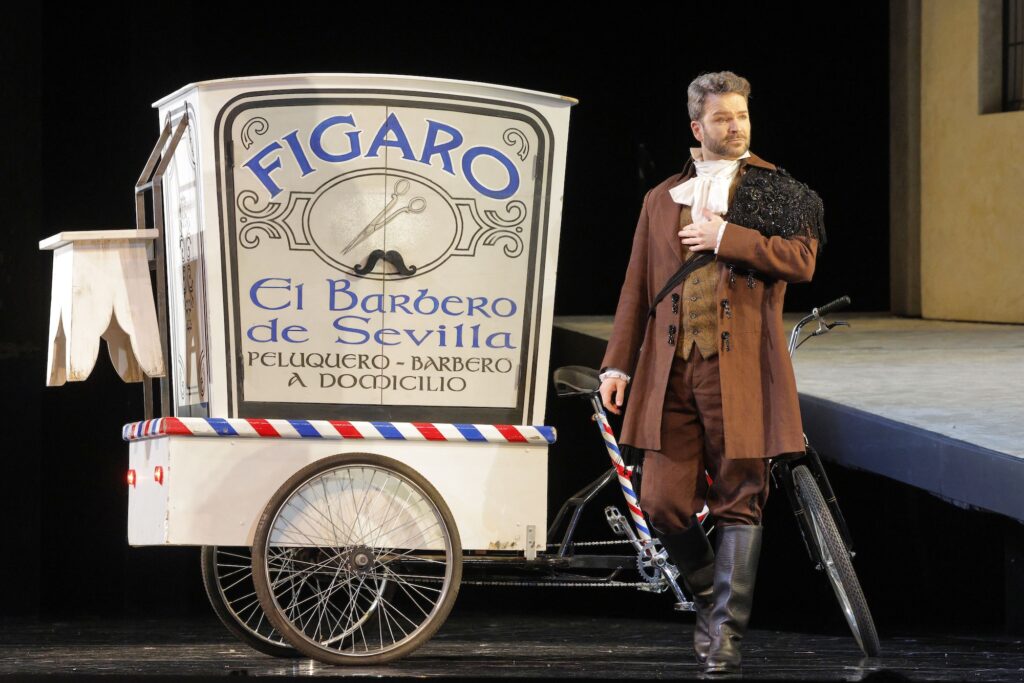
The Barber of Seville at SF Opera
Rossini’s 1816 The Barber of Seville (through June 21 at the War Memorial Opera House) isn’t meant to be followed along like a conventional story. No, it’s meant to be observed, like a circus performance. It integrates every single “opera buffe” trope of its day to create the slapstick sitcom that we know now. It does everything short of having someone throw a pie, and I’m pretty sure that’s because they shaving cream already resembles pie filling.
You know the tropes without having seen the show before: boy (Count Almaviva, played the night I saw it by South African tenor Levy Sekgapane) falls for girl (Rosina, played by German mezzo Maria Kataeva), and she falls for him, but her legal guardian (Don Bartolo, Italian baritone Renato Girolami) won’t have it—mainly because he wants her for himself. This leads our love-struck young lad to the most logical conclusion: fake his identity to get into the guardian’s house and employ the aid of jovial barber (Figaro, Canadian baritone Joshua Hopkins) to enact hilarious machinations that will win him the heart and hand of his lady fair.
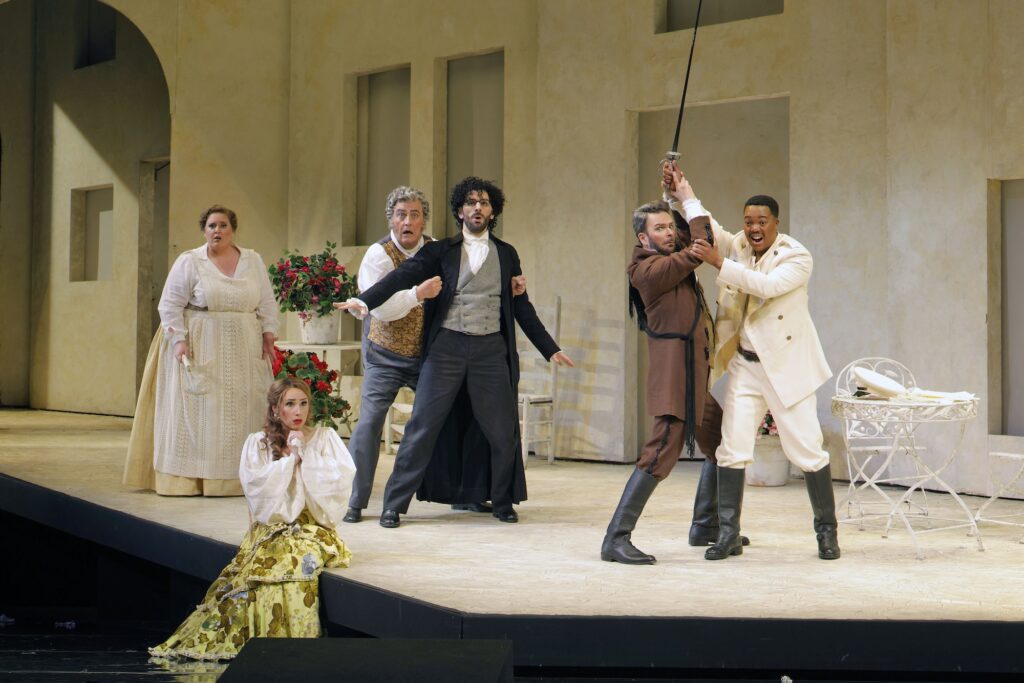
Spanish director Emilio Sagi approaches the material knowing he’s competing with Bugs Bunny for where this opera sits in the public consciousness (or, at least, it did before Warner Bros hid everything behind a streaming paywall). He brings with him countryman Llorenç Corbella to add moving sets that seem as if from a Buñuel dream, yet work with the slapstick. As such, Sagi can revel in his cast’s cartoonish physicality, knowing that their vocals won’t be much of a worry. Having said that, it’s noticeable when Hopkins never quite pulled off the verbal juggling act that is “Largo al factotum.” By the time he got to the famous “Figaro! Figaro! Figaro!” sequence, he already sounded exhausted. Still, everything stayed on a vocal and visual high note.
Having streamed the show, CO² levels weren’t a concern (I only saw a handful of masked patrons in the audience). After 200 years, The Barber of Seville doesn’t ask much of its audience. Just show up for characters taking pratfalls for love and power, then you won’t be disappointed.
THE BARBER OF SEVILLE runs through June 21 at the War Memorial Opera House, SF. Tickets and further info here.