Read Charles Lewis III’s review of Alleluia Panis’ Burden of Proof here.
Alleluia Panis, the artistic director of American Pilipino company KULARTS, has carved a fascinating space in local dance, combining Pilipino tribal and traditional arts and American contemporary forms.
One of her themes has been the stories of Pilipino healthcare workers, creating striking performances through which she illuminates the trauma and resilience of the Pilipino diaspora. Another theme has been incarceration and its effects on family and community. 2023’s Nursing These Wounds meditated on colonization and exploitation while highlighting caregivers and ancient ceremony. Incarcerated 6×9, from 2018, was “inspired by the real-life accounts of young Pinoys and Asian Americans incarcerated between 1966 and 2008.”
Her latest, Burden of Proof (through Sun/26 at Bindlestiff Studio), straddles those two subjects by imagining the true-life story of Pilipina nurses Leonora Perez and Filipina Narciso, who were wrongfully convicted and incarcerated for the 1975 deaths of patients at the Veterans Administration Hospital in Ann Arbor, Michigan, until a judge ordered their release due to the prosecutor’s “overwhelming prejudice.”
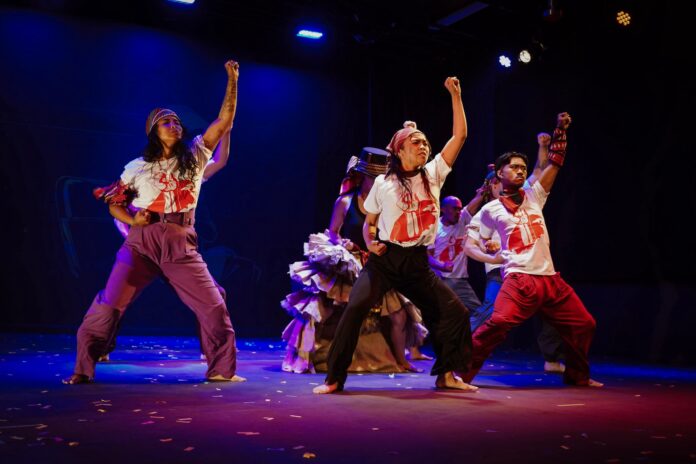
The work is Panis’ most ambitious yet, an immersive dive into the effects of institutional racism and generational trauma, using the words of Leonora herself and her son Jason Magabo Perez, the 2024 San Diego Poet Laureate who helped build the piece. Burden of Proof is augmented by gorgeous illustrations and costumes, as well as innovative sound design that bring the story to life, and bridge ancient Pilipino spirituality with contemporary horrors like ICE terror.
KULARTS recently inaugurated a new home in SF’s SOMA Pilipinas neighborhood, which it shares with the Asian Pacific Islander Cultural Center. I spoke with Panis about the space, the long journey Burden of Proof to fruition, and the piece’s shocking relevance to today.
48 HILLS Hello, Alleluia. I want to start by asking, how everything is going with KULARTS and the new Asian Pacific Islander Cultural Center building?
ALLELUIA PANIS We’re doing really good. I mean, considering everything going on, right? We just feel really fortunate that we have the building with the API Culture Center. It’s anchoring us. And knowing that we’re making this project happen not just for today, but for hopefully another 100, 200 years—I think that’s what’s keeping us going. What we do today will impact tomorrow. All this noise, it’s there, we recognize it. But at the same time, we know that the way to respond to it is to do the good work that we all need to do together.
48 HILLS Tell me a little about Burden of Proof. What attracted you to this story? Obviously this is in the vein of your work before, documenting and interpreting the histories of the Pilipino diaspora, especially with regards to healthcare workers.
ALLELUIA PANIS Jason [Magabo Perez] loves to say that we’ve been working on this story since 2011. I directed his own piece about this story when he was still going to New College, as part of his master’s program. We did it at the Bayanihan Community Center. And so, I’ve been really involved in this story in a way for years. It’s such an intimate family story, beyond having such wider implications. I feel really honored and privileged that he’s letting me do this.
For this version—we knew the story of his mother, how she had experienced this horrific thing. But I was also incredibly curious about his dad, and about how this events affected the family itself, and the wider community. But because it’s such an intimate family story, a lot of questions can be touchy. I didn’t know how much I could push. So I told Jason, we’re going to do a historical thing—we’re going to take the story, and place it in a diorama, basically. We’re going to create these fictional characters so we don’t get stuck, we won’t get snagged in the details of different peoples’ versions of what happened.
It allows us to imagine a little bit, to imagine the unimaginable. We can still be mindful of what his family experienced. But I can still say, Jay, this is not directly about your family. As I’ve aged, I’ve become more empathetic. A little more sensitive, but also brave in a different sense. Because it really is still a tough subject. We can find a way to let the broader humanity and the complexity in while still honoring the family and their story.
What really resonated with me was the trauma that has been left to the family. Even the ones that were not born yet when it happened, and that really stayed with me: The punishment is not only towards whoever, it’s really the whole family who are victims. I asked Jason if he wanted to do a piece that was specifically about his father, and he did do one. His father passed away just a couple weeks ago. So I feel really good that we are honoring him.
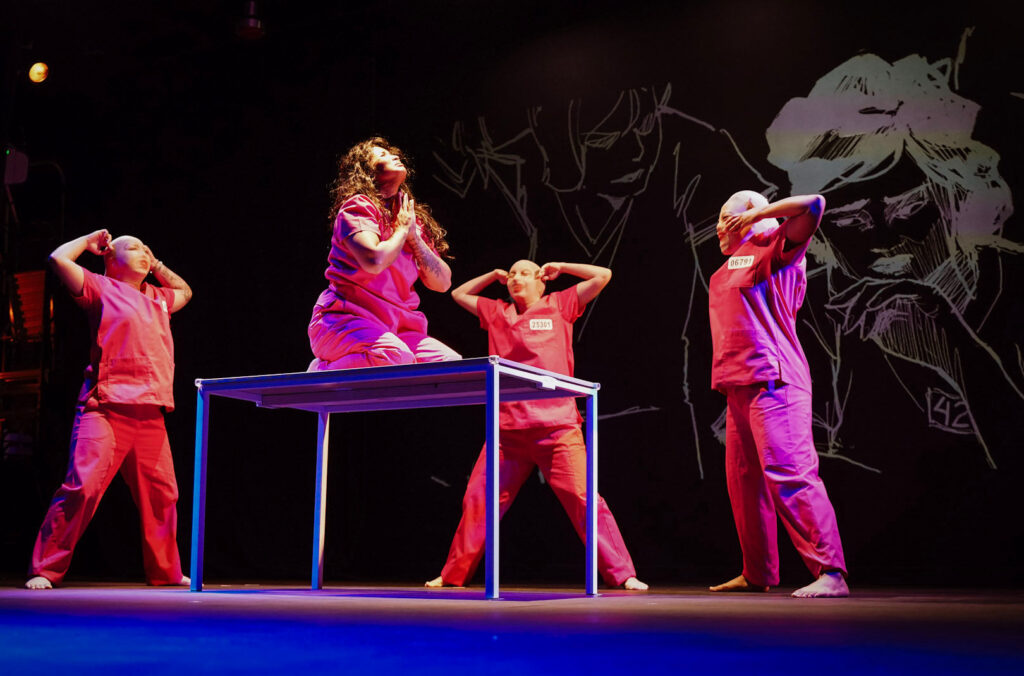
48 HILLS You use actual quotes from Leonora and Jason in the piece, you’re still bringing them directly into it.
ALLELUIA PANIS Jason has been very proactive about this story. He wrote a couple performance pieces around it that were a mix of poetry and theatrics. As part of his thesis, he did some video recordings with interviews around the early to mid-2000s. We drew directly from that for the first iteration of this piece, the work-in-progress. But they were on VHS, and you know how the quality of that can be. My poor sound designer and composer, Joshua Icban, was having some technical difficulties trying to include the direct samples. So I told Jason that it might be better to have some actors read the quotes, and he was cool with it.
48 HILLS Speaking of sound design, this is an immersive experience. How is it different from what you’ve done before? The photos look incredible, I especially love the costumes.
ALLELUIA PANIS One of the new things that I was able to experiment with is different kinds of media. So we worked with a comic book illustrator, Raf Salazar. I had approached him about creating a series of images for this piece, and then projecting it onto the stage. That’s a new approach for me, and in some ways, it softens the landing. But it also bolsters it. With stories like this, one of the things I want to be very mindful with the audience is the care, that this can be really traumatic for many people.
When I did Incarcerated 6×9, people were running out of the theater. This was before we actually thought about having a therapist on-hand for the dancers. Luckily, as old school dancers they were able to just get into character and then check out. But there are some characters that can stay with performers. The illustrations soften what I think can be a very hard piece. I don’t want people to run away. Because that happens.
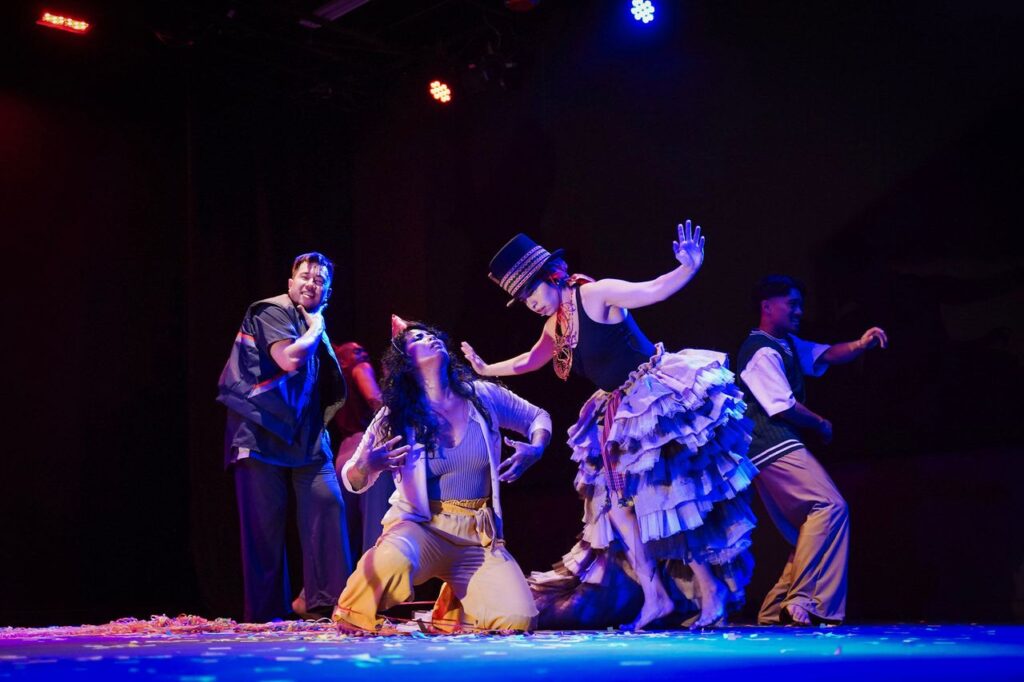
48 HILLS I really love the costumes in the photos I’ve seen…
ALLELUIA PANIS There’s a story behind those. We come from a culture that was basically animist, before the Spaniards came. There was a spirit in everything—ideas, concepts, family, culture, everything had a physical representation. The spirit world in this belief system is called kapwa, or twins. It’s a kind of shared duality, an inner self that connects everyone. All people have a kapwa. I explained to my dancers that our inner selves, our kapwa, are manifested through the forest deity Kapre.
Kapre is a trickster who is the protector of the forest, and was basically demonized by the colonizers, since they wanted control, and the forest was like our grocery store, you know? So the Kapre came to be this kind of caricature, a seven-foot tall ogre sitting on a tree branch and smoking a cigar. “Don’t go into the forest or the Kapre will trick you.” That kind of thing.
My costume designer June Arellano is really steeped in Indigenous practices and lore; he’s from the Philippines. We talk about what the representations of these deities mean, and how do we do our own decolonization—how do we uplift them and show them in a different light? We really dug into this concept, and that’s why June’s costumes are so gorgeous.
48 HILLS I was really struck by what you said earlier, about how incarceration doesn’t just affect one life, but so many around it. How do you see this story of justice miscarried through racial prejudice as applicable to our times?
ALLELUIA PANIS We’ve been working on this show for so long, that it’s come to be associated with many things. But I did not know that when we finally got to show it, it would be in the time of ICE happening. I had always imagined the scene of Leonora’s arrest from Jay’s family lore. The oldest sibling was watching the six o’clock news, he’s maybe, like, four or five, and he sees his mother on television being arrested. I said, you know, we definitely have to look at that and see how we can present that, because already, even before anything, that child was already being punished and traumatized.
And now it’s so relevant to what we are witnessing. This happened when we put on Nursing These Wounds, as well. It takes three or more years for me to work through the idea for a show. And we were working on this one about nurses during a pandemic, and then the pandemic happened. I don’t know how the timing of these things has happened. Maybe it’s my kapwa.
BURDEN OF PROOF through April 26 at Bindlestiff Studio, SF. Tickets and further info here.