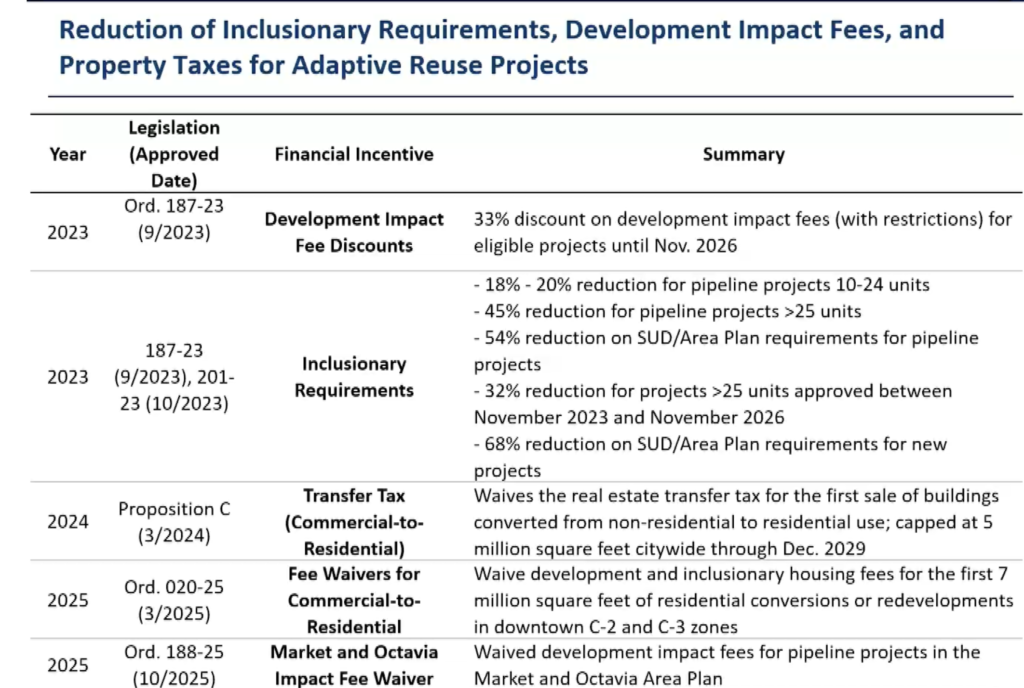
The failure of tax and fee cuts for big developers was on full display Wednesday as Sup. Connie Chan held a hearing on a Budget and Legislative Analysts report showing that the so-called “incentives” pushed by Mayor Daniel Lurie and Sup. Bilal Mahmood have done almost nothing to address the housing crisis.
Nick Menard, a principal analyst at the Budget and Legislative Analyst’s Office, presented a report showing that the lack of new market-rate housing had very little to do with the city’s affordable housing requirements or impact fees.
Lurie has insisted that cutting fees will encourage more business, across the board, and that housing developers will build more if the city stops charging them for the impacts they create.
Impact fees exist for a reason: When you build a new office or housing project, the additional residents and workers require more Muni service, new schools and parks, more water and sewer service, more cops and firefighters, more traffic mitigation—and, if you build housing for rich people, more affordable housing for the baristas, the drivers, the child-care workers, the house cleaners, and the other lower-wage workers who will be needed to serve the rich.
As the longtime local urbanist Tom Radulovich has always said, growth needs to pay for growth.
Eliminating impact fees and affordable housing requirements makes the city’s budget problem far worse. And just allowing or encouraging developers to build more market-rate housing does nothing to address the real, serious crisis of affordability.
Besides, it doesn’t help.
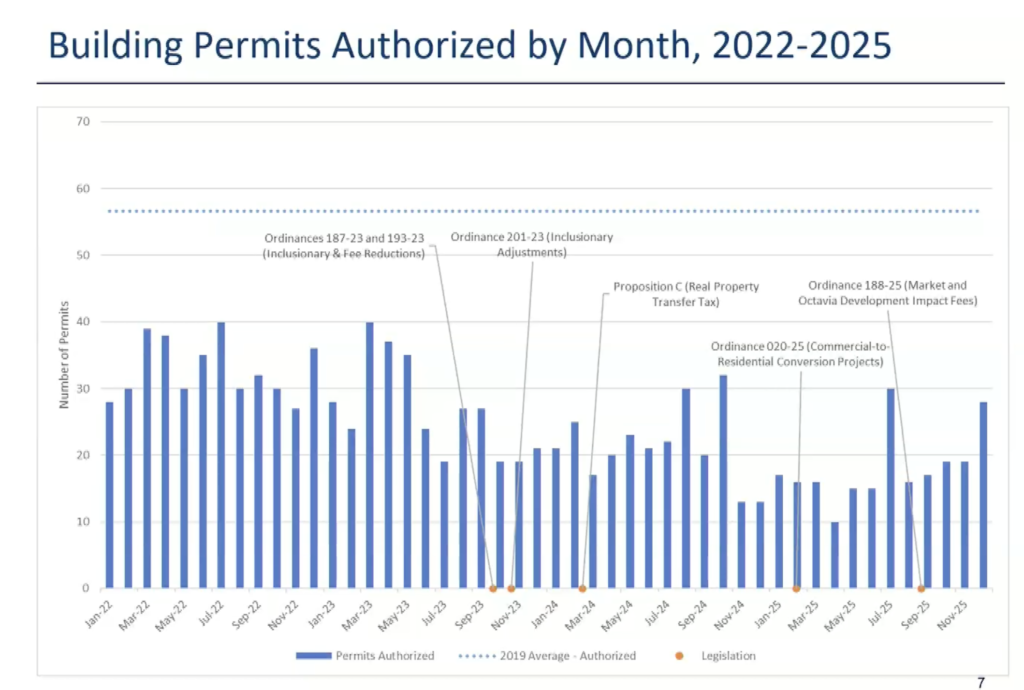
Menard told the Budget and Appropriations Committee that “there is not an immediate and observable impact of [fee and affordability cuts] on building permit activity.”

The difference between the cost of building housing and the current market for housing—the “feasibility gap”—is between $80,000 and $308,000 a unit. The cuts in fees just cost the city money and, as Chan pointed out, make it harder to balance the budget; they don’t encourage new housing.
Why is it so expensive to build in San Francisco? City fees and “red tape” have almost nothing to do with the issue, which is, Menard said, all about “macroeconomic conditions.”
Trump’s tariffs and supply-chain issues have driven up radically the cost of building materials; lumber, steel, plumbing pipes and other essentials are up more than 50 percent since Trump took office.
Labor costs are up, too, and for a good reason: Lurie has decided (as former Mayor Ed Lee did a decade ago) that the city’s future is in tech, in this case, AI. Three tech booms in San Francisco have driven up housing prices and forced working-class people, including construction workers, out of the city.
To keep pace with housing prices, other employers, including construction companies and the city, have to pay much higher wages.
Workers who were forced out of the city by the Lee and Lurie tech booms are forced to commute longer distances, which also costs more money.
So: “Fee waivers did reduce city revenues,” Menard said. If the board continues to approve reductions in fees, it will need “to backfill that revenue,” possibly with sales taxes. That would mean the working class of this city would be underwriting the profits of huge international speculative capital and development interests.
Chan said that all of these factors need to be part of the budget negotiations.
In the meantime, Sup. Chyanne Chen asked Menard about the data on new building permit applications. It’s complicated, but in essence, Menard agreed that developers are buying land and seeking entitlements, although they aren’t going to build anytime soon.
“They are land-banking, right?” asked Chen. Menard said she was correct.
Speculators are looking to get land and permission to build now, so that some time in the future, maybe ten years or more in the future, rents will go up enough that they can sell those entitlements for a fortune.
When Dean Preston was on the board, he repeatedly argued that the city should do the same thing: Buy land when it’s cheap (during the pandemic, a 20-story office building sold for just $2 million) and hold it for future affordable housing.
Mayor London Breed refused to even consider it.