
A supes committee heard a report Monday that contains some of the most important information about the housing crisis that I’ve seen in a while, and it utterly undercuts the entire Yimby narrative.
But other than MissionLocal, the news media outlets have largely ignored it.
The report answers a question I have posed for years, to Yimby activists, to real-estate developers, to politicians, to anyone who would listen, and I’ve never gotten a good answer:
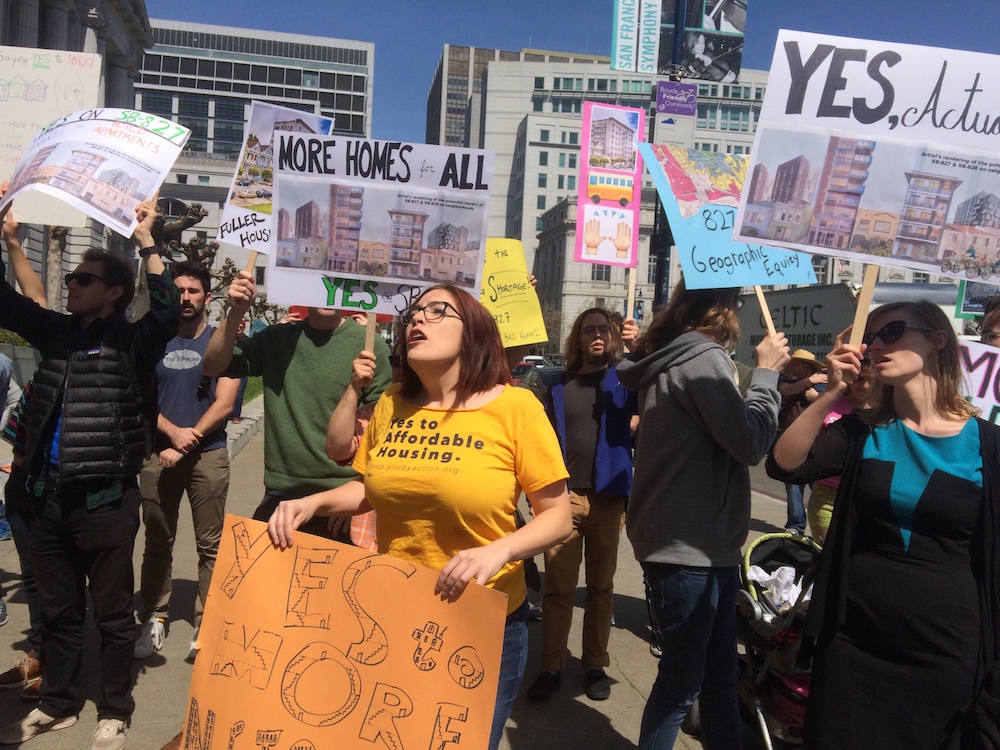
Suppose we abolished CEQA, did away with discretionary review, upzoned the neighborhoods to ten stories, limited affordable housing rules, gave developers density bonuses, and fulfilled all of the rest of the Yimby agenda. Would private developers, with no “obstacles” to construction, actually create housing that’s even remotely affordable to the San Francisco workforce?
Show me a pro forma, I’ve asked. Show me how it could work.
The answer: It won’t.
The report, by Century Urban, a private real-estate consulting firm, says very clearly that private developers aren’t going to build new market-rate housing on prime available land—and city fees and regulations are not the obstacle.
The study looks at Mayor London Breed’s proposal to eliminate conditional use requirement for turning old gas stations into housing. Fair enough.

But even with the most optimistic assumptions—that the land will be delivered clean of any residual toxics, that no demolition is required, that the state’s Density Bonus law will apply, that no CEQA review will be required, and that the city will provide all necessary entitlements at no cost to the developer—new private-sector housing in the neighborhoods doesn’t make financial sense in today’s market. It simply doesn’t provide enough return on investment for the speculative capital that finances housing.
That even assumes market-rate rents, in the neighborhood of $3,800 to $6,500 a month rent for a 1,000-square-foot unit, or $800,000 to $1.4 million for a similar-sized condo, which is far more than most families in need of housing in this city can afford.
Building housing for the working class is completely off the table for the private sector.
The study analyzed 32 potential projects ranging from 30 to 104 units, in the Sunsent, Marina, Excelsior, and Russian Hill. In no case would the developer realize enough return on investment to make the projects feasible, the study showed.
That, it turns out, is not because of any of the things the Yimbys complain about. This study assumed that the projects were entitled at no costs, have between 10 and 20 percent affordability, and could be built with little if any delay.
From the Planning Department’s memo:
The analysis assumes all projects can receive relatively straight-forward entitlement, including a Categorical Exemption from CEQA analysis and no significant entitlement or legal costs other than routine fees and costs for generally code-compliant projects.
The total costs per square foot of the projects ranged from $709 to $726. City fees accounted for, at most, $34.
“The estimated negative residual values across the prototype scenarios indicate that development of projects similar to the prototype scenarios in the current market may be challenging regardless of land cost,” the study says.
The city memo is more clear: “At Current Construction Costs, City Requirements, and Rental/Sales Rates, all Prototypes Studied are Infeasible.”
Oh, and by the way: The city could radically cut affordable-housing requirements, and the private market still won’t build anything other than super-luxury condos and apartments.
Sup. Myrna Melgar, a former planning commissioner, told me she read the study and agrees: “It has nothing to do with the process.” A year after the state forced the city to upzone everwhere, “nothing is moving,”
she said. “Not a single project.”
If the city increases density for gas station sites, Sup. Dean Preston told me, it won’t create any new housing in the private market—but will drive up the price of the land, making it harder for affordable housers or the city to buy it.
“What are we, land-banking for developers?” he said. “The only housing that’s going to be built here is affordable housing, and all we are doing is making that more expensive. Why are we even moving forward with this?”
Let me put it in my own simple terms: The problem isn’t CEQA, or neighborhood appeals, or zoning.
It’s Capitalism, stupid.