It was incredibly cool to see Michael Rios, one of the legends of San Francisco art and Mission murals, standing at the 24th Street BART station and talking about the restoration of his 1975 mural.
I can’t even begin to talk about the role Rios has played in public art in this city. When he came onto the scene in the 1970s, murals weren’t even a thing in the Mission; now, they are a world-class art scene. That’s in part because of Rios.
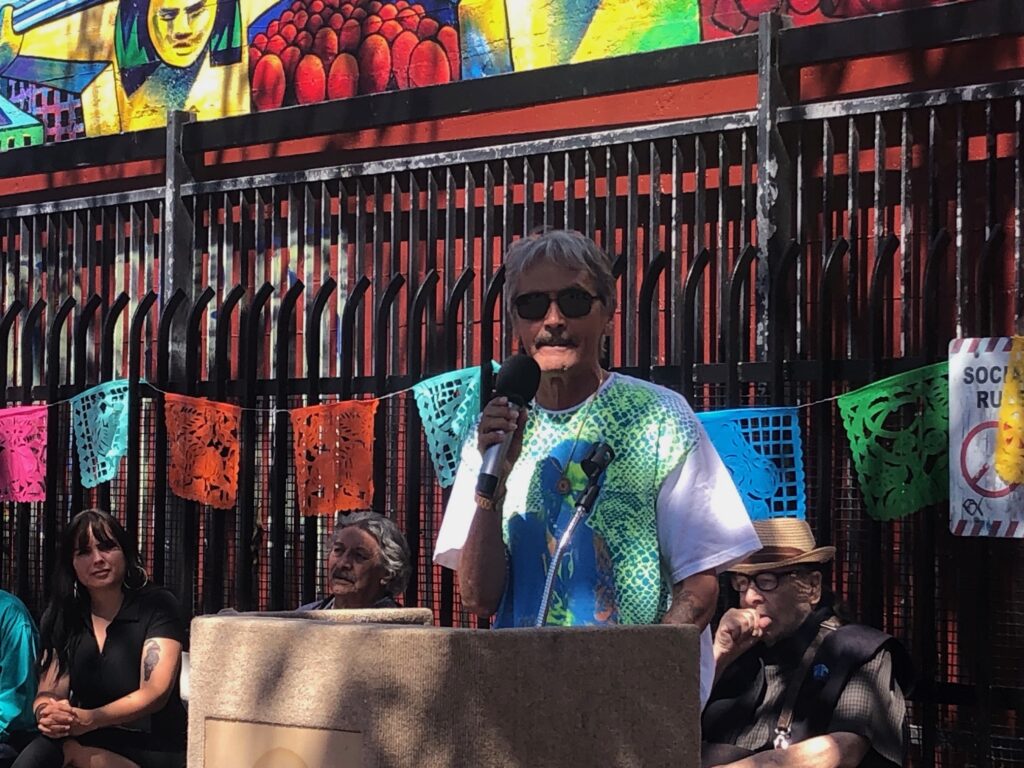
Michael Rios, who helped create the Mission mural scene, celebrates the renewal of his 24th and Mission BART mural
It’s also in part because of Susan Cervantes, founder of Precita Eyes, who was also on hand in the warm sunshine, welcoming the newly restored mural.
The restored mural is amazing.
Many speakers talked about the importance of public art, including TODCO President John Elberling, who helped fund the work, and Sup. Aaron Peskin, who gave Rios the city’s highest award for lifetime achievement.
BART Board member Bevan Dufty was there to talk about how the transit agency supports art and public space and wants to make sure the plaza is an active and welcoming public space.
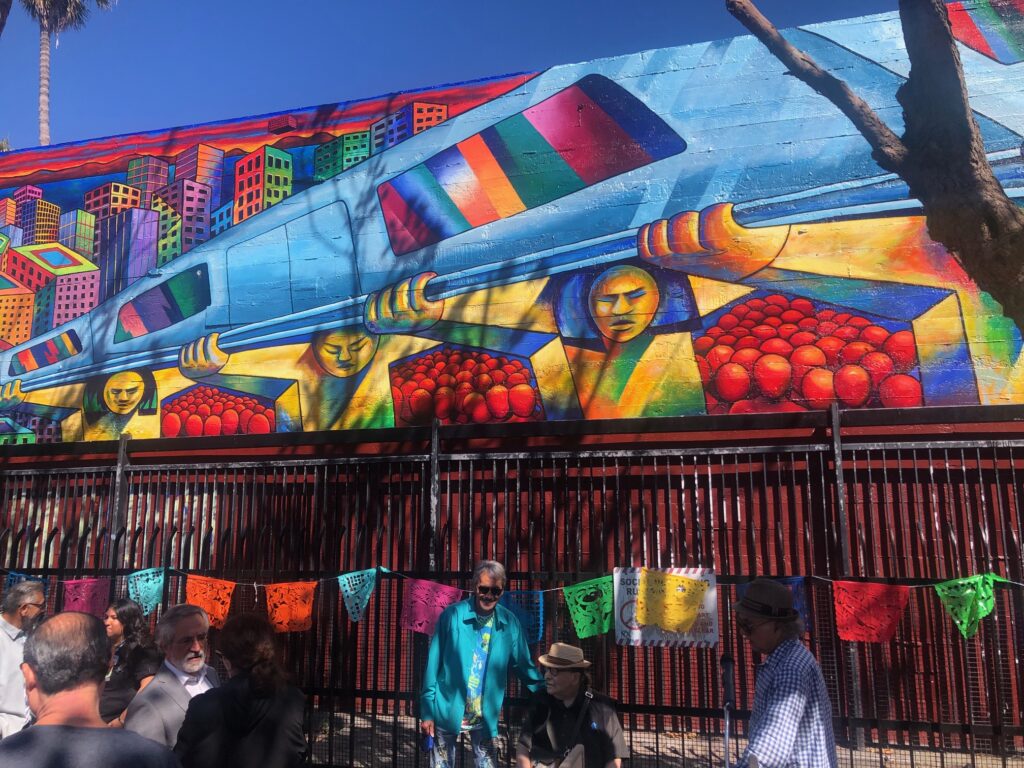
The mural celebrate BART—but also community struggle.
But I was particularly struck by what Cervantes had to say. She was around when BART tore up Mission Street in the 1960s and created the 16th Street and 24th Street station.
It was not an entirely positive experience.
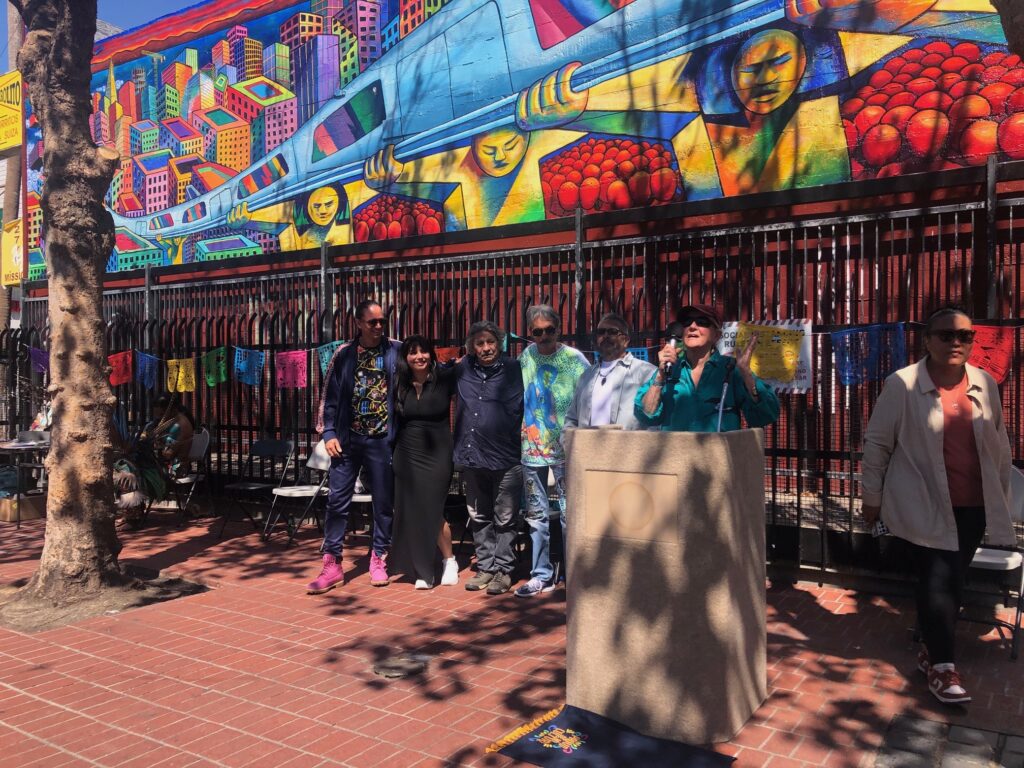
Susan Cervantes, who founded Precita Eyes, talks about BART’s role in the gentrification of the Mission: ‘The rents tripled.’
In fact, BART was designed in the 1950s as a part of a post-War plan to turn San Francisco in a new Manhattan: Downtown would become a highrise office district for finance, insurance, and real estate and trade with the Pacific Rim, farmland in the East Bay and the Peninsula would become suburbs, and a rail system would bring workers into the city core.
The planning was done in secret, and the people who lived, for example, in the Mission, never got a say.
It was the first wave of gentrification in San Francisco.
The process, Cervantes reminded us, was often brutal. Many small businesses failed as the street became impassible. When the Mission stations opened, “rents tripled,” and she and her family were evicted.
But never mind: This was progress, and the landowners and developers made a fortune from what the late Chester Hartman called The Transformation of San Francisco.
The Rios mural depicts not just trains but a rail system that is both built and twisted by people and powerful interests. It’s a powerful reminder of the legacy of an era of urban planning controlled and directed by a small group seeking maximum profits—and the way communities have tried and sometime succeeded in turning those efforts into public benefits.